Suspension: the tools, and the one that stores energy
Suspension work needs three things: a way to separate tapered joints without destroying the boot, a way to hold a spring safely, and a torque wrench for reassembly. The second of those is the only tool on this site that stores enough energy to injure, and it is the one where the manufacturer’s procedure outranks everything written here.
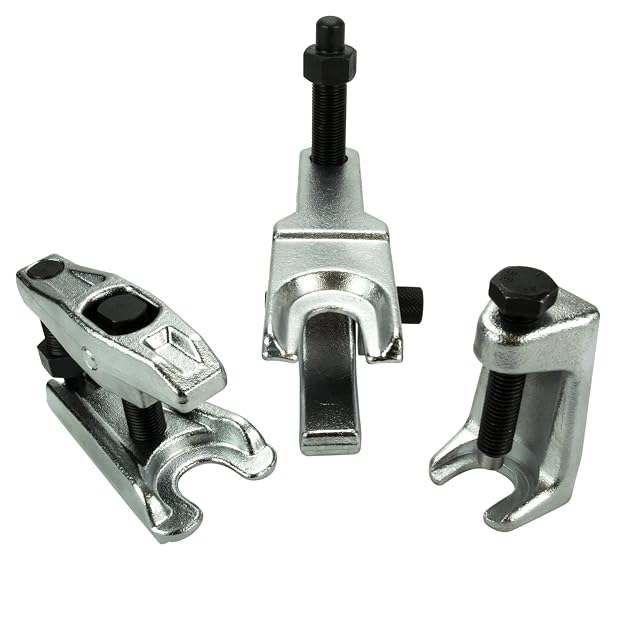
The HASKYY three-piece set publishes every figure for each tool: jaw openings of 22–18, 19.5 and 19 mm (0.75 in), clamping ranges, drive sizes and thread pitches — including a fine M16 × 1.5 thread, which gives more mechanical advantage against a stubborn taper.
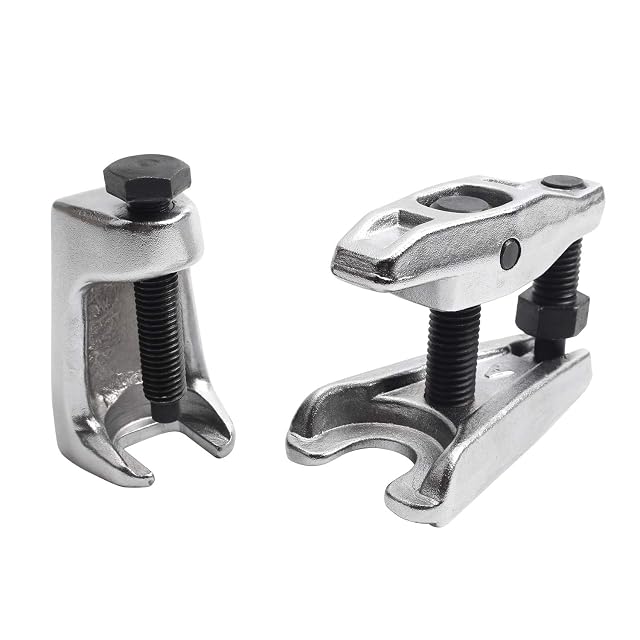
The CCLIFE two-piece set is the cheaper answer at 18 and 20 mm (0.79 in), and it includes a protective adapter for aluminum components — which matters on modern control arms, where a steel screw against an alloy casting leaves a mark.
The spring compressor: publish or do not buy
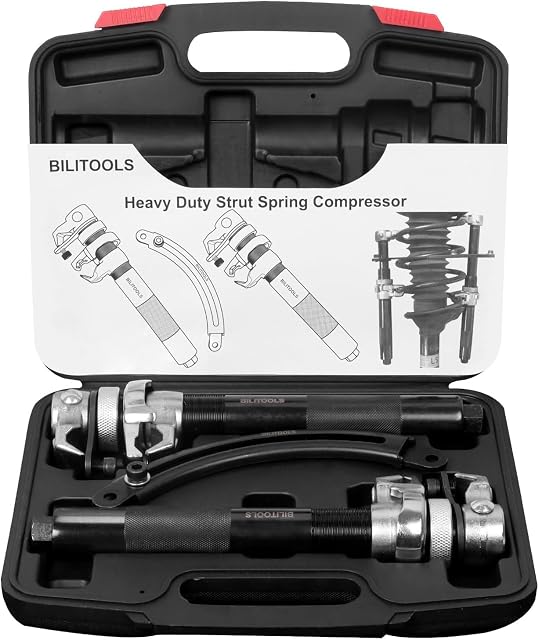
The BILITOOLS set states a 1200 kg (2645.5 lb) rated load, a jaw capacity of roughly 70 to 270 mm (2.76 to 10.6 in), drop-forged interlocking safety claws and a heat-treated 45# carbon steel construction. Competitors at the same price publish none of those, and on a tool holding a compressed spring the rating is the specification.
Reassembly: a wrench that reaches the values
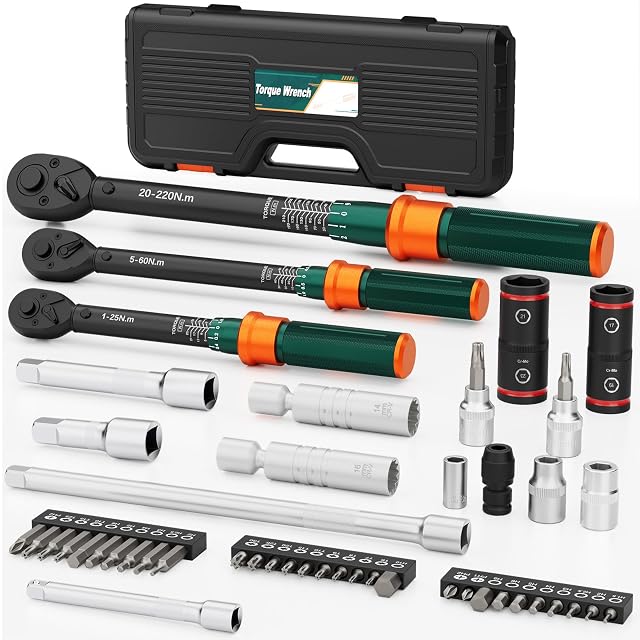
The NADOKHI three-drive set covers 1–25, 5–60 and 20–220 Nm, which spans every published value on an ordinary car. What it does not publish is an accuracy figure — worth weighing against a single wrench that states ±3%.
And the sockets to drive them
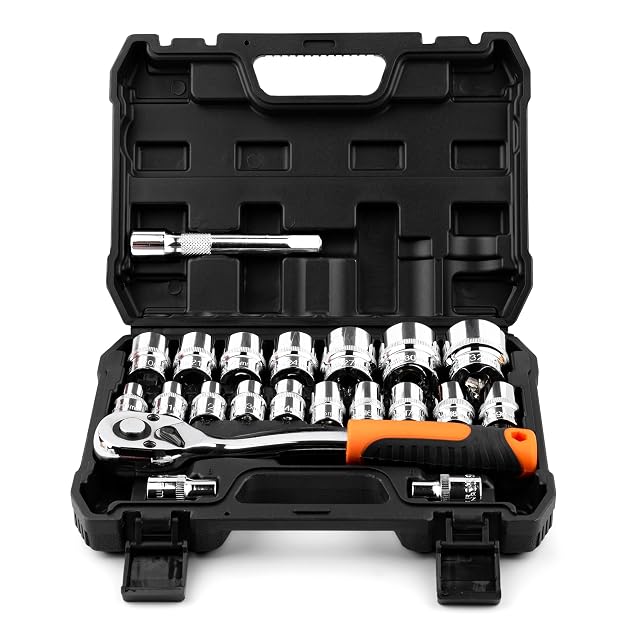
The QualiapeX 1/2 inch set lists every size from 8 to 32 mm (0.31 to 1.26 in) and states a 72-tooth ratchet — a five-degree swing arc, which is what makes it usable in a wheel arch.
Where this guide stops
At the tools. Which strut, which sequence, which torque, and how to compress that particular spring are published by the vehicle manufacturer, and suspension is not the place to improvise.
Which tool does the job you have?
You are replacing shock absorbers only
Often a straightforward job, provided the strut is not the coil-over type that must be compressed.
The spring has to come off the strut
A spring compressor is required, and this is the job where home mechanics get hurt.
You are working on bushes and ball joints
Presses and separators, and a great deal of penetrating fluid.
The car will go back on the road
Budget for an alignment afterwards: almost all suspension work disturbs it.
Picking by the job in hand
Shock absorbers
Frequently within reach, and the improvement is immediately noticeable. The difficulty is corrosion, not complexity.
Coil springs
The job that demands respect. A compressed spring stores a large amount of energy and releases it instantly if the tool slips.
Bushes
Pressing old bushes out and new ones in. A press or a purpose-made puller makes this feasible; improvising rarely does.
Ball joints and track rod ends
A separator, and patience. Heat and penetrating fluid do more than force.
What to look at first
Spring compressor design
The single most important choice on this list. Clamp-type compressors can slip; designs that capture the spring properly are markedly safer.
Ball joint separator type
A fork separates quickly and destroys the boot; a press-type separator preserves it. If the joint is being reused, the type matters.
Access to seized fasteners
Suspension bolts corrode in place. A long breaker bar, penetrating fluid and sometimes heat are the real tools for this work.
Torque wrench range
Suspension fasteners are torqued high, and many must be tightened with the suspension at ride height rather than hanging.
Whether you have somewhere to send it
Alignment cannot be done at home to any useful standard. Knowing where the car goes afterwards is part of planning the job.
Which figure for which repair
The job
The critical tool
The follow-up
Shock absorbers
Breaker bar, penetrating fluid
Often none
Coil springs
A safe spring compressor
Alignment check
Bushes
Press or puller
Torque at ride height
Ball joints
Separator
Alignment
What goes wrong most often
Using an inadequate spring compressor
A slipping compressor releases a spring with enough force to cause serious injury. This is the job where cheap tooling is genuinely dangerous.
Torquing bushes with the suspension hanging
Rubber bushes are meant to be tightened at ride height. Torqued while hanging, they are permanently pre-loaded and fail early.
Forcing seized fasteners
Suspension bolts snap, and a snapped bolt in a subframe turns an afternoon into a week. Penetrating fluid and time cost nothing by comparison.
Skipping the alignment
Almost all suspension work disturbs the geometry. Driving on it unaligned ruins tires quickly and handles badly.
By how much you do yourself
The shock absorber replacement
A well-bounded job for a competent home mechanic, provided the springs do not have to come off.
The full strut refresh
Either buy complete assembled struts, or use a genuinely safe spring compressor. There is no sensible third option.
The bush and joint job
Presses, separators, patience, and an alignment booked for afterwards.
Calibration, storage and working life
The tools here work in the most corroded part of the car, and they suffer for it. A spring compressor in particular is safety equipment and is inspected before use rather than after.
Inspect spring compressor threads and jaws before every use; retire anything bent or worn.
Keep separators and pullers clean and lightly oiled: seized threads on a puller are useless.
Replace penetrating fluid rather than keeping an old can: it works better than force.
Check the torque wrench’s calibration if it has been used as a breaker bar, and never use it as one.
Safety
Compressed coil springs are the most dangerous thing a home mechanic handles.
Never stand in line with a compressed spring, and keep others away from the area.
Use a compressor designed to capture the spring, not a clamp that can slip off a coil.
Release compression slowly and check the tool’s grip at every stage.
Work on a supported vehicle with the wheels chocked, never on a jack alone.
18 mm (0.71 in) and 20 mm (0.79 in) separators · protective adapter for aluminum parts · forged Cr-V, oil-hardened stated
Two press-type separators in 18 and 20 mm (0.79 in), with a protective adapter for aluminum components — the detail that separates a tool from a hammer.
Best for: A single suspension job on a car whose joints are 18 or 20 mm (0.79 in).
1/2 inch drive · 21 pieces, 8–32 mm (0.31 to 1.26 in) · 72-tooth reversible ratchet · hardened chrome-vanadium stated
A 1/2 inch set that publishes both the size range and the ratchet tooth count — 8 to 32 mm (0.31 to 1.26 in) with a 72-tooth head, which is the pair of figures that matters.
Best for: The 1/2 inch half of a home garage, bought for the fasteners that actually need torque.
A fork is driven in with a hammer and tears the boot — fine when the joint is being replaced, expensive when it is not. A press pushes the taper out under screw pressure and leaves the boot intact.
How do I choose a spring compressor?
On the published rated load and on the claw design. Interlocking claws capture the coil rather than resting against it, and a compressor without a published rating cannot be checked against the job.
Can I use an impact driver on a spring compressor?
No. Makers say so explicitly: fast, uneven winding is how a clamp walks off a coil. Both sides are wound by hand, alternately.
Can I change struts without a spring compressor?
Only if you fit complete pre-assembled strut units. Otherwise the spring must be compressed, and that requires the proper tool.
Why must bushes be torqued at ride height?
Because a rubber bush is bonded and takes a neutral position at ride height. Tightened while hanging, it is permanently twisted and fails early.
Do I always need an alignment afterwards?
Almost always: most suspension work disturbs the geometry. Skipping it wears tires fast and can affect handling.
Fork or press-type ball joint separator?
A fork is quick and destroys the boot; a press-type preserves it. If the joint is being replaced anyway, the fork is fine.
What if a suspension bolt snaps?
It becomes a much bigger job, often needing drilling and extraction. That is why penetrating fluid and patience are the real tools here.
Are spring compressors safe?
The good ones, used correctly, are. The risk comes from designs that can slip off a coil, and from standing in line with a compressed spring.
Adapters, leads and spares from the same aisle, at the price we read. Confirm they suit the tool you choose before ordering: it turns on the connector and the part number, which the product page gives.
CAINCAY c-6 · Screw extractors — HSS 4341 stated · 6 extractors in 5 sizes (#0–#4) · double-ended: drill one end, extract the other · magnetic bit holder and socket adapter
Brennenstuhl 1175590100 · Work lights — 200 lm stated · up to 12 h runtime stated · 5 modes · Li-Po 3.7 V / 450 mAh · rechargeable · $32
PacoLit 1 Head · Work lights — 10,000 lm, 72 LEDs · IP66 · cast aluminum and tempered glass · 120° beam · 5 ft cord · 2-year replacement
Allstar Performance ALL44047 · Tire pressure gauges — 0–30 PSI · 4 in glow face · 14 in hose, 360° swivel chuck · release valve · no accuracy stated
AstroAI T3 · Tire pressure gauges — ANSI B40.1 · ±2 PSI from 80–120, ±3 below 80 · dual-head chuck · 1/4 in quick-connect · −10 to 50 °C (14 to 122 °F)
The tools above are taken from the catalog of this site. Specifications come from the manufacturer and the Amazon product page; prices are what Keepa reported on the date shown, and both move. The order uses declared specifications, the weight of stated strengths against stated limits, and price. No tool here has been used by us on a real job, and nothing here claims it has.
Last checked on
Prices quoted in these summaries are dated readings. The live price is shown next to each product.