A four-inch face over thirty PSI, and one bullet
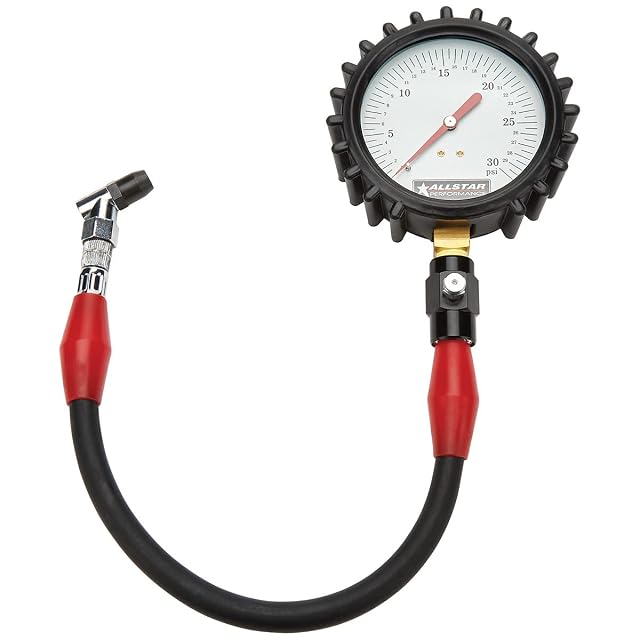
Allstar Performance 4-inch Gauge, 0–30 PSI
A four-inch glow-face gauge reading only 0 to 30 PSI, on a 14-inch hose with a swivel chuck.
What you are getting
A 4-inch gauge reading 0–30 PSI with a glow-in-the-dark face, a 360-degree swivel chuck on a 14-inch rubber hose, a rubber cover with a ribbed grip and a built-in pressure release valve. 553 g (19.5 oz). $52.99 — the most expensive gauge here.
Four inches of dial over thirty PSI is the finest scale on this shelf
That is the whole point of this gauge and it takes a moment to see.
| Gauge | Range | Face |
|---|
| This gauge | 0–30 PSI | 4 in |
| TIRETEK | 0–60 PSI | dial |
| JACO ElitePro | 0–100 PSI | 2 in |
| LUMITECO | 10–150 PSI | sliding bar |
| AstroAI digital | 0–150 PSI | LCD |
A 4-inch face spread over 30 PSI gives roughly four times the needle travel per PSI of a 2-inch face over 100 PSI. On a dial gauge that is the difference between reading to 1 PSI and reading to a quarter of one.
The introduction to this shelf: a gauge “is bought for repeatability rather than for absolute truth: the useful gauge is the one that gives the same reading twice on the same tire, so you can correct from it.” A long scale is exactly how a mechanical gauge becomes repeatable — the eye resolves a small needle movement that a crowded dial hides.
And thirty PSI is a deliberate ceiling, not a limitation
Allstar Performance is a motorsport parts maker, and this is a racing gauge.
A competition car on slicks or a dirt-track car runs well below 30 PSI — often 12 to 25 — and sets tire pressures to a quarter of a PSI because the pressure changes the contact patch. For that work a 150 PSI gauge is useless, because 20 PSI sits in the first eighth of the dial.
For a road car the ceiling is a problem: 30 PSI is below many modern car pressures (32 to 38 is common) and well below a spare’s 60. A tire at 35 PSI will push this needle past the end of the scale, which on a Bourdon tube is how a gauge is permanently zeroed wrong.
So this is the right gauge for a track day and the wrong one for a driveway, and the listing never says so.
One bullet, and everything else in the description
The complete bullet list: “ALLSTAR 0-30 psi Analog Glow in the Dark Tire Pressure Gauge P/N 44047.”
The description adds the rest: the glow face, the 360-degree swivel chuck on a 14-inch rubber hose, the rubber cover with “a ribbed molded pattern for increased grip”, and the pressure release valve “for removing air in small amounts for precise pressure adjustments”.
Every one of those is a real feature and none is in a bullet.
Fourteen inches of hose with a swivel, which is the best chuck arrangement here
“Swivel chuck rotates 360 degrees on a 14” long rubber hose for easy placement on valve stems with leak free operation.”
The introduction: “a straight chuck will not reach a valve behind an alloy spoke, and an angled or dual-foot one will.”
A swivel on a flexible hose beats both: it reaches any angle and it does not transmit the hand’s position to the seal. It is also what lets the 4-inch dial be held up and read while the chuck stays on the valve — which is the pairing that makes this gauge work.
The LUMITECO in this survey has 12.3 inches of rigid reach, which is for depth rather than angle. The JACO has a swivel on a shorter hose.
And the release valve is for small amounts
“Features a built-in pressure release valve for removing air in small amounts for precise pressure adjustments.”
On a racing gauge that is the function: bleed a quarter of a PSI at a time with the gauge still reading. Five of the seven gauges here have a bleeder, and this one and the TIRETEK describe what theirs is for.
No percentage, no grade, no standard, in one bullet and five lines of description.
The introduction: stated accuracy “is the only comparable figure on the packaging”.
Three of the seven American gauges here cite ANSI, and the published Etenwolf gauge cites ANSI B40.7 grade 2A at ±0.06 bar. On a motorsport gauge the expectation would be a published grade or a calibration certificate, and this publishes neither — which at $52.99, eight times the AstroAI digital, is the gap that matters.
What it does have is the long scale, and a long scale with no tolerance figure is a gauge that is precise and not necessarily correct. The buying advice applies with force: “check your gauge against a second one once. Two gauges that agree are almost certainly both right; a single gauge that has drifted is invisible.”
Five hundred and fifty-three grams, and glow rather than a light
The heaviest gauge on this shelf, which is a 4-inch brass movement and a hose.
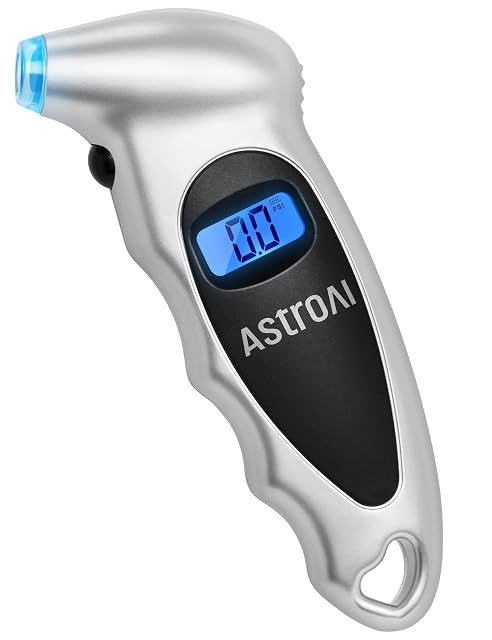
The glow face needs charging in daylight and fades over an evening; the AstroAI digital gauge in this survey has a lit nozzle and a backlit screen instead, which work at three in the morning. For a pit lane in daylight the glow is enough.
What is not published
No accuracy, grade or standard. No units but PSI. No operating temperature. No calibration certificate. No warranty. No scale increment — the face is 4 inches and how it is marked is not stated.
At $52.99 it is the most expensive gauge here by $30, it has the longest scale on the shelf, and it stops below the pressure most road cars run.
Availability
On sale at around $53 on the American Amazon store at the time of checking.
Prices and availability are what Keepa reported on the date this page was updated; both move.
Prices quoted in this text were read on 6 October 2026. The live price is at the top of the page.