Tire tools: the gauge, the pump and the get-you-home kit
Three tools cover tires at home: something to measure with, something to inflate with, and something for the morning one goes flat. They are separate purchases because the gauge built into an inflator reads high while the pump is running — which is exactly when you are reading it.
Measure with something that publishes its accuracy
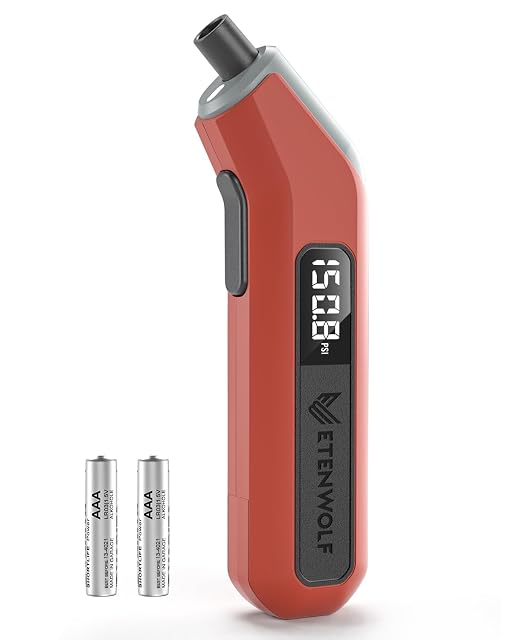
The ETENWOLF digital gauge is the only one here that names a standard: ANSI B40.7 grade 2A, hand-calibrated, stated at ±0.06 bar, reading in bar rather than PSI. It is also the only one whose accuracy is stated to hold at the extremes of its range.
Inflate with something that stops by itself
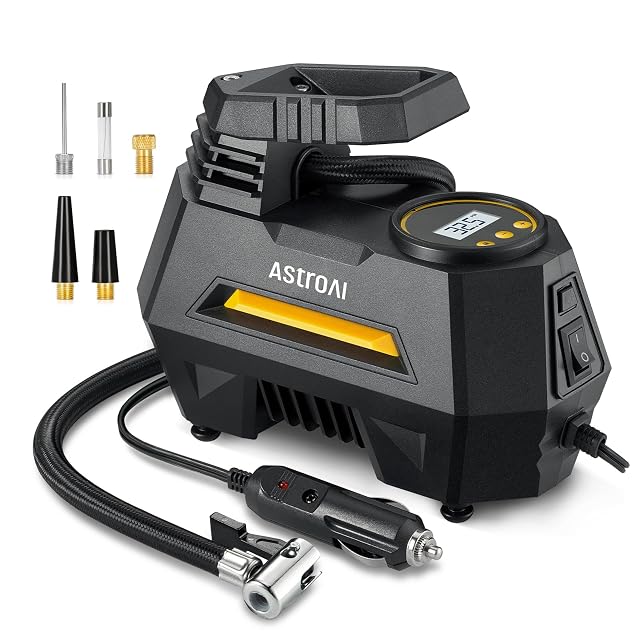
The AstroAI A220B has a programmable preset with unit selection — bar, PSI or kPa — and a published 10.3 bar maximum. A preset is what turns four tires into four button presses instead of four sessions standing over a pump.
If you want a real performance figure
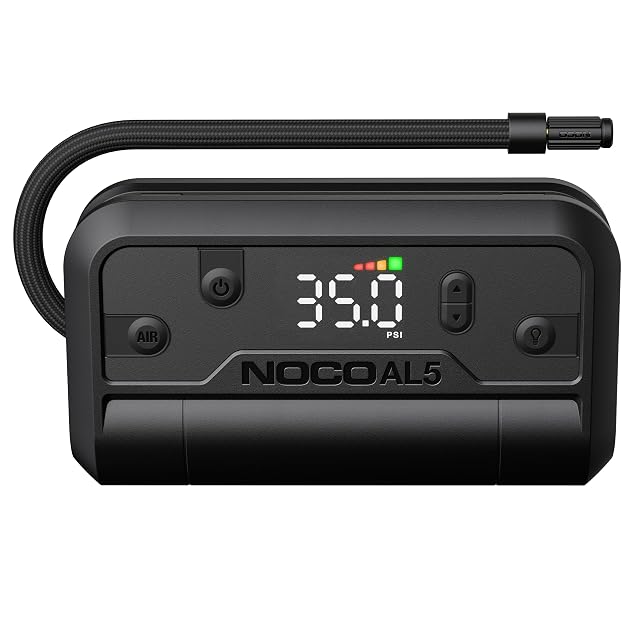
The NOCO AL5 publishes airflow: 17 standard liters per minute. Maximum pressure tells you nothing, because every inflator exceeds what a tire needs; airflow is what determines how long it takes.
Carry something for the morning it goes flat
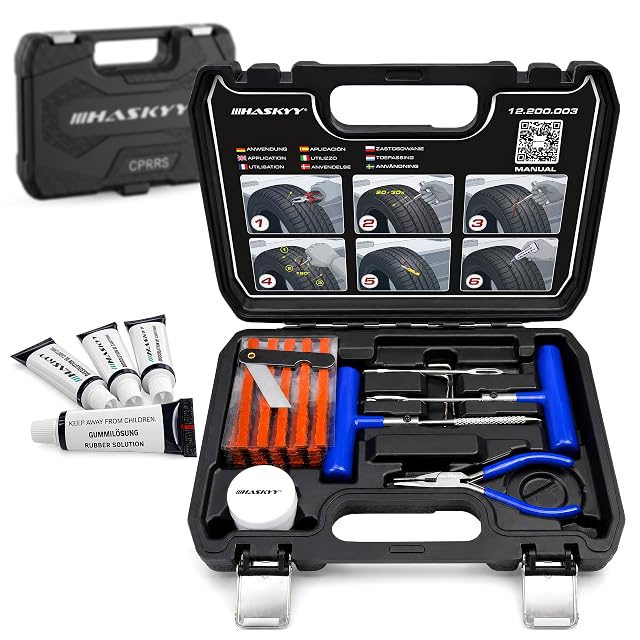
The HASKYY 47-piece kit includes vulcanizing strips and printed instructions — and the maker states that preparing the hole and the needle properly is what decides the result. Tread area only, temporary, and inspected by a fitter afterwards.
And a second gauge, because it costs nothing
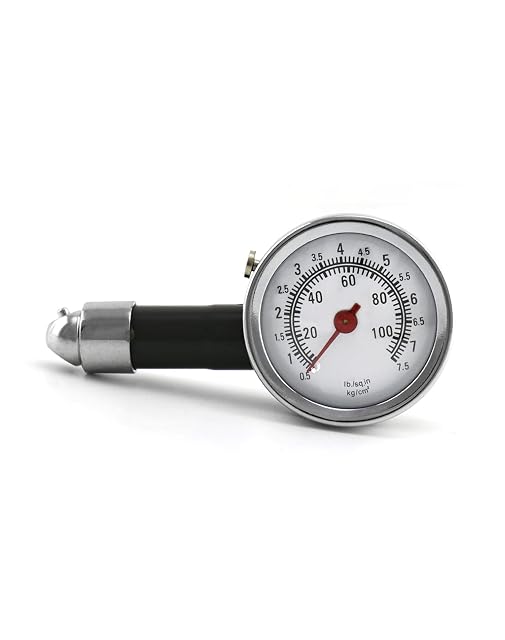
The QWORK dial gauge has no battery and works after two years in a glovebox. Its real job is to be the instrument you check the others against.
The habit that matters more than any of them
Set pressures cold, against the placard on the door pillar, and pause the pump before reading.
Which tool does the job you have?
You want one tool above all
An accurate pressure gauge. It is the cheapest item here and the one that changes wear, grip and fuel use.
You swap wheels seasonally
A breaker bar and a torque wrench, and somewhere clean to store the set off the car.
You want to handle a puncture
A repair kit and a compressor cover the roadside case, with the limits of a temporary repair understood.
You want to change tires on rims yourself
Be honest about the equipment required; without it, damage to rim and bead is very likely.
Picking by the job in hand
Checking and adjusting pressure
The routine job, and the one that matters most. It is done cold, and forecourt gauges are frequently out.
Seasonal wheel swaps
Undo, refit, torque. The tools are few and the discipline is in the torque and the retorque.
Roadside puncture
A plug kit or a sealant and compressor. Both are temporary measures that get you to a place where the tire can be assessed.
Monitoring wear
A tread depth gauge and a look at wear patterns tells you about alignment and pressure long before the tire is illegal.
What to look at first
Gauge accuracy and readability
A gauge that is out by a meaningful amount is worse than none, because it gives false confidence. Digital or dial both work; a stick gauge in a glovebox rarely stays accurate.
Torque wrench range for wheel bolts
Wheel torques are high and specified. A wrench whose range stops below them is the commonest reason people give up and guess.
A proper breaker bar
Undoing a wheel bolt with a ratchet damages the ratchet. A breaker bar is cheap and is the correct tool for the force involved.
Compressor duty and hose reach
A small compressor that overheats before it inflates a tire is a false economy. Hose length decides whether it reaches all four wheels.
Repair kit type
External plugs are quick and are a temporary repair; internal patches are permanent but require the tire to be removed. Knowing which you have matters.
Which figure for which repair
What you want to do
The tool
What it does not do
Keep pressures right
An accurate gauge
Replace a visual check
Swap wheels
Breaker bar and torque wrench
Fix a seized bolt
Fix a puncture roadside
Plug kit or sealant plus compressor
Make a permanent repair
Judge tire condition
Tread depth gauge
Spot internal damage
What goes wrong most often
Checking pressures hot
A tire warms and gains pressure as it is driven. Setting pressures after a long run leaves them low once the tire cools, which is the opposite of the intention.
Overtightening wheel bolts
Excess torque stretches studs and warps discs, and it makes the next roadside change impossible with the car’s own tools. There is a specified figure for a reason.
Treating a plug as a permanent repair
External plugs are a get-you-home measure. A tire that has been plugged should be inspected internally before it is trusted.
Ignoring the wear pattern
Wear on one shoulder, or in the center, is telling you about alignment or pressure. Replacing the tire without reading it means the new one wears the same way.
By how much you do yourself
Every driver
An accurate gauge and a tread depth gauge. Two cheap items that cover the whole routine.
The seasonal swapper
Breaker bar, torque wrench, and a set of wheel storage bags. Straightforward and repeatable.
The long-distance driver
A compressor and a repair kit in the boot, with the understanding that both are temporary measures.
Calibration, storage and working life
The tools here are simple, and the maintenance is mostly about keeping the gauge honest and the compressor clean. A gauge that has been dropped should be checked against another before it is trusted.
Compare your gauge against another occasionally: a gauge that reads consistently wrong is worse than none.
Keep the compressor’s filter and inlet clear of dust.
Store repair kit plugs and cement sealed: cement dries out and then does nothing.
Keep wheel bolts and their seats clean, and never grease them unless the manufacturer specifies it.
Safety
Wheels and tires carry the whole car, and the failures are sudden.
Torque wheel bolts to the specified figure and retorque after a short distance.
Never inflate beyond the tire’s marked maximum pressure.
Stand to the side when inflating a tire that has been run flat: bead seating can be violent.
Do not drive on a temporary plug repair at high speed or for long distances.
12 V · 10.3 bar (150 PSI) stated · programmable preset with unit selection · compact storage
A 12 V inflator with a programmable preset: choose a unit, set a pressure, and it inflates to it — which is the feature that makes an inflator usable alone.
Best for: Four tires, one after another, without standing over the pump.
Cold — parked for a few hours or driven less than a couple of kilometers. Placard pressures are cold pressures, and correcting to them on warm tires leaves them soft once they cool.
Is a plug repair permanent?
No, and every kit says so. It seals a tread puncture well enough to reach a fitter; the tire still has to be inspected from the inside, and sidewall damage is never repairable.
Why do two gauges disagree?
Because one has drifted. Comparing two once tells you more than trusting one forever, which is the argument for owning a cheap second gauge.
Hot or cold pressure check?
Cold, before driving or after the car has stood. A warm tire reads higher, and setting it then leaves you under-inflated later.
How much should I torque wheel bolts?
To the figure in your handbook, which varies by vehicle. Then retorque after a short distance, because bolts settle.
Should I grease wheel bolts?
Not unless the manufacturer specifies it. Grease changes the relationship between torque and clamping force, so a torqued bolt may be far tighter than intended.
Do sealant cans damage the sensor?
Some sealants can foul a pressure sensor, and many tire fitters charge to clean it. Check the can, because formulations differ.
How do I read a wear pattern?
Both shoulders worn suggests under-inflation, the center worn suggests over-inflation, one shoulder suggests alignment. It is the cheapest diagnostic on the car.
Adapters, leads and spares from the same aisle, at the price we read. Confirm they suit the tool you choose before ordering: it turns on the connector and the part number, which the product page gives.
Allstar Performance ALL44047 · Tire pressure gauges — 0–30 PSI · 4 in glow face · 14 in hose, 360° swivel chuck · release valve · no accuracy stated
AstroAI T3 · Tire pressure gauges — ANSI B40.1 · ±2 PSI from 80–120, ±3 below 80 · dual-head chuck · 1/4 in quick-connect · −10 to 50 °C (14 to 122 °F)
The tools above are taken from the catalog of this site. Specifications come from the manufacturer and the Amazon product page; prices are what Keepa reported on the date shown, and both move. The order uses declared specifications, the weight of stated strengths against stated limits, and price. No tool here has been used by us on a real job, and nothing here claims it has.
Last checked on
Prices quoted in these summaries are dated readings. The live price is shown next to each product.