Skip to content

The best lithium jump starters for 2026

A lithium pack replaces the second car, and its headline number is the least useful one on the box: peak amps are measured over milliseconds and no standard governs how. The figure worth reading is the starting or cranking current, and after that the capacity in watt-hours — which also decides air travel, since airlines treat 100 Wh as the threshold for carrying a pack without prior approval. Then come the parts you actually hold: clamps with real copper, reverse-polarity and spark protection, and honest behavior in the cold, because lithium loses capacity exactly when a car refuses to start. We compare stated starting current, capacity, clamp construction, protections and outputs.

The models we recommend

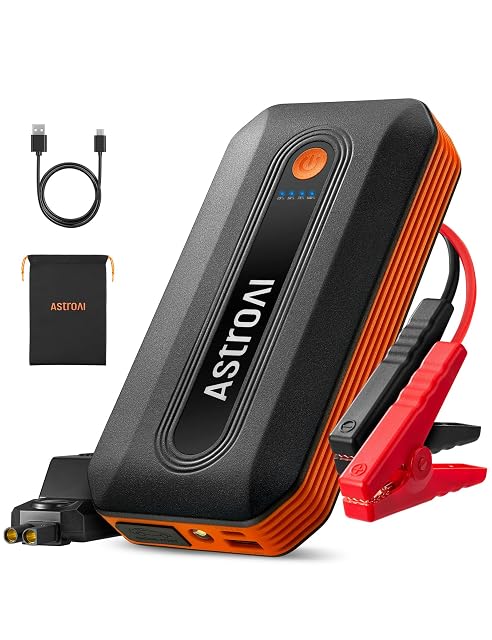
  1. AstroAI B8 compact jump starter

    329 g (11.6 oz) stated · −20 °C (-4 °F) to 50 °C (122 °F) stated · 10 built-in protections · QC 3.0 USB output

    The pocket one: 329 grams, ten stated protections and a working range from −20 to 50 °C (-4 to 122 °F) — bought for the winter morning rather than for a headline current figure.

    Best for: A small petrol car, and anyone who would rather carry the pack than store it.
    7.2/10

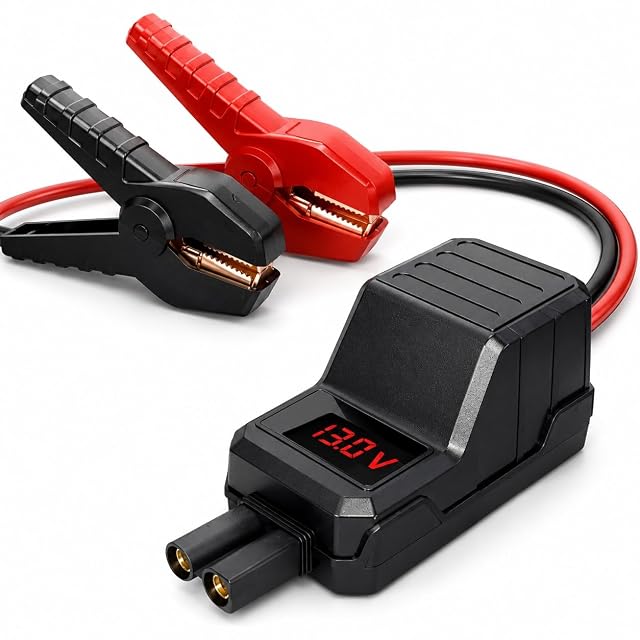
  2. MEGAWISE Smart clamp cable, 12 V

    Replacement clamp cable · LCD voltage display · reads battery voltage on its own · 5 named protections · 240 g (8.5 oz) · no pack included

    The clamp cable on its own, with an LCD that reads battery voltage even with no pack attached.

    Best for: A MEGAWISE pack whose cable has gone missing, and a quick voltage check

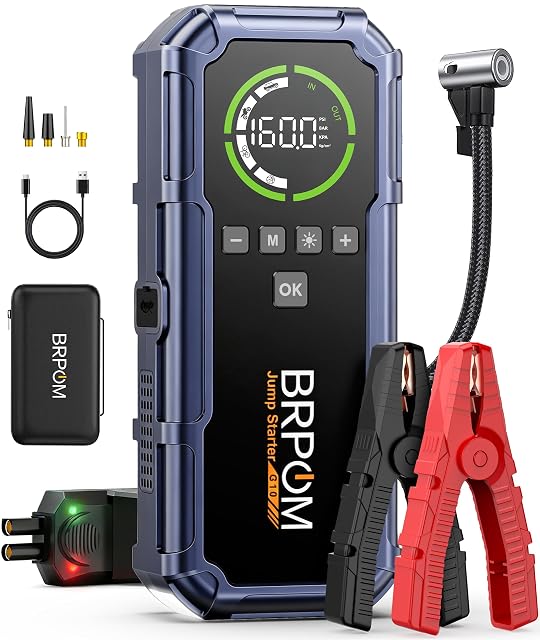
  3. BRPOM G10-MX with 160 PSI compressor

    9000 A peak stated · 160 PSI inflator with memory and preset · 2.5-inch LCD · 3 LED modes

    The same idea as the pack above with a higher stated inflator pressure and a memory function that remembers the last pressure you set.

    Best for: A household with a van, a trailer or a caravan, where tire pressures are higher.

    7.8/10

    ≈ $70

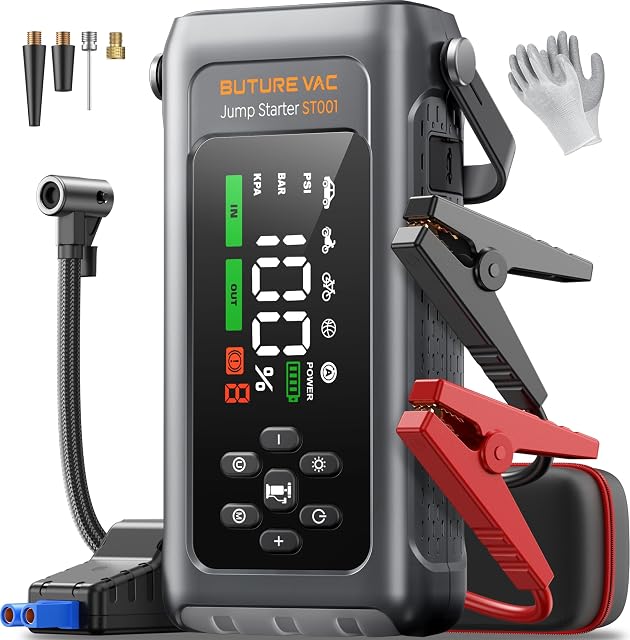
  4. BuTure VAC ST001 with 150 PSI compressor

    5000 A peak stated · 150 PSI inflator with preset and auto-stop · 3.3-inch display · 9 functions stated

    Two tools in one case: a jump starter and a 150 PSI inflator with a preset and automatic stop, on a 3.3-inch screen.

    Best for: A car that goes on long trips, where a flat tire and a flat battery are the two things you cannot solve on foot.

    7.8/10

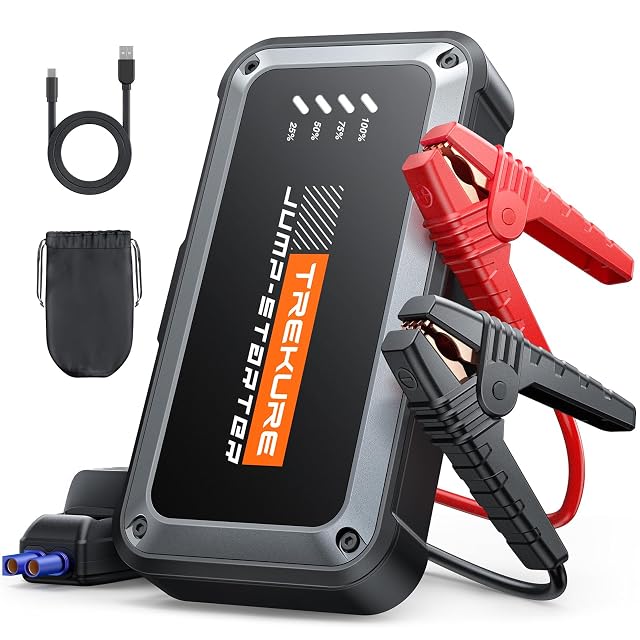
  5. TREKURE TK10 5000 A

    5000 A peak stated · up to 9.0 L petrol / 8.5 L diesel stated · power bank · 4-mode LED light

    A mid-size pack sold on the engine sizes it claims rather than on amps alone, with a four-mode light that includes a strobe — the detail that matters at a roadside.

    Best for: A family car that occasionally sits, and a driver who wants a light in the same pocket.

    7.8/10

    ≈ $46

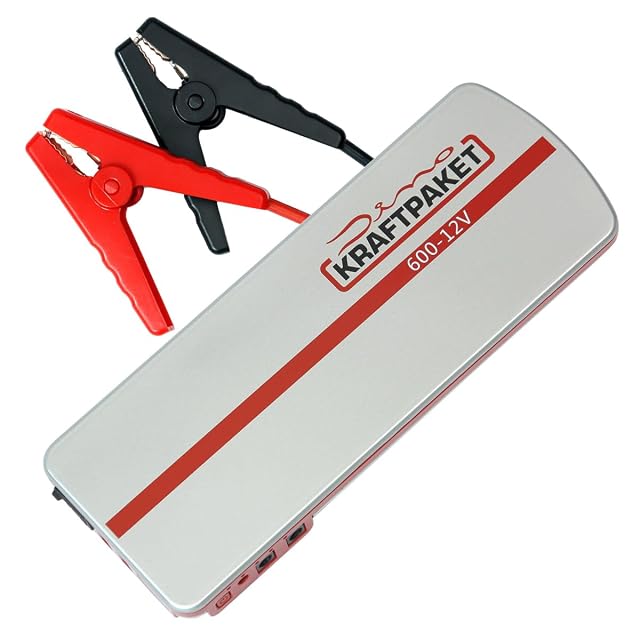
  6. Dino KRAFTPAKET 12 V 600 A starter

    600 A starting current stated · 66.6 Wh / 18,000 mAh stated · max 20 start attempts stated · 23 × 8.7 × 2.8 cm (9.1 × 3.4 × 1.1 in)

    The only pack here that publishes the figures that actually compare: 600 A starting current, 66.6 Wh of capacity, and a stated maximum of twenty start attempts.

    Best for: Someone who wants to compare specifications rather than headline numbers — and who flies with the pack.

    8.4/10

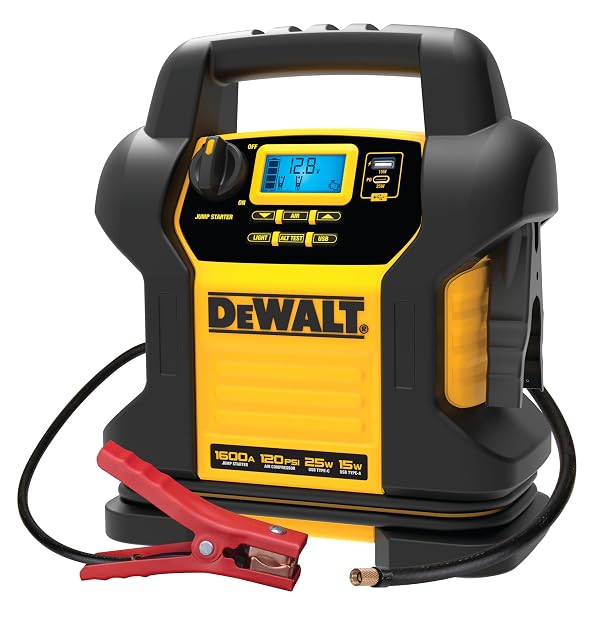
  7. DEWALT DXAEJ14, 1600 peak amps

    1600 peak amps · 120 PSI digital inflator with a 10-minute timer · 25 W USB-C · alternator test · mains recharge · 7,847 g (276.8 oz)

    The only unit here that publishes how often to recharge it — every 30 days — and the only one that tests an alternator.

    Best for: A garage shelf by a socket, on a V8 that needs a boost and an alternator check

Need by need, within lithium jump starters

Starting a large engine

Peak current decides the ability to crank a large engine or a diesel in cold weather. It is the decisive characteristic.

BRPOM G10-MX

A compact rescue pack

A modest model is enough for a small petrol engine and stows in a glovebox.

DEWALT DXAEJ14-Type3

Holding its charge six months in a boot

A jump starter is used once a year and must be full on that day. The stated self-discharge rate, or a recharge reminder, decides whether the unit is any use.

Dino KRAFTPAKET 136102

Who each family suits, across lithium jump starters

Little-used vehicle
A battery going flat while parked is the most ordinary breakdown there is. A jump starter saves waiting for recovery.
Diesel and large engines
The current needed is markedly higher, especially when cold. An undersized jump starter cranks nothing.
A flat battery twice a winter
A lithium jump starter self-discharges slowly and has to be recharged periodically. One forgotten for two years is flat at the moment it is wanted.

What you gain and what you give up, on lithium jump starters

Peak current against real current
The peak figure is a very brief spike. The current the unit actually sustains is markedly lower and rarely stated.
Compactness against power
A pocket jump starter cranks a small petrol engine. Large diesels call for a unit in another category.
Extra functions against capacity
Inflator, light and USB charging draw on the same battery. A jump starter used as a power bank can be flat when starting is needed.

Frequent questions on lithium jump starters

Is peak current representative?

It is a very brief spike. The current actually sustained is markedly lower, and it is rarely stated as visibly.

In what order do I connect?

Red clamp on the positive, black clamp on a metal earth point of the vehicle away from the battery, never on the negative terminal. That is the precaution against a spark near battery gases.

Should it charge before cranking?

On a deeply discharged battery, a few minutes connected before cranking markedly improves the chances.

How often should the jump starter be recharged?

Every few months, even unused: a lithium battery self-discharges. A forgotten jump starter is flat at the moment it is wanted.

Can it be left in the car?

Extreme temperatures, summer heat included, degrade the lithium battery. Many manufacturers advise against it.

Can a completely dead battery be started?

Some units refuse to work below a voltage threshold and have a forced mode. That mode is used with caution.

What if the engine will not crank?

Check the contacts and the connection order before persisting. Repeated attempts empty the jump starter quickly.

Can a completely flat battery be jump-started?

Many units refuse to activate below a floor voltage, as a safety measure, and offer a forced mode to use with care. A battery at zero volts is a replacement case, not a jump-start case.

What stays with you, on lithium jump starters

The black clamp goes on a metal earth point away from the battery, never on the negative terminal: that is the precaution against a spark near the gases. Peak current is a brief spike, and a jump starter left uncharged for months is flat on the day it is needed.

Summed up: lithium jump starters

  • Peak current: 1,600 to 9,000 A, on 4 of the 7 models.
  • Inflator: 120 to 160, on 3 of the 7 models.
  • Weight: 240 to 7,847 g (276.8 oz), on 3 of the 7 models.

Lithium jump starters, side by side

There is no table here, and the reason is in the listings. The figure published most often across these 7 products is peak current, given by 4 of them — short of the four in five a column needs to compare rather than to display gaps. Each product page says what its own maker published.

Our guides on lithium jump starters

Sources, and the way we rank

Specifications: manufacturer sheets for garage tools and the matching Amazon product pages. Prices and availability: Keepa.

Most recent revision in this category: October 6, 2026.

The method applied to lithium jump starters