What you are getting
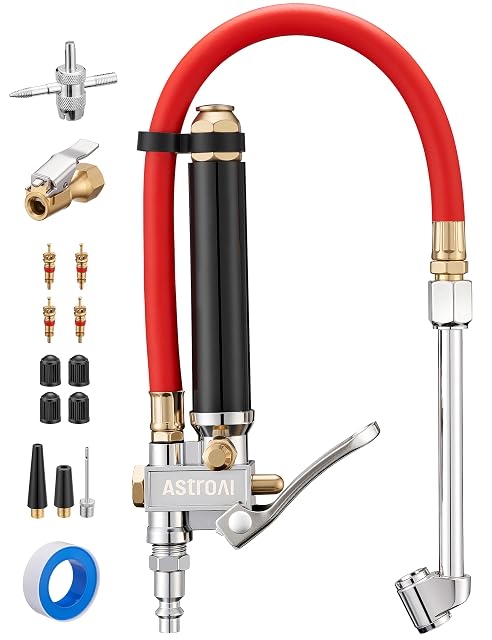
A mechanical gauge and inflator reading 10–120 PSI, calibrated to ANSI B40.1 with a stated tolerance of ±2 PSI from 80 to 120 PSI and ±3 PSI below 80 PSI, with a 1/4-inch quick-connect fitting, a dual-head chuck — straight plus a 30-degree reverse — an indicator bar, a stainless steel and brass body rated −14 to 122 °F (−10 to 50 °C), and a box of accessories: 4 valve cores, 4 valve caps, a valve core tool, a brass chuck, sealing tape, two cone nozzles and a ball needle. An air pump must be connected to inflate. 440 g (15.5 oz). $15.19.
Its tolerance is the only one on this shelf that gets worse where cars live
“Calibrated to the ANSI B40.1 international accuracy standard, this tire pressure gauge accurately measures between 10-120 PSI. The accuracy is ±2 for the measurement range of 80-120 PSI or ±3 for the measurement range below 80 PSI.”
Read that at the pressure a car uses. A car tire is 30 to 40 PSI, which is in the lower band.
±3 PSI at 35 PSI is ±8.6%.
| Gauge | Tolerance at 35 PSI |
|---|
| JACO ElitePro | ±1.5% of reading → about ±0.5 PSI |
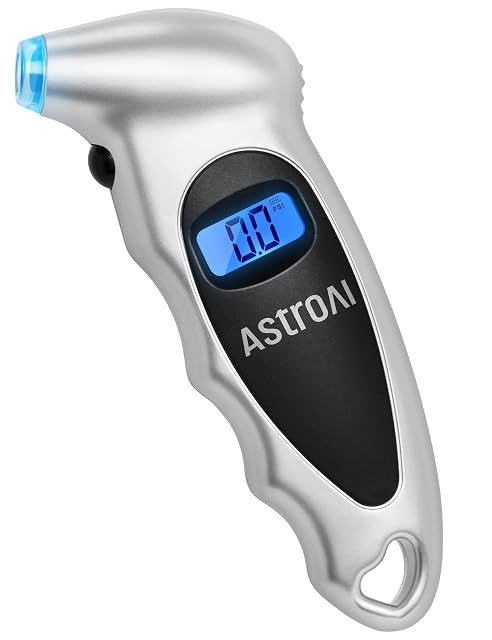
| AstroAI digital | ±1 PSI → ±2.9% |
| TIRETEK | 2% of 60 PSI full scale → ±1.2 PSI |
| This gauge | ±3 PSI → ±8.6% |
Three PSI is the difference between a correctly inflated tire and one that is noticeably soft. The introduction to this shelf says a gauge “is bought for repeatability rather than for absolute truth” — and a three-PSI band is wide enough that two readings inside it are not the same reading.
Where it is in its element is the top of its range: at 110 PSI, ±2 is ±1.8%, which is good. That is a light-truck, trailer or commercial pressure, and this is a gauge built for those.
AstroAI publishes the split honestly, which is more than most. It is still the figure to read before buying it for a car.
The dual-head chuck is the best answer on this shelf to the chuck question
“The straight chuck and 30° reverse chuck are designed to easily access the inner and exterior dual wheels, tight angles, and other hard-to-reach spaces.”
The introduction: “What decides daily use is the chuck: a straight chuck will not reach a valve behind an alloy spoke, and an angled or dual-foot one will.”
A dual-foot head has two openings back to back, one straight and one reversed, so the same head reaches the near and the far valve of a twin-wheel axle without turning the tool round. That is the configuration for a van, a motorhome or a trailer.
The LUMITECO in this survey has the same arrangement with a 12.3-inch reach; this publishes no length.
And it is the only gauge on this shelf with a temperature range
“It can work in −14 ℉ ~ 122 ℉ (−10 ℃ ~ 50 ℃) environments.”
Nothing else on this shelf publishes one, and it is a real limit: a Bourdon tube and a seal behave differently cold, and a gauge used at −15 °C (5 °F) is outside its own stated range.
It is also the figure the AstroAI digital gauge from the same maker does not publish, which is the one with an electronic sensor.
It inflates, with a condition stated
“Integrating tire pressure measurement, inflation, and deflation in one compact tool… Please Note: To inflate tires, an air pump must be connected to the gauge.”
That note is the honest part. This is not a compressor — it is the handle and gauge that go between a compressor and a valve, via a 1/4-inch quick-connect, which is the standard garage air fitting.
So it needs a tire inflator or a compressor, and this site has a tire inflators shelf for that. On its own it is a gauge with a trigger and a bleed lever.
Nine accessories in the box, which is the real value at $15.19
Four valve cores, four valve caps, a valve core tool, a brass chuck, threaded sealing tape, a long and a short cone nozzle and a ball needle.
A valve core is the part that leaks when a tire goes down slowly, and the core tool is the twenty-cent wrench that replaces it. Nobody else on this shelf supplies either — the LUMITECO pair ships four cores and four caps and no tool.
The cone nozzles and the ball needle make it an air gun for footballs, air beds and bicycle tires as well.
Four hundred and forty grams of stainless and brass
Second heaviest here after the Allstar’s 553 g (19.5 oz), and it is the right weight for a tool held at a trigger against 120 PSI.
“Constructed of high-quality stainless steel and brass” — the same materials as the TIRETEK and the LUMITECO, and the pairing that matters: brass for the sealing faces, steel for the body.
What is not published
No chuck reach, where the LUMITECO publishes 12.3 inches. No hose length. No dial or bar resolution. No units but PSI. No bleed rate. No warranty. And no accuracy at all below 10 PSI, which is where the range starts.
At $15.19 it is a well-equipped inflator head for a van or a trailer, and on a car it is the loosest gauge in this survey.
Availability
On sale at around $15 on the American Amazon store at the time of checking.
Prices and availability are what Keepa reported on the date this page was updated; both move.
Prices quoted in this text were read on 6 October 2026. The live price is at the top of the page.