Skip to content

The best 12 V power inverters for 2026

An inverter turns 12 V into mains, and the first choice is the waveform. Modified sine is cheaper and fine for resistive loads; pure sine is what motors, chargers and anything with a switch-mode supply prefer, and some equipment states it outright. The second number is continuous power, not peak — and it is usually not the limiting factor anyway, because a 12 V accessory socket is typically fused between 10 and 15 A, which caps a plug-in unit at roughly 120 to 180 W whatever the badge says. Above that, the inverter connects directly to the battery with its own fuse. We compare waveform, continuous and peak power, connection type, protections and stated idle draw.

The models we recommend

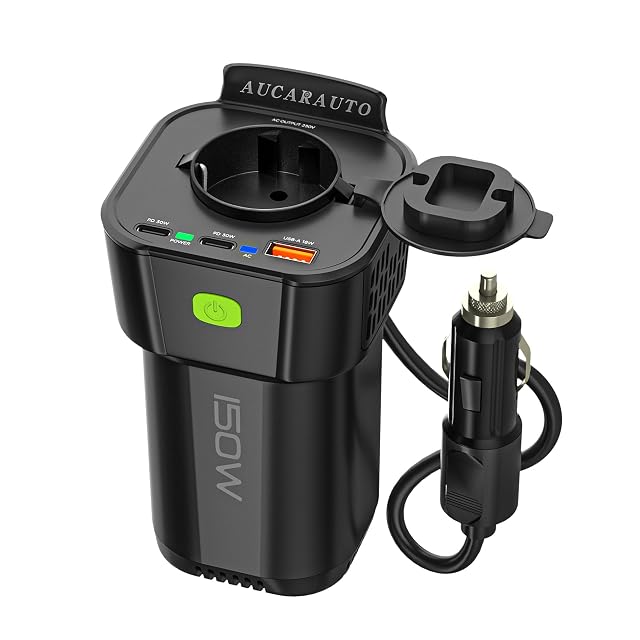
  1. AUCARAUTO C150B cup-holder inverter

    150 W · cup-holder form · 1 AC socket + 18 W USB-C + 2× 30 W PD · 10 A plug · 7 protections stated

    A 150 W inverter shaped to sit in a cup holder, with the socket count that actually gets used: one mains outlet and three USB ports.

    Best for: Charging laptops and cameras on a long drive, from the accessory socket.

    7.5/10

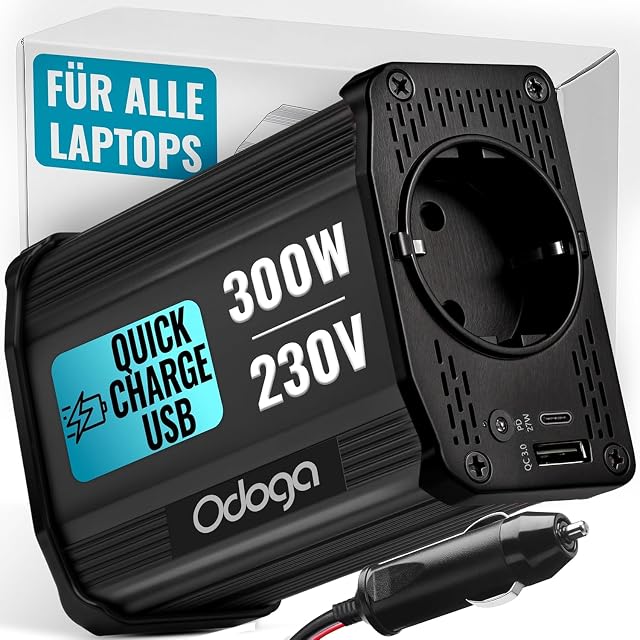
  2. Odoga 300 W modified sine wave

    300 W · modified sine wave stated · 230 V socket + USB-C and USB-A 3.0 A · aluminum housing · NOT for kettles, stated

    A 300 W modified sine unit whose listing does the rare thing: it names what the inverter is not for, starting with kettles.

    Best for: Charging laptops and cameras where waveform does not matter and price does.

    8.1/10

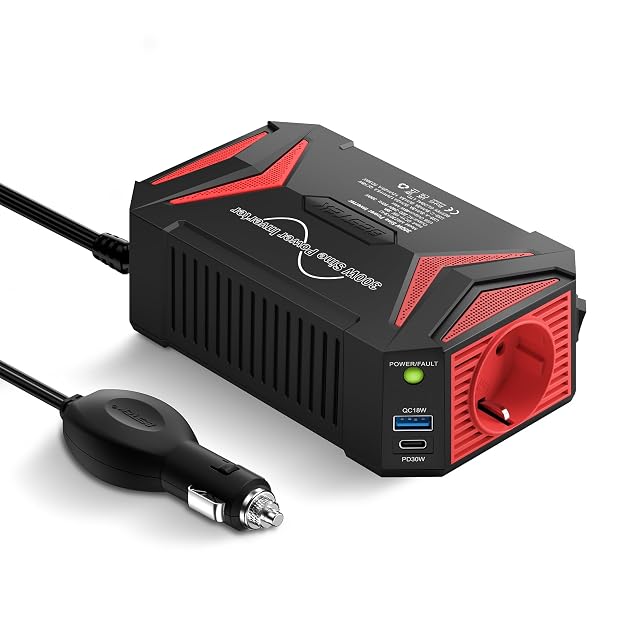
  3. BESTEK 300 W pure sine wave

    Pure sine wave stated · 300 W continuous · 38 W USB-C with PD 20 W and QC 18 W · 40 A internal fuse

    Pure sine wave at 300 W with a genuinely modern USB section — PD and Quick Charge on the same unit, behind a 40 A fuse.

    Best for: Someone whose device manual asks for pure sine, but who does not need 500 W.

    7.5/10

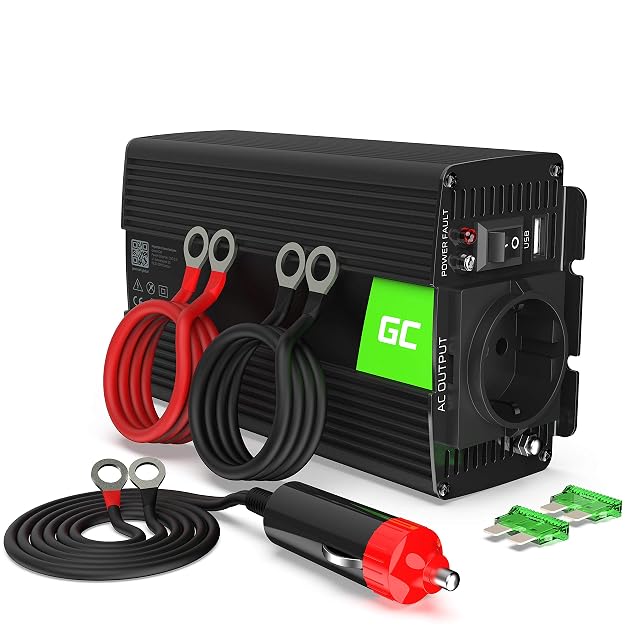
  4. Green Cell 500 W pure sine wave

    Pure sine wave stated · 500 W continuous / 1000 W peak · 12 V to 230 V · sockets plus USB

    A pure sine wave inverter at 500 W continuous — the waveform that matters for anything with a motor or a switch-mode power supply.

    Best for: Running tools, chargers or medical-grade electronics away from mains power.

    7.5/10

    ≈ $115

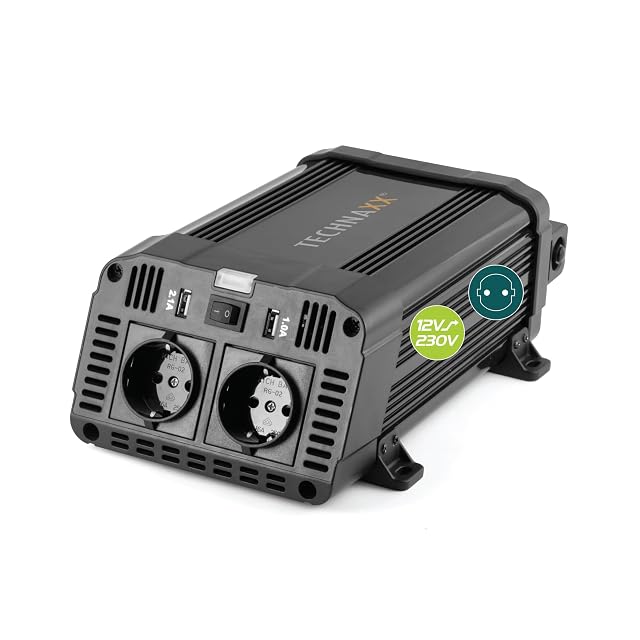
  5. technaxx 1200 W inverter

    1200 W continuous / 2400 W peak · 2 Schuko sockets + 2 USB 5 V 3.1 A · TÜV certified, stated

    The big one: 1200 W continuous through two Schuko sockets, with TÜV certification stated — the only third-party mark on this shelf.

    Best for: A van, a motorhome or a site vehicle where mains tools have to run away from a socket.

    8.1/10

    ≈ $135

Need by need, within 12 V power inverters

Powering a demanding appliance

Continuous power decides what can be run. Peak power only lasts a few seconds at start-up.

technaxx 4753

Plugging in several devices

The number of outlets avoids extra adapters, while remaining limited by the total power available.

Odoga PWEK00009

Delivering a clean wave for electronics

A modified-wave inverter makes a transformer whine and upsets some chargers. The stated waveform, pure sine or modified, decides what can safely be plugged in.

technaxx 4753

Who each family suits, across 12 V power inverters

Charging devices
A computer, light power tools and small appliances run off a correctly sized inverter. That is the everyday use.
Sensitive devices
Some devices cope badly with an approximate waveform. A pure sine wave inverter is necessary for them.
High power
Beyond a certain threshold, the cigarette lighter socket is no longer enough. Direct connection to the battery becomes compulsory.

What you gain and what you give up, on 12 V power inverters

Continuous power against peak power
The peak figure only lasts a few seconds. Sizing on the peak guarantees a cut-out as soon as the appliance settles into steady running.
Modified wave against pure sine wave
Modified wave costs less and suits many simple appliances; some motors and power supplies get hot or refuse to run on it.
Power available against the battery
A powerful inverter empties a vehicle battery very fast with the engine off. That is the real limit, not the unit.

Frequent questions on 12 V power inverters

Can it be plugged into the cigarette lighter?

Only below a modest power. Above that, direct connection to the battery with a fuse is compulsory.

How long can it be used with the engine off?

Far less than you would imagine: a few hundred watts empties a starter battery in little time. It is not designed for that use.

Modified wave or pure sine wave?

Pure sine wave for sensitive devices, motors and some power supplies. Modified wave suits simple loads.

What inverter power for a workshop tool?

Based on the appliance's continuous power, with margin for the start-up spike. Sizing on the peak guarantees a cut-out.

The inverter gets hot, is that normal?

It dissipates part of the energy as heat. The ventilation grilles must never be obstructed.

Do I need a fuse?

On a direct connection to the battery, absolutely, as close to the terminal as possible. That is what protects the cable in a short circuit.

Can I run a heater or a kettle?

Those appliances draw a power that few inverters and no starter battery sustain for long.

Can an inverter run off the cigarette-lighter socket?

The accessory socket is limited to a modest output, often around a hundred and fifty watts, and its fuse blows beyond that. A larger inverter connects directly to the battery, with a correctly sized fuse.

What stays with you, on 12 V power inverters

Size on continuous power, never on the peak, which only lasts a few seconds. A starter battery is not made to run an inverter with the engine off — and a direct connection requires a fuse as close to the terminal as possible.

Summed up: 12 V power inverters

  • Highest figure for power: technaxx 4753 (1200 W continuous, 2400 W peak — stated).

The full table of 12 V power inverters

A column is opened only if four tools in five publish its value. Otherwise the table would compare what nobody has measured.

ModelPriceOutputsPower
Green Cell INV03DE$115Mains sockets plus USB, stated500 W continuous, 1000 W peak — stated
technaxx 4753$1352 Schuko sockets and 2 USB at 5 V / 3.1 A, stated1200 W continuous, 2400 W peak — stated
AUCARAUTO C150B—1 AC socket, 18 W USB-C, 2 × 30 W PD — stated—
BESTEK 6975907165357——300 W continuous, stated
Odoga PWEK00009—230 V AC socket, USB-C and USB-A at 3.0 A — stated300 W, stated

Sources, and the way we rank

Specifications: manufacturer sheets for garage tools and the matching Amazon product pages. Prices and availability: Keepa. Every figure in this table names its source.

Most recent revision in this category: September 4, 2026.

The method applied to 12 V power inverters

Prices quoted in these summaries are dated readings. The live price is shown next to each product.