Skip to content

The best brake bleeders for 2026

Bleeding alone is possible in two ways. A pressure bleeder pushes fluid down from the reservoir and gives the most consistent result; a vacuum bleeder pulls from the nipple and is quicker to set up but draws air past the threads, which looks like a bubble that never clears. Either way the part that decides success is the adapter cap — it has to seal on your reservoir, and coverage varies enormously between kits. Brake work is exactly where this site stops and the workshop manual starts: fluid specification, sequence and torque all come from the vehicle maker. We compare method, adapter coverage, tank capacity, stated pressure and hoses.

The models we recommend

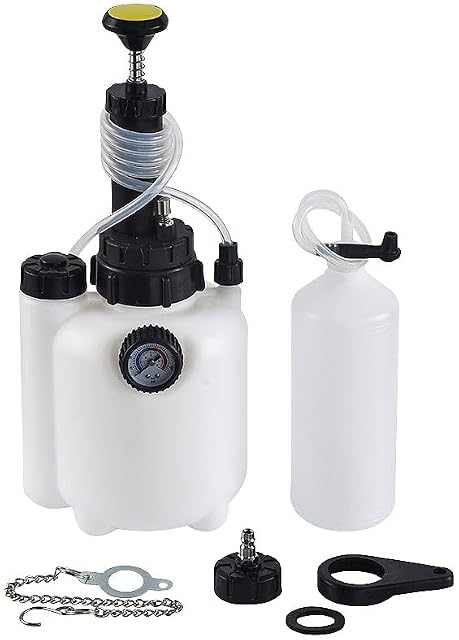
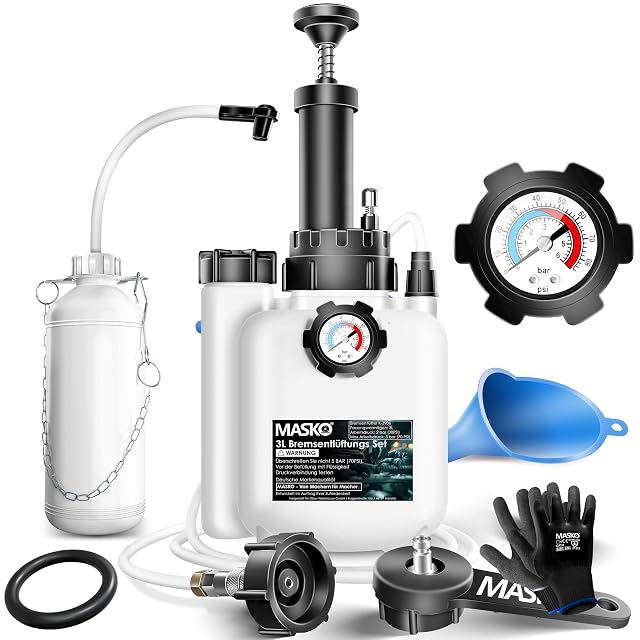
  1. MASKO 3 L pressure bleeder

    3 l pressure vessel · manual pressure system · integrated gauge · one-person operation stated

    A 3 liter manual pressure bleeder with a gauge: fluid is pushed down from the reservoir, which is the method that gives the most consistent result alone.

    Best for: Bleeding brakes alone, on a car whose reservoir the supplied cap fits.
    7.5/10

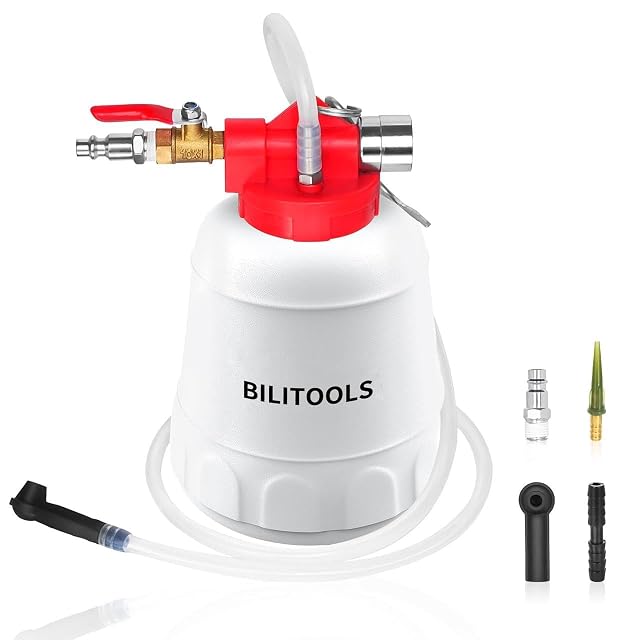
  2. BILITOOLS 1 L pneumatic vacuum bleeder

    1 l · vacuum method · needs 6–12 bar compressed air · no reservoir cap required · stated ABS-safe

    A pneumatic vacuum bleeder that needs no reservoir adapter at all — it draws from the bleed nipple, which is what makes it fit every car.

    Best for: A garage with a compressor, and any car whose reservoir cap is unusual.

    8.1/10

    ≈ $27

  3. AGT 3 L bleeder with E20 adapter

    3 l pressure vessel · E20 adapter Ø 45 mm (1.77 in) stated for most European cars · 1 l collection bottle · integrated gauge

    A pressure bleeder that names its adapter: an E20 at 45 mm (1.77 in), which is the fitting most European reservoirs use.

    Best for: A European car whose reservoir takes the common E20 cap.

    7.5/10

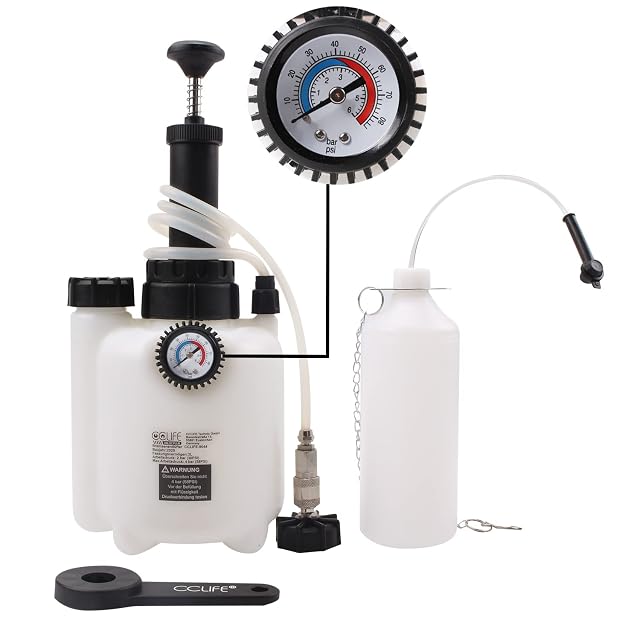
  4. CCLIFE 3 L bleeder with E20 adapter

    3 l · integrated pressure system · E20 adapter Ø 45 mm (1.77 in) · stated for cars, motorcycles and many European vehicles

    The same E20 pressure format from a brand with wide European distribution, stated for motorcycles as well as cars.

    Best for: A household with a car and a motorcycle, both on E20 reservoirs.

    7.5/10

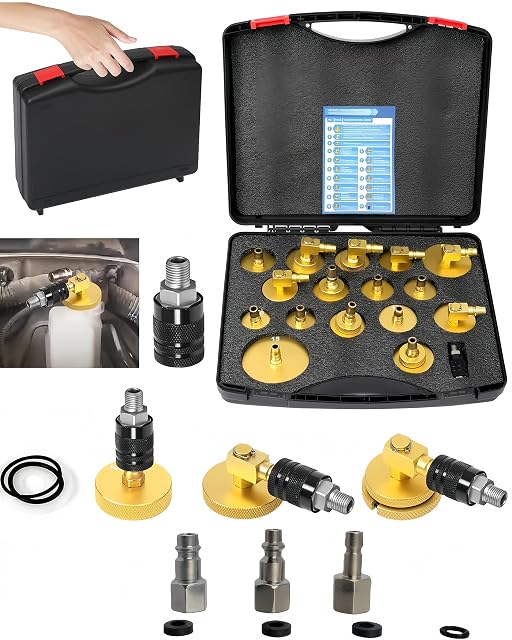
  5. XSTARYE 20-piece adapter set

    20 adapters · quick couplings · stated coverage for Toyota, VW, Tesla, BMW, Lexus, Land Rover, Jaguar and others

    Not a bleeder but the adapters for one: twenty reservoir caps with quick couplings, which is what makes a pressure bleeder fit more than one car.

    Best for: Someone bleeding several different cars, where one adapter is never enough.

    8.1/10

Need by need, within brake bleeders

Bleeding a complete circuit

The bottle capacity decides how many wheels can be bled without emptying it. Interrupting a bleed complicates the job.

CCLIFE 9044

Working alone without a second pair of hands

A conventional bleed needs someone on the pedal, which makes it impossible single-handed. Stated vacuum or pressure systems change the feasibility, not the quality of the bleed.

BILITOOLS B1A92920

Connecting to the vehicle's reservoir

A pressure bleeder screws onto the fluid reservoir, whose thread changes from maker to maker. The stated number of adaptor caps decides real compatibility.

BILITOOLS B1A92920

Who each family suits, across brake bleeders

Bleeding alone
A bleeder allows you to work without a helper on the pedal. That is the main argument for the format.
Complete fluid change
Brake fluid is hygroscopic and is replaced periodically. It is safety maintenance that is often forgotten.
After work on the system
Any opening of the circuit calls for a bleed. A spongy pedal signals air left in the circuit.

What you gain and what you give up, on brake bleeders

Vacuum against pressure
The vacuum bleeder draws through the nipple and can draw air around the thread; the pressure bleeder pushes from the reservoir and requires a good seal at the master cylinder.
Bleeding alone against the two-person method
The tool lets you work alone; the classic pedal method needs no equipment and a helper.
Speed against reservoir level
A fast bleed empties the master cylinder reservoir in seconds. Letting it run dry lets air into the whole circuit.

Frequent questions on brake bleeders

What happens if the reservoir runs dry?

Air gets into the master cylinder and the bleed has to be started again from the beginning, sometimes with difficulty. Watching the level is the absolute rule.

In what order should the wheels be bled?

According to the manufacturer's instruction, often starting with the wheel furthest from the master cylinder. The order is not a matter of indifference.

Is brake fluid aggressive?

It attacks paint immediately and irritates skin. Any splash on bodywork is rinsed off thoroughly with water without delay.

How often should the fluid be replaced?

According to the manufacturer's recommendation: the fluid absorbs moisture, which lowers its boiling point and degrades braking when hot.

Can two types of fluid be mixed?

Some types are incompatible and mixing them can destroy the seals. The vehicle's specification has to be respected.

The pedal is still spongy, why?

Air remains in the circuit. Start the bleed again, checking the seal around the nipples.

Should the brakes be tested before driving?

Absolutely, stationary and then at very low speed. An incomplete bleed shows up at the first application, and that has to happen in a yard, not on the road.

In what order are the wheels bled?

The order depends on the vehicle's circuit and is given in its documentation; it cannot be guessed. The reservoir must never run dry during the job, or everything starts again.

What stays with you, on brake bleeders

Never let the reservoir run dry: air gets into the master cylinder and the whole bleed has to be done again. The fluid attacks paint immediately, respect the manufacturer's bleeding order — and test the brakes stationary and then at walking pace before driving.

Summed up: brake bleeders

  • Capacity: 1 to 3 l pressure vessel, on 3 of the 5 models.

Brake bleeders, side by side

There is no table here, and the reason is in the listings. The figure published most often across these 5 products is capacity, given by 3 of them — short of the four in five a column needs to compare rather than to display gaps. Each product page says what its own maker published.

Our guides on brake bleeders

Sources, and the way we rank

Specifications: manufacturer sheets for garage tools and the matching Amazon product pages. Prices and availability: Keepa.

Most recent revision in this category: September 4, 2026.

The method applied to brake bleeders