The first four tools, and the order they earn their place
A home garage needs far less than a tool catalog suggests. Four things cover a wheel change and an oil service: a socket set, a torque wrench, a jack and a pair of axle stands. The order matters more than the brands — and the last two are bought together, because a jack without stands is a jack that cannot be used properly.
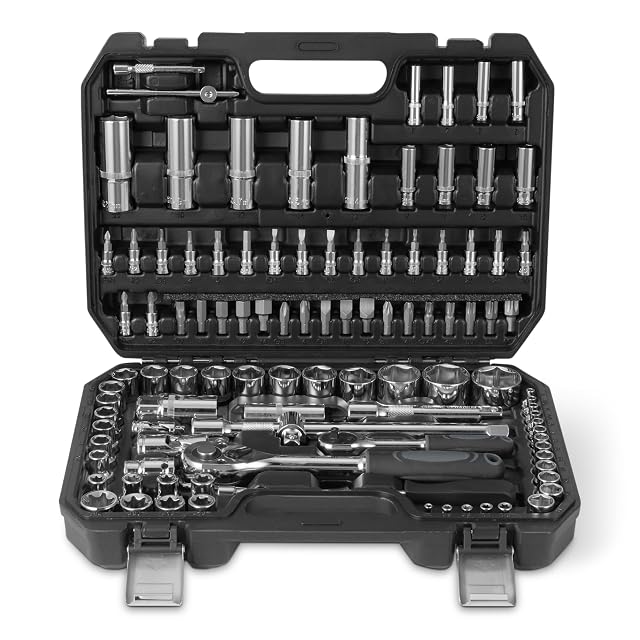
The 108-piece Amazon Basics set covers 1/4 and 1/2 inch with two quick-release ratchets, in CRV steel with embossed markings — printed sizes wear off within a couple of years. It is the tool every other job on this site assumes you have.
2. A torque wrench that covers your wheel bolts
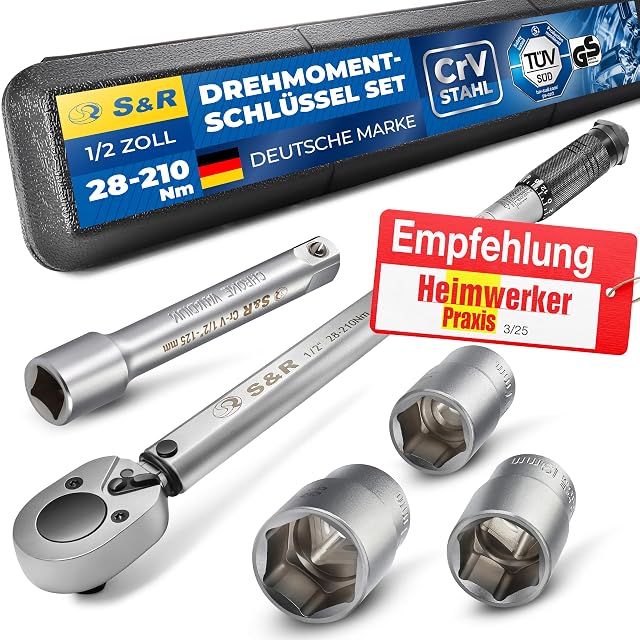
The S&R set runs 28 to 210 Nm and includes 17, 19 and 21 mm (0.83 in) sockets, which are the sizes wheel bolts use on the overwhelming majority of cars. It is TÜV tested with a GS mark. The value to apply comes from your vehicle manufacturer — no page here supplies one.
3. A jack that actually fits under your car
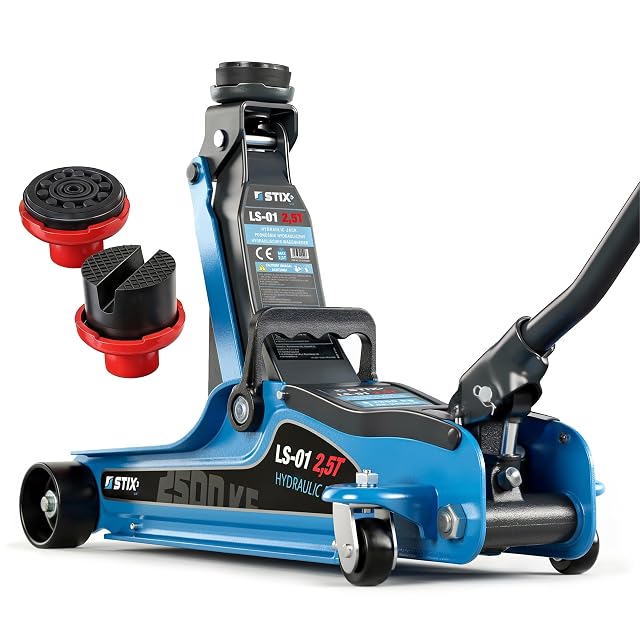
The Stix LS-01 publishes both figures that matter: 85 mm (3.35 in) to get under a low car, 365 mm (14.4 in) of lift with the adapter. It ships with two rubber pads, one grooved for a pinch weld — the part that stops a sill folding under a wide saddle.
4. Axle stands, bought at the same time
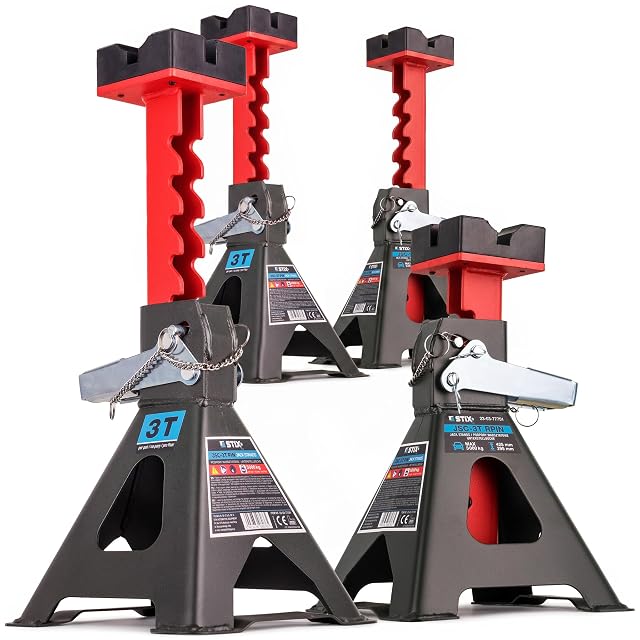
The Stix set of four adjusts from 275 to 430 mm (10.8 to 16.9 in) in six steps, with a ratchet, a chained safety pin and bolted grooved rubber pads. Four rather than two, because a brake job or winter storage needs the whole car up.
What can wait
An impact wrench, which is a convenience rather than a capability. A tool trolley, which is storage. A code reader, unless a warning light is already on — in which case it moves to the top of the list.
What is not a tool
The handbook for your car. Jacking points, support points, fluid specifications and tightening values are all published there, and every job on this site starts by reading it.
Which tool does the job you have?
You have never opened a bonnet
Start with the tools that undo things safely: a socket set and a torque wrench cover most of what a first job asks.
You want to do your own oil change
Add a way to lift and support the car, because that is the part that cannot be improvised.
You only want to handle small jobs
A modest set plus a jump starter covers wipers, bulbs, filters and a flat battery.
You already own a general toolbox
What is usually missing is the torque wrench and the axle stands, not more wrenches.
Picking by the job in hand
Filters and consumables
The natural first job: accessible, low risk, and it teaches the layout of your own car.
Wheels
Removing a wheel needs the right socket, a breaker bar and a torque wrench for refitting. That is a complete small kit on its own.
Battery and electrics
Terminals, a multimeter and a jump starter. The tools are cheap and the jobs are frequent.
Anything under the car
This is where the tool list stops being about wrenches and starts being about supporting the vehicle.
What to look at first
Socket drive size
Small drives suit interior and engine bay work; larger drives handle wheels and suspension. Buying one size only is what forces a second purchase within weeks.
A torque wrench that covers your range
One wrench rarely spans small fasteners and wheel bolts. Check the stated range against what you actually intend to tighten.
Deep versus shallow sockets
Many fasteners sit on a long stud. A set without deep sockets stops you at the first spark plug or wheel bolt with an extended thread.
Whether the set is metric, imperial or both
Most modern cars are metric, but older and some specialist vehicles are not. Buying the wrong system is a common and costly first mistake.
Case and organization
A set you can see at a glance gets used. This sounds trivial until you are under a car looking for one size.
Which figure for which repair
Your first job
The tools it needs
What people forget
Air or cabin filter
Screwdrivers and small sockets
Nothing much
Wheel swap
Breaker bar, socket, torque wrench
The torque figure
Oil change
Sockets, drain pan, lifting gear
Axle stands
Battery
Wrenches, multimeter
A memory saver on some cars
What goes wrong most often
Buying a huge set of unknown quality
A large set that rounds off fasteners costs far more than a small good one, because a rounded bolt turns a simple job into a difficult extraction.
Skipping the torque wrench
Wheel bolts, sump plugs and many engine fasteners have specified torques for a reason. Guessing is how threads are stripped and wheels come loose.
Using a socket as a hammer point
Sockets and extensions are not designed to be struck. Impact sockets exist precisely because ordinary chrome ones can shatter.
Working under a car on a jack
A jack is a lifting device, not a support. This is the single most dangerous habit in home car maintenance.
By how much you do yourself
The absolute beginner
A good socket set, a torque wrench, and lifting equipment before anything else. Everything else can wait for a specific job.
The occasional owner
Tools for consumables and a jump starter. That covers the jobs that come up on any car.
The one who intends to go further
Buy quality in the sizes you use most rather than quantity across sizes you will not.
Calibration, storage and working life
Hand tools last a long time if they are kept dry and if their calibrated members are respected. A torque wrench is the exception in a toolbox: it is a measuring instrument, and it is treated as one.
Wind a click-type torque wrench back to its lowest setting before storing it.
Wipe tools dry after use, especially in an unheated garage where condensation is constant.
Replace sockets that show rounded internal corners rather than persevering with them.
Keep the set complete: a missing size is what drives the use of the wrong one.
Safety
Most home-garage accidents come from supporting a vehicle badly, not from using a tool badly.
Never go under a car supported only by a jack: use axle stands or ramps.
Work on level, solid ground, with the wheels that stay down chocked.
Wear eye protection for anything under the car: rust and fluid fall straight down.
Disconnect the battery before working on electrics, and know your car’s procedure first.
You can lift a car with a jack alone and you cannot work under one. Axle stands cost less than the jack and they are what makes the rest of this list usable, so they are bought at the same time.
Do I need a torque wrench for a wheel change?
Yes. Wheel bolts have a tightening value published by the vehicle manufacturer, and both under- and over-tightening have consequences. An impact gun loosens; a torque wrench finishes.
Which drive size for the socket set?
Both. A quarter-inch drive for trim, sensors and engine-bay fasteners, and a half-inch for suspension and wheels. Sets that include the two cost little more than one.
What is the single most useful tool to buy first?
A good socket set in the drive size your car’s fasteners mostly use. It touches nearly every job, and quality here prevents rounded fasteners.
Do I really need a torque wrench?
For anything with a specified torque, yes: wheel bolts and sump plugs in particular. It is a cheap tool that prevents expensive failures.
Metric or imperial?
Most modern cars are metric. Older vehicles and some specialist ones are not, so check yours before buying rather than assuming.
Are cheap tool sets worth it?
A cheap set that rounds fasteners costs more in the end than a modest good one. Buy fewer, better pieces in the sizes you use.
What do I need before I can work under the car?
A jack to lift, and axle stands or ramps to support. The jack alone is never a support, and that distinction is the important one.
Should I buy an impact wrench straight away?
Not usually: a breaker bar undoes almost everything a home mechanic meets. An impact wrench saves time once the frequency of the work justifies it.
Adapters, leads and spares from the same aisle, at the price we read. Confirm they suit the tool you choose before ordering: it turns on the connector and the part number, which the product page gives.
CAINCAY c-6 · Screw extractors — HSS 4341 stated · 6 extractors in 5 sizes (#0–#4) · double-ended: drill one end, extract the other · magnetic bit holder and socket adapter
Aohoo Q1-T25X-BELB · Trim removal tools — 280 pieces · 11 removal tools · full clip and wedge range · stated professional set
Bojo ATH-I7-INTERIOR · Trim removal tools — 7 pieces · heavy-duty nylon, chemical resistant · fork tip for fir-tree clips · tips for most standard clip sizes · plastic toolbox case
Brennenstuhl 1175590100 · Work lights — 200 lm stated · up to 12 h runtime stated · 5 modes · Li-Po 3.7 V / 450 mAh · rechargeable · $32
PacoLit 1 Head · Work lights — 10,000 lm, 72 LEDs · IP66 · cast aluminum and tempered glass · 120° beam · 5 ft cord · 2-year replacement
Straight to it
If the job demands our rating → look at Stix 79310
Comparisons worth your time
Tool against tool, where the comparison is already published in this guide or this aisle.
The tools above are taken from the catalog of this site. Specifications come from the manufacturer and the Amazon product page; prices are what Keepa reported on the date shown, and both move. The order uses declared specifications, the weight of stated strengths against stated limits, and price. No tool here has been used by us on a real job, and nothing here claims it has.
Last checked on
Prices quoted in these summaries are dated readings. The live price is shown next to each product.