Skip to content

The best body sanders for 2026

Sanding filler and paint is a different job from sanding wood, and the machines differ where it counts: small orbits (2 to 3 mm (0.08 to 0.12 in)) for finishing, larger ones for leveling, and pad sizes chosen for the panel rather than the bench. The specification that decides the result is dust extraction: a multi-hole pad matched to an extractor keeps the abrasive cutting instead of clogging, and it keeps the dust out of what you are about to spray. Variable speed matters for the last passes, and low stated vibration matters for anything longer than an hour. We compare orbit, pad diameter and hole pattern, extraction, speed control and stated vibration.

The models we recommend

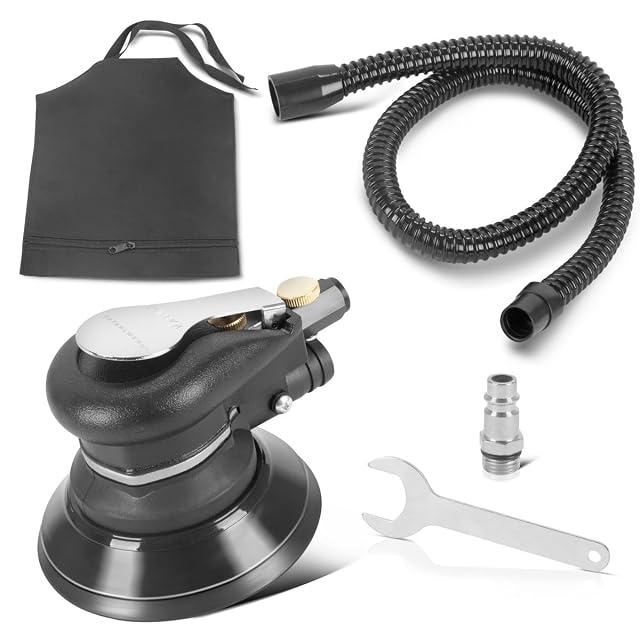
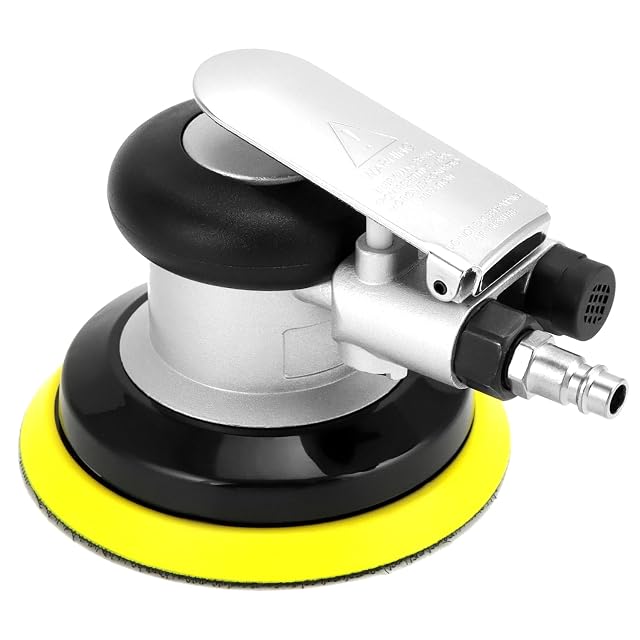
  1. QWORK WD11533,125 mm (4.92 in) air sander

    Air · 125 mm (4.92 in) · 12,000 rpm stated · 5 mm (0.20 in) eccentric · all-steel rotor · low vibration stated

    A 125 mm (4.92 in) air random orbit sander at 12,000 rpm with a 5 mm (0.20 in) orbit — the fine throw that suits paint rather than timber.

    Best for: Paint preparation in a garage that already has compressed air.
    7.5/10

  2. STAHLWERK DES-125 ST 125 mm (4.92 in) air sander

    Air · 125 mm (4.92 in) pad · 11,000 rpm stated · 1 kg (2.2 lb) stated · one-handed operation · paint, metal, plastic and wood

    A one-kilogram 125 mm (4.92 in) air sander — light enough to work one-handed, which is what a long session on a vertical panel requires.

    Best for: Vertical panels and overhead work, where every hundred grams counts.

    8.1/10

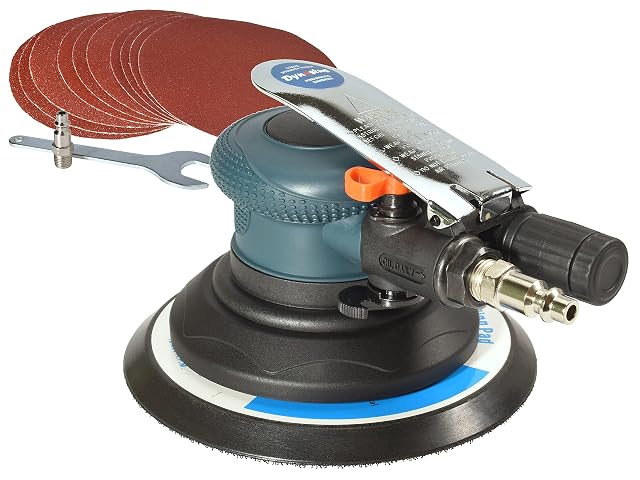
  3. Dynastus 6 in air palm, 1.85 lb

    6 in hook-and-loop · air palm · internal silencing · built-in regulator · metal touch trigger · 1/4 NPT · 1.85 lb · 10 discs

    The lightest sander on this shelf at 839 grams, with internal silencing and a trigger that modulates.

    Best for: A long session on a door or a wing, in a garage where noise matters

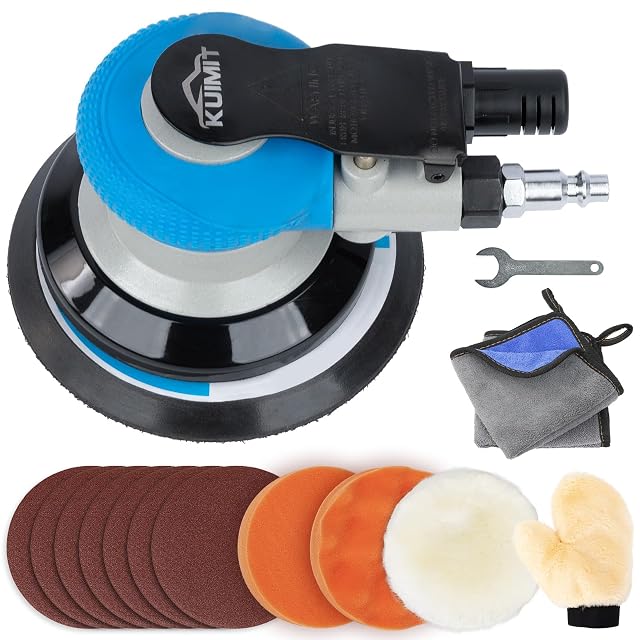
  4. KUIMIT 5 in air DA, 2,500–12,000 rpm

    Air DA · 2,500–12,000 rpm published range · 5 in hook-and-loop pad · 3.1 lb · quick-connect fitting · contour sponge set

    The only sander here that publishes both ends of its speed range, in a kit with three contour sponges.

    Best for: Work that needs a slow pass as well as a fast one, on a 5-inch pad

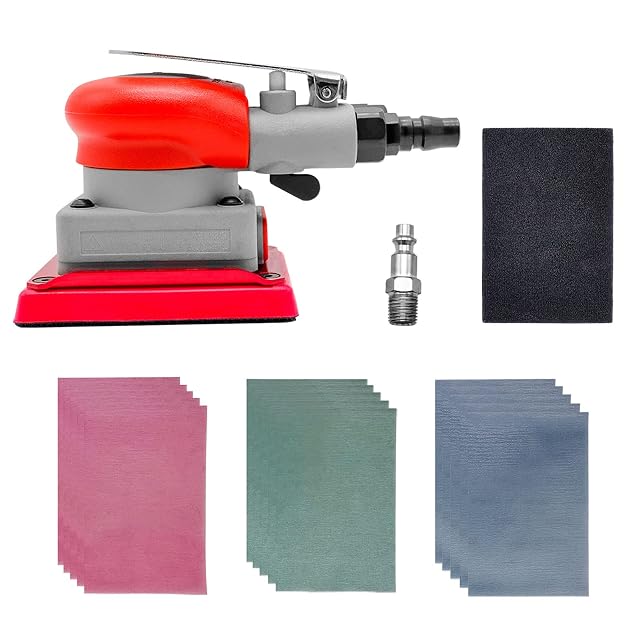
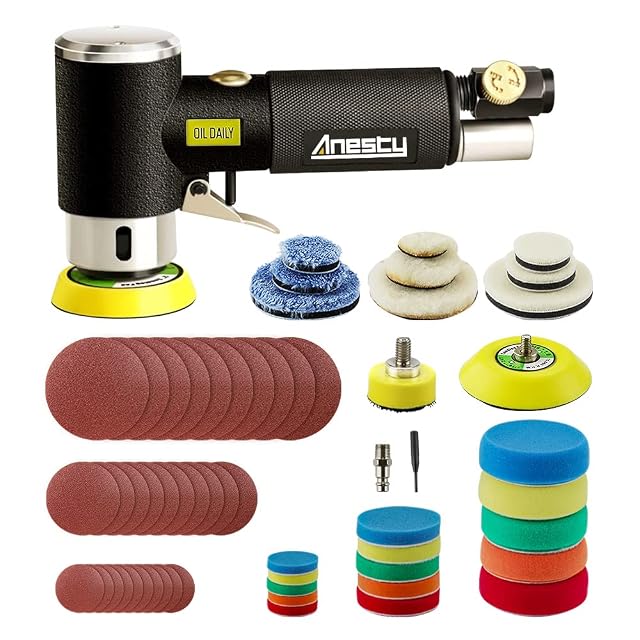
  5. Anesty 25/50/75 mm mini sander set

    Air · three pad sizes 25, 50 and 75 mm (2.95 in) · low air consumption stated · low noise · one-handed

    Three pad sizes in one kit — 25, 50 and 75 mm (2.95 in) — which is what makes a mini sander cover a stone chip and a whole repair patch.

    Best for: Spot repairs of varying sizes, on a garage compressor that is not large.

    8.1/10

  6. TCP Global 6 in DA sander, 4.5 CFM stated

    6 in · 10,000 rpm free speed · 4.5 CFM at 90 PSI, 2 hp compressor suggested · two plates, PSA and hook-and-loop · 1.89 lb

    The only sander here that publishes what compressor it needs, and the only one with both kinds of plate.

    Best for: A garage with a real compressor, and a drawer of mixed PSA and loop discs

Need by need, within body sanders

Removing material fast

Speed decides the removal rate. On bodywork preparation, that is what separates one hour from three.

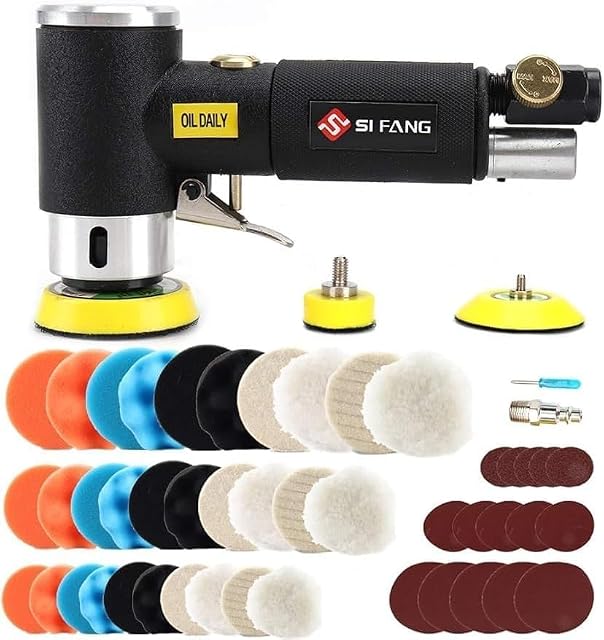
SI FANG SFde1a000002Aa-LJH

Working to a finish

A reduced speed allows finishing without digging in or marking, which matters on a surface that will take paint.

KUIMIT DMJ-Black-6in

Connecting to the workshop extraction

Sanding filler makes a fine dust that settles on everything due to be painted next. The stated extraction port diameter decides how clean the booth stays.

Anesty NLA580GL558

Who each family suits, across body sanders

Preparation before painting
The flatness obtained entirely governs the final look. A sanding defect shows up under the paint, never before.
Stripping
Removing old paint takes a coarse grit and a lot of patience. It is the job that eats the most abrasive.
Dust
Bodywork sanding dust is fine and abundant. Extraction and respiratory protection are not optional.

What you gain and what you give up, on body sanders

Removal rate against flatness
An aggressive machine digs in where you dwell. Flatness comes from crossed, even passes, not from power.
Extraction against bulk
Connecting to a vacuum gets in the way of movement and radically changes how clean the work is and the air you breathe.
Wide orbit against finish
A large orbit removes fast and leaves more marked scratches. A small orbit finishes better and works slowly.

Frequent questions on body sanders

Do I need extraction?

Bodywork dust is very fine and abundant. Extraction and a suitable mask are necessary, not optional.

What grit progression?

Without skipping more than one step: each grit has to remove the scratches of the previous one. Skipping a step leaves marks that will show under the paint.

How do I avoid digging in?

Machine constantly moving, without pressing, in crossed passes. Dwelling in one place digs in within seconds.

Should I wet-sand?

On finishes and primers, wet sanding gives a finer surface and removes the dust. It does not suit bare metal.

How do I check flatness?

A guide coat sprayed on reveals the hollows, which stay colored after a pass. It is the bodyshop method.

When should the disc be changed?

As soon as it heats, slips or clogs. A clogged disc burns and polishes instead of removing.

Should neighboring areas be protected?

Masking avoids accidentally sanding a finished area. It is quicker than putting it right.

What grit sequence on filler?

Rough it out around eighty, level around a hundred and eighty, and prepare for primer around three hundred and twenty. Skipping two steps leaves scratches the primer will not fill.

What stays with you, on body sanders

A sanding defect only shows up under the paint, never before: that is what makes the grit progression non-negotiable. Machine constantly moving without pressing, guide coat to reveal the hollows — and extraction with a mask is not optional with this dust.

Summed up: body sanders

  • Speed: 2,500 to 15,000, on 6 of the 10 models.

Body sanders, side by side

There is no table here, and the reason is in the listings. The figure published most often across these 10 products is power source, given by 6 of them — short of the four in five a column needs to compare rather than to display gaps. Each product page says what its own maker published.

Our guides on body sanders

Sources, and the way we rank

Specifications: manufacturer sheets for garage tools and the matching Amazon product pages. Prices and availability: Keepa.

Most recent revision in this category: October 6, 2026.

The method applied to body sanders