Skip to content

The best car battery chargers and maintainers for 2026

Two different tools share this shelf. A charger puts capacity back in hours; a maintainer holds a parked battery at rest for months and is what a seasonal car actually needs. Both are now multi-stage, and the stages are where the differences hide: bulk, absorption, float, and on several models a recovery or desulphation attempt that makers describe carefully rather than promise. Chemistry mode matters — AGM and EFB take a different voltage profile from flooded, and lithium takes a different one again, so a charger without the right mode is the wrong charger. Amperage should suit the battery: makers commonly state a rate around a tenth of the capacity in amp-hours. We compare stages, chemistries, stated amperage, protections and IP rating.

The models we recommend

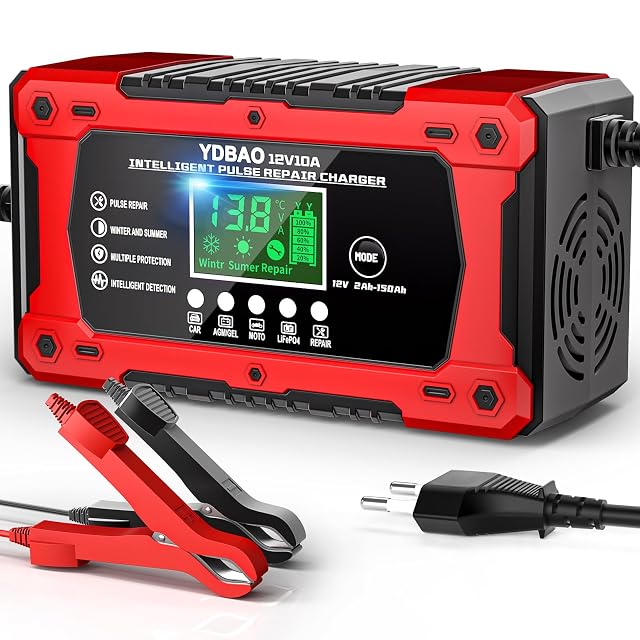
  1. YDBAO 10 A charger with LCD

    12 V · 10 A · LCD showing voltage, current, status and temperature · repair mode · 5 protections stated

    A 10 A charger with a screen that shows what it is doing — voltage, current, state and temperature — at the price most chargers show two LEDs.

    Best for: A conventional flooded battery in a car that has been standing.
    6.9/10

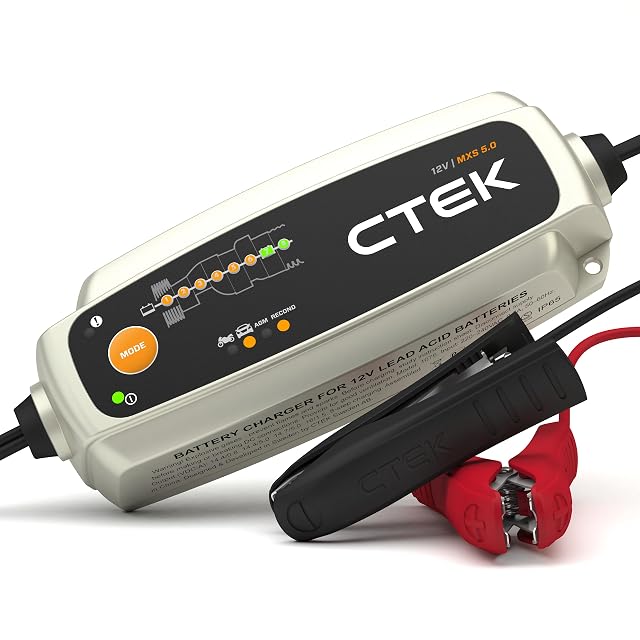
  2. CTEK MXS 5.0

    12 V · temperature compensation · RECOND recovery mode · AGM program · from the maker of the first smart 12 V charger

    The reference on this shelf: temperature compensation, a recovery mode for deeply discharged batteries, an AGM program, and a charging profile used by more than forty vehicle manufacturers according to the maker.

    Best for: Anyone who intends to own one charger for a decade, and anyone with an AGM battery.

    8.1/10

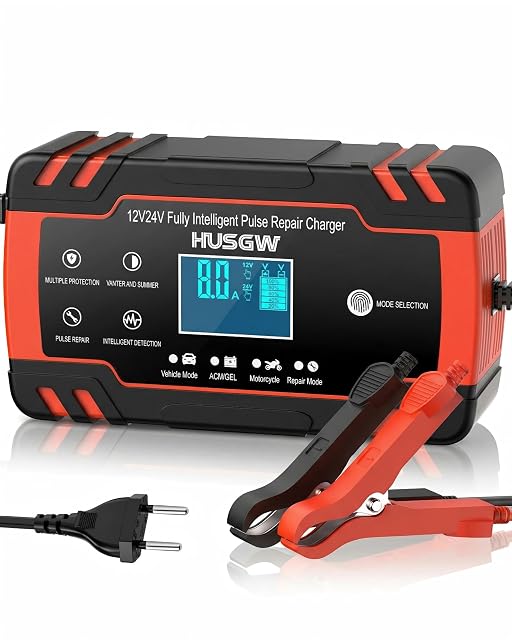
  3. Husgw 8 A 12/24 V charger

    12 V and 24 V · 8 A · automatic shut-off · pulse repair technology stated · ABS housing

    A dual-voltage charger for households with a van as well as a car, with automatic shut-off and a pulse desulphation attempt.

    Best for: A mixed driveway: car, van, or anything with a 24 V system.

    8.1/10

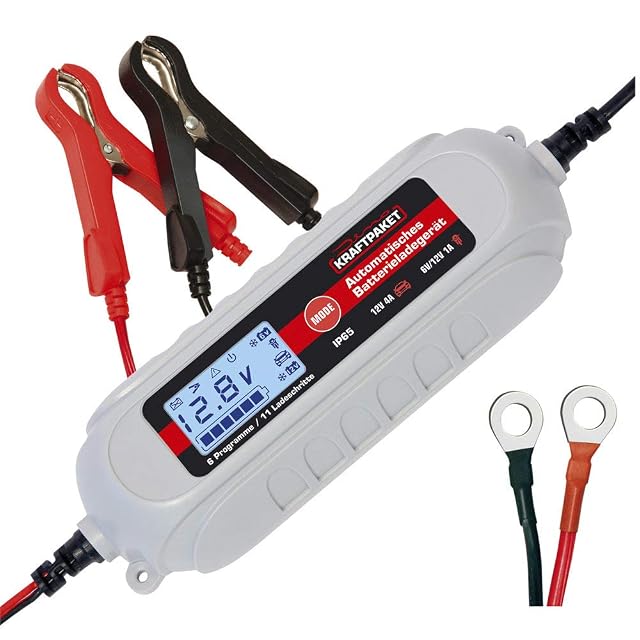
  4. Dino KRAFTPAKET 4 A 6/12 V automatic charger

    6 V and 12 V · 4 A · lead-acid, wet, MF, gel and AGM stated · built-in battery tester · float charge · memory after power cut

    A maintainer with a battery tester built in: it names the chemistries it supports, holds a float charge, and remembers its program after a power cut.

    Best for: A second car, a classic or a motorcycle that stands between uses.

    8.1/10

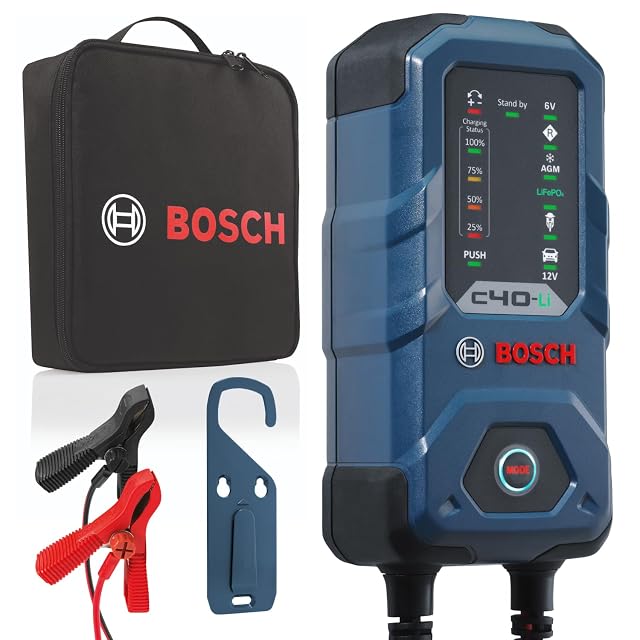
  5. Bosch battery charger 0189921040

    14.7 V input stated · 5 A effective charging current · 169 × 81 × 54 mm (6.65 × 3.19 × 2.13 in) · sold as a vehicle part reference

    Sold and catalogued as a vehicle part rather than a consumer product: the listing publishes dimensions and effective charging current, and asks you to check compatibility against your vehicle data.

    Best for: Someone who wants a Bosch part number and is willing to read the data table.

    8.1/10

Who each family suits, across battery chargers and maintainers

Vehicle laid up
A maintenance charger left connected keeps a battery in condition through months of immobility.
Flat battery
A slow, full charge is far better for the battery than a jump start followed by a few kilometers.
Recent batteries
Recent technologies require a specific charging profile. An old charger can damage them.

What you gain and what you give up, on battery chargers and maintainers

Fast charging against service life
A high current recharges fast and tires the battery. A slow charge is markedly better for its longevity.
Automatic against manual
An automatic charger stops and switches to maintenance; a manual charger continues indefinitely and can boil the electrolyte.
Multiple programs against simplicity
A charger that recognizes the battery type avoids a profile error. Without that, you have to know what you are charging.

Frequent questions on battery chargers and maintainers

Can a charger be left connected permanently?

A maintenance charger, yes: that is its function. An unregulated manual charger, never: it keeps charging and degrades the battery.

Does the battery have to be disconnected from the vehicle?

Modern chargers connect with the battery in place. Disconnecting loses the memory of some modules.

Does the battery type matter?

A great deal: recent technologies require a specific charging profile. A wrong profile shortens the life or damages the battery.

Fast or slow charging?

Slow charging is markedly better for the battery. Fast charging gets you going and tires it.

Does charging need a ventilated space?

A lead battery on charge gives off hydrogen. Ventilation and the absence of flame are not theoretical precautions.

Can a deeply discharged battery be recovered?

Sometimes, with a recovery mode. A battery left flat for a long time is often permanently degraded.

Does driving recharge the battery?

Partly and slowly. A few kilometers after a jump start do not recharge a deeply discharged battery.

Can a charger be left connected all winter?

A maintenance charger is made for that and alternates charging and rest without overcharging. An old fixed-output charger, on the other hand, cooks the battery if it stays connected.

What stays with you, on battery chargers and maintainers

A slow charge is far better than a fast one for longevity, and driving does not recharge a deeply discharged battery. The profile has to match the battery technology, and a lead battery on charge gives off hydrogen — ventilate.

Summed up: battery chargers and maintainers

    Battery chargers and maintainers, side by side

    There is no table here, and the reason is in the listings. The figure published most often across these 5 products is current, given by 2 of them — short of the four in five a column needs to compare rather than to display gaps. Each product page says what its own maker published.

    Our guides on battery chargers and maintainers

    Sources, and the way we rank

    Specifications: manufacturer sheets for garage tools and the matching Amazon product pages. Prices and availability: Keepa.

    Most recent revision in this category: September 4, 2026.

    The method applied to battery chargers and maintainers