Skip to content

The best tool trolleys for 2026

A roller cabinet is judged by the parts that move. Ball-bearing slides open fully under load and keep doing it; friction slides bind as soon as a drawer holds a socket set. The stated load per drawer is the figure that tells you which kind you are buying, and it is worth more than the total weight of the cabinet. Then come the castors — two fixed, two swivelling, with brakes that actually reach the floor — and the lock, which on a shared workshop is the difference between a trolley and a bench. Filled sets deserve a second look: the tools included are usually the cheapest part of the package, and the cabinet is the part that stays. We compare drawer count and slides, construction, castors, locking and worktop. Not one of the drawer cabinets on this shelf publishes a load per drawer, which is the figure a heavy socket set actually tests — while the open carts and trays beside them all publish a total capacity.

The models we recommend

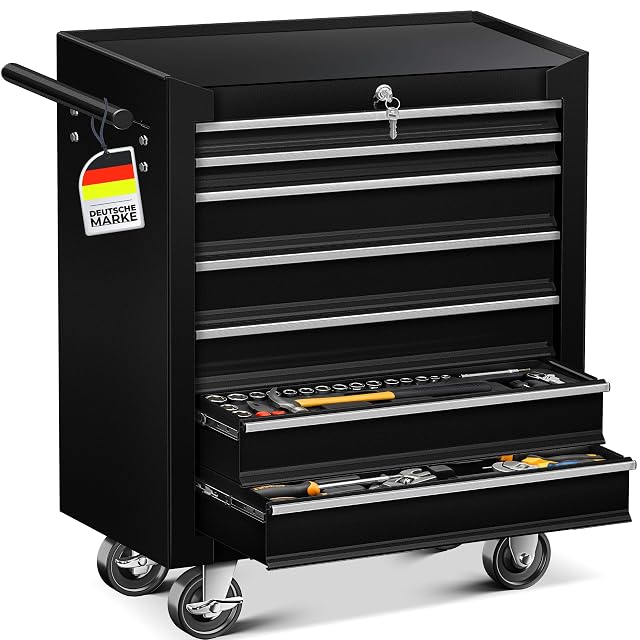
  1. MASKO 7-drawer lockable trolley

    7 drawers · central locking · ball-bearing slides stated · 4 castors, 2 swivelling with brakes · steel

    Seven drawers on ball-bearing slides with a central lock, at the price where most trolleys still use friction slides.

    Best for: A first proper trolley, where the slides matter more than the badge.

    7.2/10

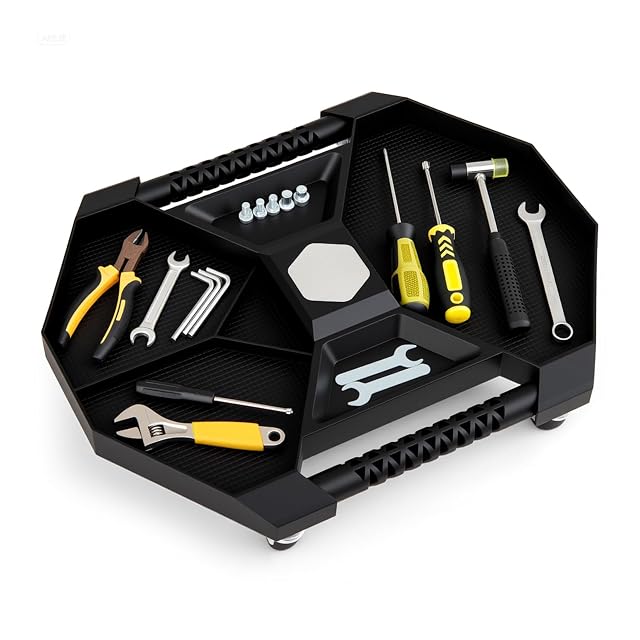
  2. Goplus Rolling tray, 4.5 lb, magnets

    55 lb capacity · 4.5 lb empty · 4 compartments, 4 magnets · 4 swivel casters · 102 mm (4.02 in) high · 520 × 419 mm (20.5 × 16.5 in)

    A 102-millimeter-high rolling tray with magnets in two compartments, made to go under a car.

    Best for: A job under the car, with the fasteners held down and the tray within reach

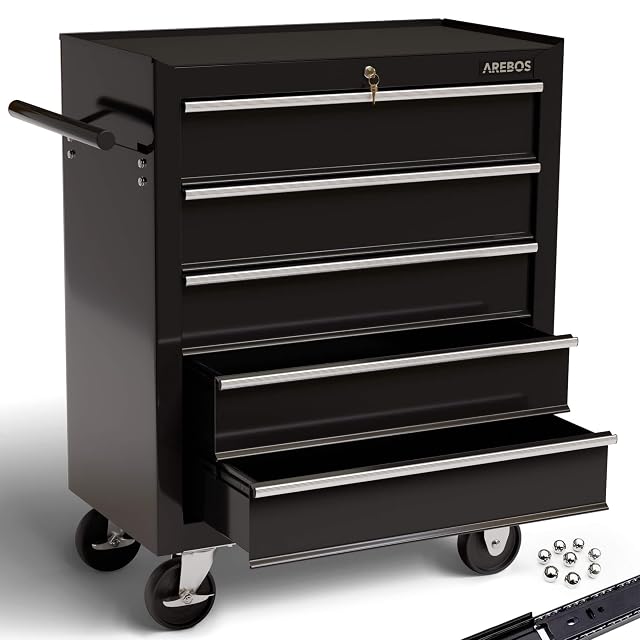
  3. Arebos 5-drawer lockable trolley

    5 drawers · solid steel stated · ball-bearing slides · central locking · 2 fixed and 2 swivelling castors

    Five drawers rather than seven, with the same essentials: ball-bearing slides, a central lock and a mix of fixed and swivelling castors.

    Best for: A garage with a few large tool sets rather than many small ones.

    7.8/10

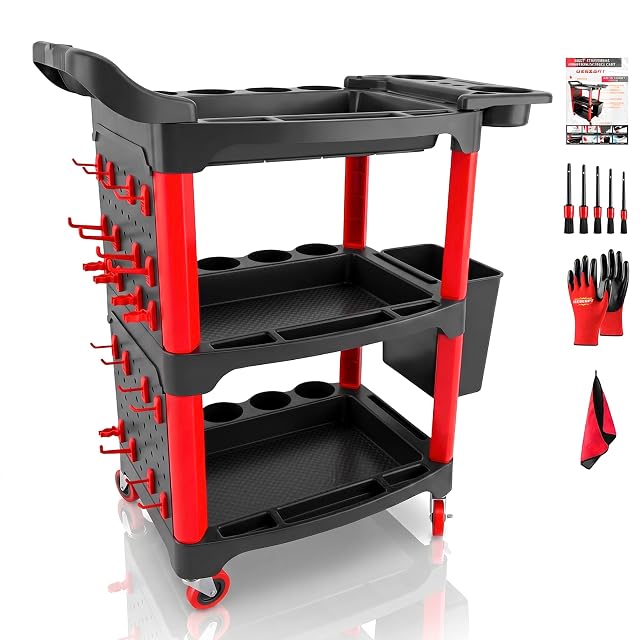
  4. DESEQPT 3-tier detailing cart, 297 lb

    3 tiers · 297 lb stated · hanging board, hooks, bucket hanger, bottle holders · 2 lockable casters · press-fit, no screws · 1-year warranty

    A three-tier detailing cart that states 297 pounds and also states that nothing is screwed together.

    Best for: Washing and polishing, where bottles and a bucket matter more than drawers

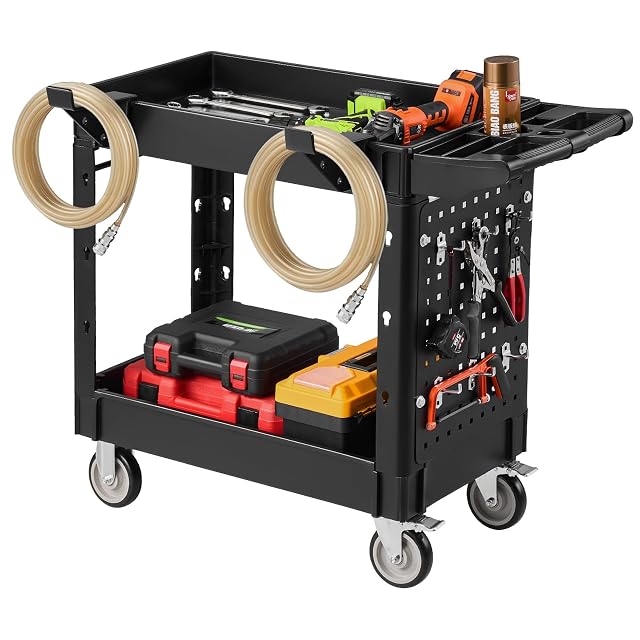
  5. VEVOR 2-tier cart, 550 lb, pegboard

    550 lb total — 200 lb top, 400 lb bottom · pegboard and 6 hooks · 5 in casters, 2 lockable · industrial PP · 15,499 g (546.7 oz)

    The only item here that splits its load rating by tier, and the only one with a pegboard.

    Best for: A one-job garage where the tools stay visible and the floor gets washed

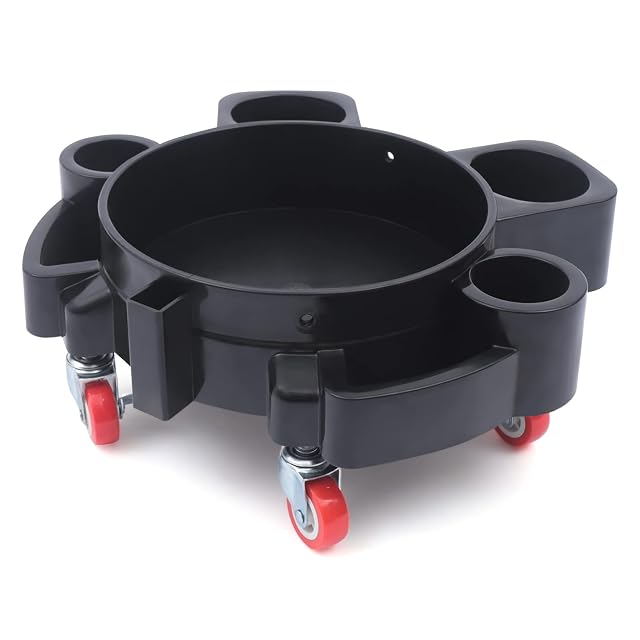
  6. WoopJeem Bucket dolly, 5 wheels, 331 lb

    Bucket dolly · fits a 10 in bucket · 220–331 lb · 5 swivel wheels, 2 with brakes · 3 fixing screws · 94 mm (3.70 in) high · 2.2 kg (4.9 lb)

    Not a trolley: a 94-millimeter dolly that carries one bucket on five wheels, with brakes on two.

    Best for: Washing a car with a full bucket, and sitting down to do the sills

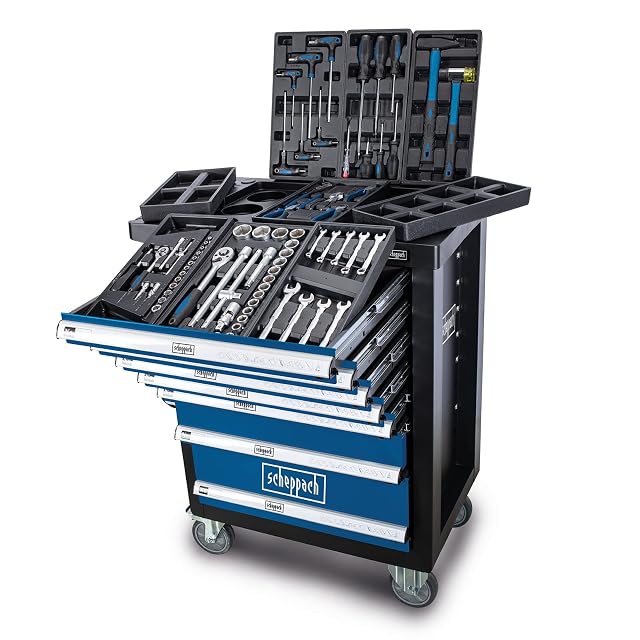
  7. Scheppach TW1100 with 70-piece tool set

    7 drawers · large worktop · cut-outs for extra storage · supplied with a 70-piece tool set · 4 castors

    The filled option: seven drawers, a large worktop and a 70-piece tool set included — which makes it a starting point rather than a cabinet.

    Best for: Equipping a garage from nothing, where the tools and the storage arrive together.

    8.4/10

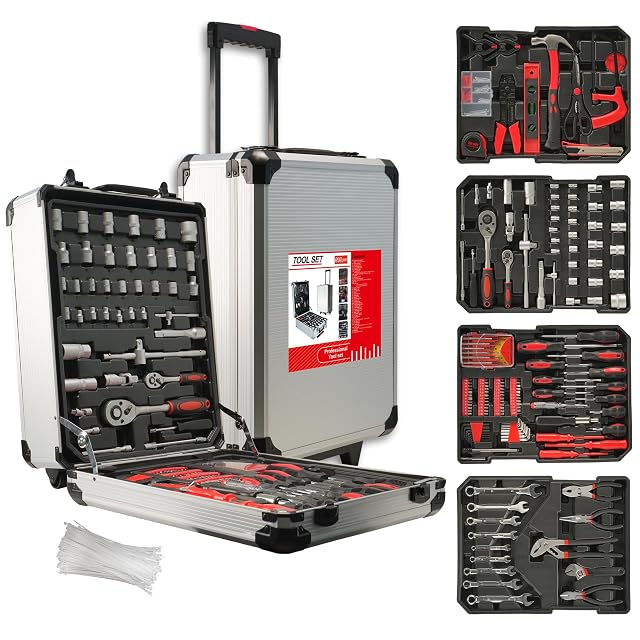
  8. ANXTECH 515 pieces, 4-drawer alloy case

    515 pieces · 4-drawer aluminum rolling case · telescopic handle and wheels · carbon steel, chrome plated · no load rating

    The only drawer case here, filled with 515 pieces and publishing no load rating for any of them.

    Best for: A van or a second property, where the set travels and the jobs are light

Need by need, within tool trolleys

Rolling loaded across a workshop floor

Fifty-millimeter castors stop at a slab joint when the unit weighs a hundred kilos. The stated wheel diameter decides real mobility once the drawers are full.

MASKO 7-drawer trolley

Opening a loaded drawer all the way

A plain slide comes half out under twenty kilos and the back of the drawer is lost. The stated slide type and load per drawer decide what you can actually find.

Scheppach 5909304901

Who each family suits, across tool trolleys

Regular workshop
Bringing the tools to the vehicle rather than the other way round completely changes how the work is organized.
A trolley that rolls between two cars
A trolley occupies a permanent footprint. In a cluttered garage, a tool box stays more flexible.
Heavy tools
The permissible load per drawer and the quality of the slides decide whether a loaded drawer still opens in five years.

What you gain and what you give up, on tool trolleys

Number of drawers against usable volume
Multiplying the drawers multiplies the partitions and reduces the total volume stored. Drawers of varied heights are more efficient.
Mobility against stability
Castors let you bring the tools to the vehicle and let the trolley set off on its own on a sloping floor. Brakes are essential.
Filled trolley against empty
A trolley sold with its tools works out cheaper per piece and imposes the quality supplied. An empty one is filled at your own pace.

Frequent questions on tool trolleys

Do I need braked castors?

Essential: a loaded trolley setting off on a sloping floor is heavy and dangerous. At least two castors have to brake.

What load per drawer?

It is stated and often optimistic. Ball-bearing slides hold up far better than plain runners under load.

Should I buy a filled trolley?

It works out cheaper per piece and imposes the quality of the tools supplied. Many prefer an empty trolley and tools of their own choosing.

Can the trolley tip over?

With several heavy drawers open, yes. Anti-tip systems only allow one drawer open at a time.

Do I need a worktop on it?

A hard-wearing top turns the trolley into a work station. A wooden top protects the parts laid on it better than sheet metal.

How should the drawers be organized?

By frequency of use, the most used at hand height. Cut foam keeps each tool in its place and makes gaps visible.

Does a tool trolley need a lock?

In a shared workshop, yes. It also stops the drawers opening while it is being moved.

Can a tool trolley tip over?

Yes, if you open a loaded top drawer while the lower ones are empty. Models with a stated single-drawer interlock prevent two drawers opening at once, and that is a real safety feature.

What stays with you, on tool trolleys

Braked castors are not an option: a loaded trolley setting off down a slope is heavy and dangerous. Ball-bearing slides are what separate the ranges, and cut foam makes a missing tool immediately visible.

Summed up: tool trolleys

  • Capacity: 55 to 550, on 4 of the 8 models.
  • Drawers: 5 to 7, on 3 of the 8 models.

Tool trolleys, side by side

There is no table here, and the reason is in the listings. The figure published most often across these 8 products is capacity, given by 4 of them — short of the four in five a column needs to compare rather than to display gaps. Each product page says what its own maker published.

Sources, and the way we rank

Specifications: manufacturer sheets for garage tools and the matching Amazon product pages. Prices and availability: Keepa.

Most recent revision in this category: October 6, 2026.

The method applied to tool trolleys