Skip to content

The best car ramps for 2026

Ramps are the fastest way to get a car high enough for an oil change, and they are useless for anything involving a wheel — the wheels stay on them. The specification that decides whether they work on your car is the approach angle: a low front bumper meets a steep ramp before the tire does, which is why low-profile and two-stage designs exist. Then comes the rated load, stated per pair or per ramp, the tire width the channel accepts, and the base, which must not slide on a smooth garage floor. We compare rated load, approach angle and lift height, material and published dimensions, anti-slip provision and stated tire width. None of these makers publishes a weight.

The models we recommend

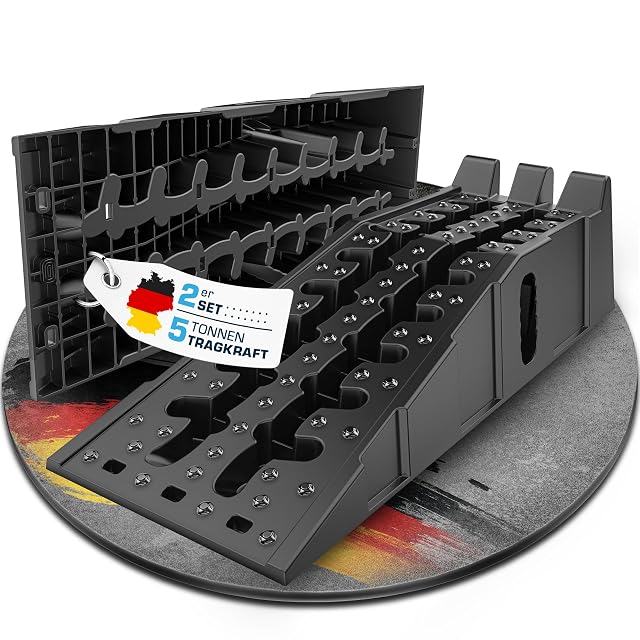
  1. MASKO HDPE ramp pair

    Rated 5 t per set / 2.5 t per ramp stated · HDPE · 22 cm (8.7 in) high, 30 cm (11.8 in) wide · non-slip surface

    A pair of HDPE ramps rated 2.5 t each, 22 cm (8.7 in) high and 30 cm (11.8 in) wide — the plain, light way to get a car high enough for an oil change.

    Best for: An oil change or an underbody inspection on a car with normal ground clearance.
    7.2/10

  2. SELLOGX SXAFR-001 HDPE ramp pair

    Rated 5 t per set stated · UV-resistant HDPE · 90.4 × 30.4 × 21.5 cm (35.6 × 12 × 8.5 in) per ramp · anti-slip profile

    The pair that publishes all three dimensions per ramp, in UV-resistant HDPE — useful if the ramps live outdoors.

    Best for: A car with a low front, where a longer ramp makes the difference.

    7.8/10

  3. WERKTHOR 15P HDPE ramp pair

    Rated 5 t stated · HDPE · 220 mm (8.66 in) high, 300 mm (11.8 in) wide · non-slip surface

    The same HDPE formula as its neighbors at a slightly higher price, with the height and width published and the length left out.

    Best for: A wide-tyred car where width matters more than a shallow approach.

    7.8/10

  4. cartrend 50156 ramp pair with stop

    Rated 1.6 t per pair stated · 17° approach angle · tires to 225 mm (8.86 in) · 20.5 cm (8.1 in) high, 93.5 cm (36.8 in) long · over-run stop

    The only ramp here that publishes an approach angle and a tire width limit — and the only one whose rating, at 1.6 t per pair, has to be read carefully.

    Best for: A light or mid-weight car with tires up to 225 mm (8.86 in), where the published figures can actually be checked.

    8.4/10

Need by need, within car ramps

Supporting a heavy vehicle

The stated capacity has to exceed the weight carried by a wide margin. An overloaded ramp splits with no warning sign.

SELLOGX SXAFR-001

Taking the tire's width

A twenty-centimeter wide ramp lets a two-hundred-and-twenty-five-millimeter tire overhang. The stated platform width is compared with the fitted tire's section.

cartrend 50156

Clearing a low front skirt

A steep ramp catches a bumper before the wheel starts to climb. The stated approach angle decides what can drive up without damage on a lowered car.

cartrend 50156

Who each family suits, across car ramps

Oil changes and engine access
Ramps lift the front in seconds with no jack. It is the quickest thing in a home workshop.
Low vehicle
A low front bumper touches the ramp before the wheels climb it. Shallow-angle ramps exist for that.
Removing wheels
A ramp does not allow a wheel to be taken off, since the vehicle is resting on it. That takes a jack and stands.

What you gain and what you give up, on car ramps

Speed against access to the wheels
Ramps are far quicker than a jack and leave the wheels on the ground. Any work on the wheels or the suspension is beyond them.
Angle against ground clearance
A steep angle climbs higher over a shorter length and blocks low vehicles. Long, shallow-angle ramps settle that point.
Plastic against steel
Composite ramps are light and store away; steel carries more and is heavy. The stated capacity decides, not the material alone.

Frequent questions on car ramps

Do I need to chock after driving up?

Absolutely: parking brake, gear engaged and chocks on the rear wheels. A vehicle can roll back down a ramp on its own.

Can you work under a vehicle on ramps?

Compliant ramps are designed to support the vehicle. Many mechanics nevertheless add stands as redundant safety.

How do I drive up without the ramps sliding?

A slow, steady climb, ramps chocked or held against a wall. Sharp acceleration shoots them forward.

My vehicle is too low, what do I do?

A board placed in front of the ramp reduces the approach angle. Long, shallow-angle ramps are the clean solution.

Can ramps be used on a smooth floor?

They slide all the more. A non-slip mat or bearing against a fixed obstacle is necessary.

Can a wheel be removed?

No: the vehicle is resting on its wheels. A jack and stands are then essential.

Are plastic ramps safe?

If their capacity is respected and they show neither cracks nor deformation. A cracked ramp is scrapped.

Do ramps work on gravel?

No: they sink on one side and the vehicle slips as it climbs. Ramps need a hard, flat, clean surface, and a spreader plate is not enough on soft ground.

What stays with you, on car ramps

Chock the rear wheels once you are up: a vehicle rolls back down a ramp on its own. A slow climb avoids shooting the ramps forward, a board reduces the angle for a low vehicle — and a wheel is never removed on ramps.

Summed up: car ramps

  • Highest figure for rated capacity: WERKTHOR 15P_Ramp (Up to 5 t, stated).

The full table of car ramps

A column is opened only if four tools in five publish its value. Otherwise the table would compare what nobody has measured.

ModelPriceRated capacity
cartrend 50156—1.6 t per pair, stated
MASKO 1—5 t per set — stated as 2.5 t per ramp
SELLOGX SXAFR-001—5 t per set, stated
WERKTHOR 15P_Ramp—Up to 5 t, stated

Our guides on car ramps

Sources, and the way we rank

Specifications: manufacturer sheets for garage tools and the matching Amazon product pages. Prices and availability: Keepa. Every figure in this table names its source.

Most recent revision in this category: September 4, 2026.

The method applied to car ramps