An air impact wrench at 1600 Nm costs less than a cordless one at 800. The catch is the compressor, and specifically its continuous air delivery in liters per minute — the specification that decides whether an air tool works properly or merely turns. Very few listings publish it, which is the recurring problem with this whole category.
The impact wrench: the clearest value in the category
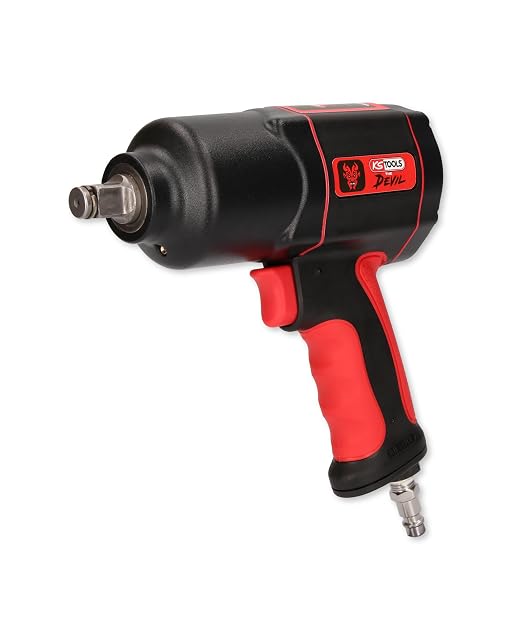
The KS Tools THE DEVIL is stated at up to 1600 Nm with a three-stage torque selector, for the price of a mid-range cordless battery. Its air consumption is not published, which is the question to settle before buying.
The sander: weight is the specification
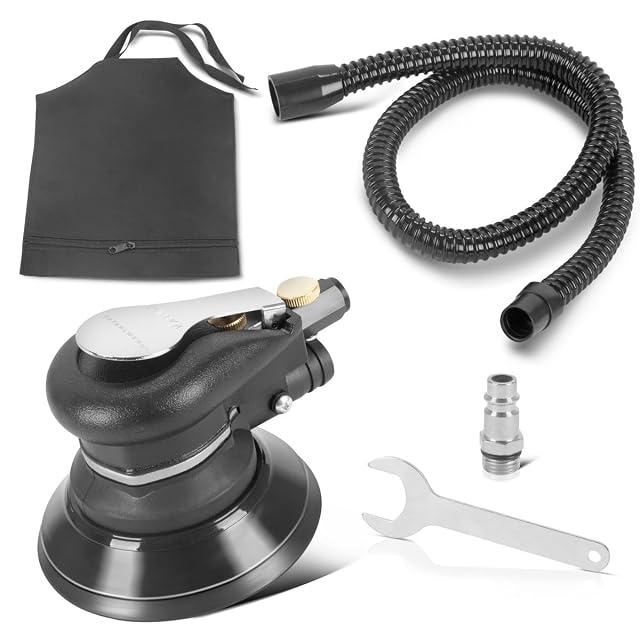
The STAHLWERK DES-125 ST weighs a stated 1 kg (2.2 lb) and runs to 11,000 rpm on a 125 mm (4.92 in) pad. A kilogram held against a door for an hour is the difference between finishing a panel and stopping halfway.
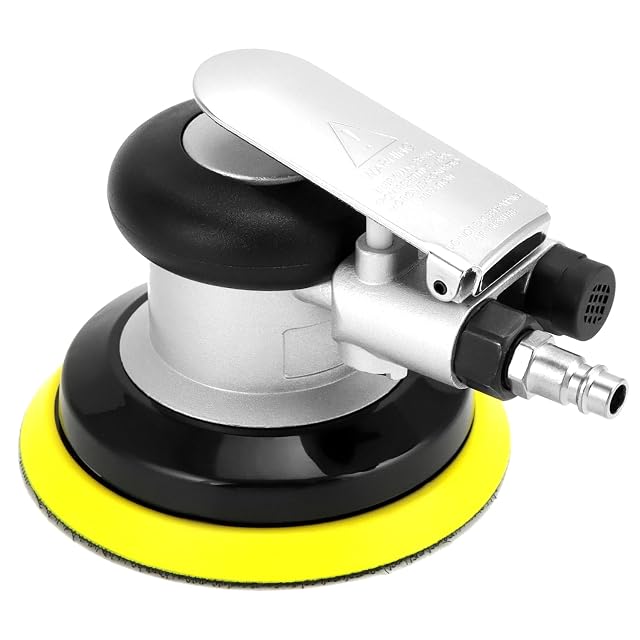
The QWORK 125 mm (4.92 in) publishes what the STAHLWERK does not: a 5 mm (0.20 in) orbit and 12,000 rpm. Five millimeters is a paint-preparation throw rather than a woodworking one.
The spray gun: buy the one that fits your compressor
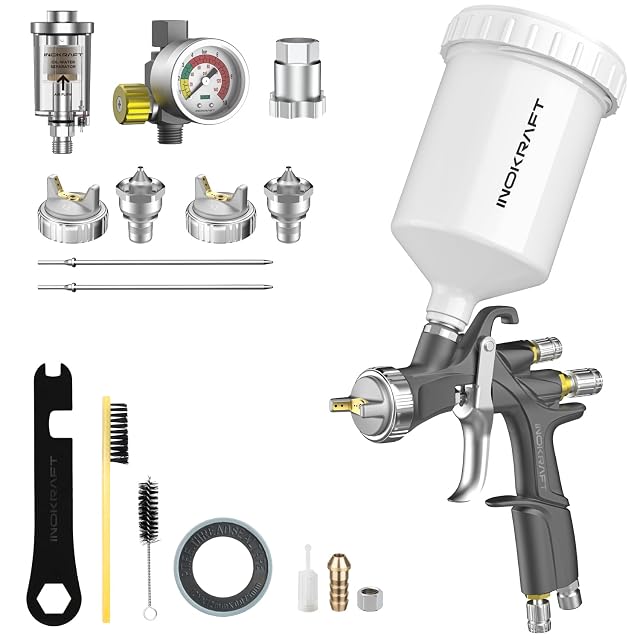
The InoKraft D1 is LVLP and comes with a pressure regulator and an oil and water separator. That is the honest starting kit for a domestic compressor: less air demanded, and the two accessories that most people discover they need afterwards.
The cordless alternative, for comparison
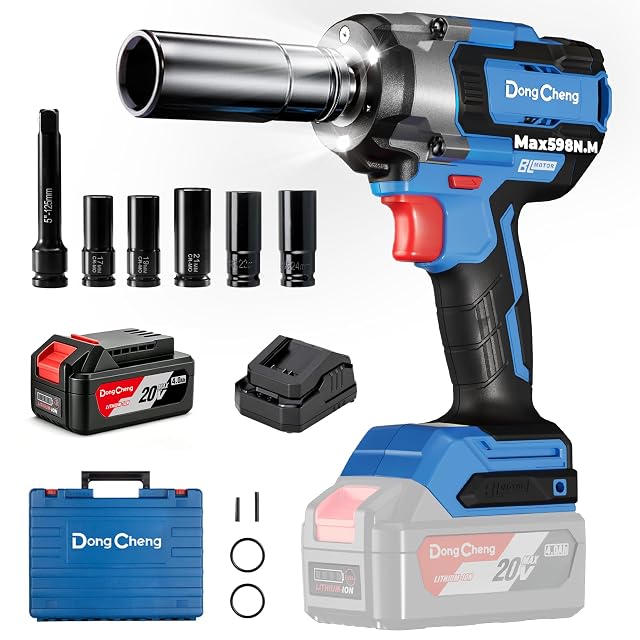
The DongCheng 20 V brushless wrench states 800 Nm, 2.2 kg (4.9 lb) with its battery, and publishes the torque of its individual stages. It costs more per newton-meter and needs no installation at all.
The specification to demand
Liters per minute. It is missing from almost every listing in this guide, and it is the only figure that predicts whether an air tool will work in your garage.
Which tool does the job you have?
You want one impact wrench for wheels
Consider a cordless one instead: it needs no compressor, no hose and no air supply to size.
You want to spray paint or blast
That is where air genuinely wins, and where the compressor has to be sized properly.
You are buying a compressor
Size it on the air consumption of the thirstiest tool you will use, not on the tank volume.
You work in an attached garage
Noise becomes a real constraint, and it is the reason many compressors end up unused.
Picking by the job in hand
Impact wrench
The classic reason people buy a compressor, and increasingly the one where cordless tools have caught up.
Spraying
Where air remains clearly superior, and where air quality — dry and oil-free — matters as much as volume.
Blasting and cleaning
Very high consumption. This is the use that exposes an undersized compressor within a minute.
Inflation and blowing down
Modest demands, and honestly the use that a small compressor handles well.
What to look at first
Air delivery, not tank size
A large tank on a small pump only delays the moment the tool outruns the supply. Delivered air volume at working pressure is the figure that matters.
Duty cycle
Many consumer compressors are not designed to run continuously. A tool that draws air steadily will find that limit quickly.
Air treatment
Compressed air carries water and often oil. A separator and a filter are not accessories for spraying; they are part of the system.
Noise
The specification most often ignored and most often regretted. In a domestic garage this is what decides whether the compressor is used.
Fittings and hose bore
A narrow hose or a restrictive coupler throttles the supply. It is a cheap part of the system that quietly limits everything else.
Which figure for which repair
What you want to do
What it demands
The alternative
Undo wheel bolts
Moderate air
A cordless impact wrench
Spray paint
Steady air, dry and clean
None that is equivalent
Blast
Very high consumption
Send it out
Inflate
Very little
A small inflator
What goes wrong most often
Buying on tank size
The tank is a buffer, not a supply. A big tank with a weak pump gives you a longer first burst and the same problem afterwards.
Ignoring water in the line
Compressed air condenses water, and that water reaches the tool and the work. Draining the tank and fitting a separator is routine, not optional.
Never draining the tank
Water sits in the bottom of a receiver and corrodes it from the inside. A pressure vessel that rusts from within is a genuine hazard.
Underestimating the noise
A compressor cycling in an attached garage is loud enough to end the job early. It is worth checking the figure before buying.
By how much you do yourself
The occasional user
A cordless impact wrench and a small inflator do most of what a compressor was going to be bought for.
The bodywork enthusiast
A properly sized compressor with air treatment. Here there is no cordless equivalent.
The well-equipped garage
Size on the thirstiest tool, treat the air, and put the compressor where its noise is tolerable.
Calibration, storage and working life
A compressor is a pressure vessel with a pump on top, and both parts need attention. The tank corrodes from the inside if it is never drained, and the pump suffers if its intake filter is left blocked.
Drain the tank of condensate regularly: it is the single most important maintenance task.
Keep the intake filter clean; a blocked filter makes the pump work hot.
Check oil level on lubricated compressors, and use the oil the maker specifies.
Inspect hoses and couplers for damage: a whipping air hose is dangerous.
Safety
Compressed air is far more dangerous than it feels, and the tank is a pressure vessel.
Never point an air line at yourself or anyone else: compressed air can penetrate skin.
Drain the receiver regularly and retire a tank showing internal corrosion.
Depressurize the line before changing tools or couplers.
Wear eye protection: blowing down parts sends debris in every direction.
It depends on the tool’s air consumption in liters per minute, and on whether the compressor can supply that continuously rather than in bursts. Ask the seller before assuming — a starved air tool is slow and weak in a way that looks like a fault.
HVLP or LVLP?
HVLP moves a lot of air at low pressure and needs a compressor to match. LVLP is designed for less air, which for a domestic compressor is often the only realistic choice.
Is cordless better?
It is more convenient and more expensive per newton-meter. Air tools are lighter at the head, never run out mid-job, and depend entirely on an installation you may not have.
What size compressor do I need?
Size it on the air consumption of the thirstiest tool you plan to use, at its working pressure. Tank volume only changes how long before the pump has to catch up.
Air or cordless impact wrench?
For wheels alone, cordless is usually the more sensible buy: no compressor, no hose, no air supply to size. Air still wins on sustained heavy work.
Why is there water in my air line?
Because compressing air condenses the moisture it contains. Draining the tank and fitting a separator is how you keep it out of the tool and the work.
How often should I drain the tank?
Regularly, and more often in humid conditions. Water left in a receiver corrodes it from the inside, and that is a safety issue.
Do I need special air for spraying?
You need it dry and free of oil, which means a separator and a filter at minimum. Contaminated air ruins paintwork that took hours to prepare.
Are compressors as loud as people say?
Many are, and it is the specification most often overlooked. In an attached garage it is worth treating noise as a primary criterion.
Adapters, leads and spares from the same aisle, at the price we read. Confirm they suit the tool you choose before ordering: it turns on the connector and the part number, which the product page gives.
Allstar Performance ALL44047 · Tire pressure gauges — 0–30 PSI · 4 in glow face · 14 in hose, 360° swivel chuck · release valve · no accuracy stated
AstroAI T3 · Tire pressure gauges — ANSI B40.1 · ±2 PSI from 80–120, ±3 below 80 · dual-head chuck · 1/4 in quick-connect · −10 to 50 °C (14 to 122 °F)
CAINCAY c-6 · Screw extractors — HSS 4341 stated · 6 extractors in 5 sizes (#0–#4) · double-ended: drill one end, extract the other · magnetic bit holder and socket adapter
Brennenstuhl 1175590100 · Work lights — 200 lm stated · up to 12 h runtime stated · 5 modes · Li-Po 3.7 V / 450 mAh · rechargeable · $32
PacoLit 1 Head · Work lights — 10,000 lm, 72 LEDs · IP66 · cast aluminum and tempered glass · 120° beam · 5 ft cord · 2-year replacement
The tools above are taken from the catalog of this site. Specifications come from the manufacturer and the Amazon product page; prices are what Keepa reported on the date shown, and both move. The order uses declared specifications, the weight of stated strengths against stated limits, and price. No tool here has been used by us on a real job, and nothing here claims it has.
Last checked on
Prices quoted in these summaries are dated readings. The live price is shown next to each product.