An oil change: the four tools, and the method question
The method is not yours to choose: some engines are specified for draining at the sump plug, others for extraction through the dipstick tube, and the manufacturer says which. What is yours to choose is the filter wrench — which depends on the housing — and whether the oil leaves in the same container it arrived in.
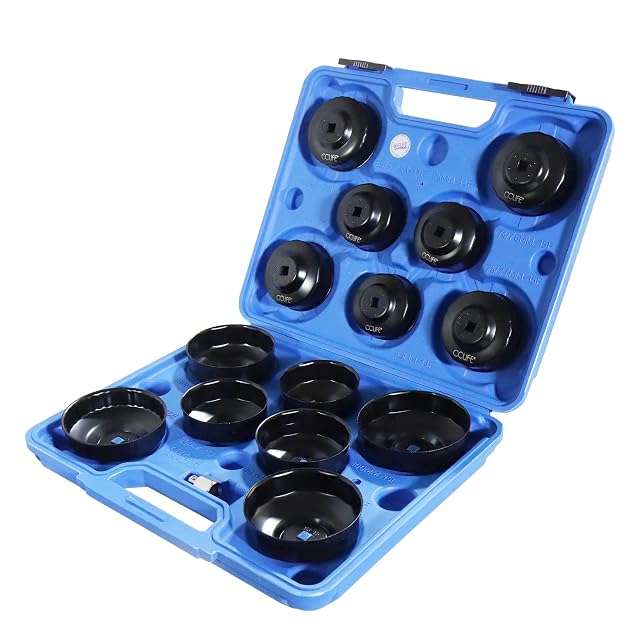
If the housing is plastic, it needs a matched cup. The CCLIFE 15-piece set covers 65 to 100 mm (2.56 to 3.94 in) with both drive adapters — find the size stamped on the housing before ordering, because a cup one size out is useless.
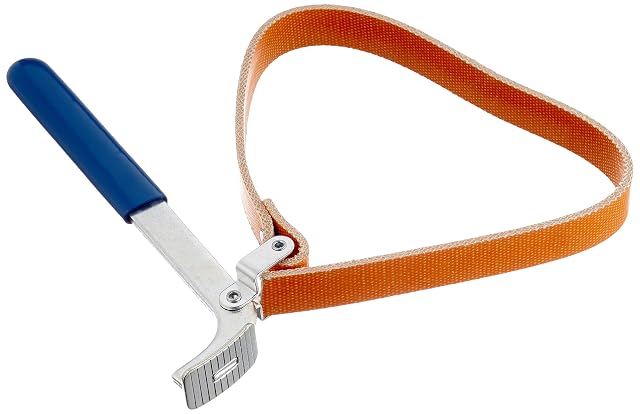
If the filter is a metal spin-on, a strap wrench fits everything. The Mannesmann costs less than the sump plug washer and is the right first purchase.
If the car has an undertray: extraction
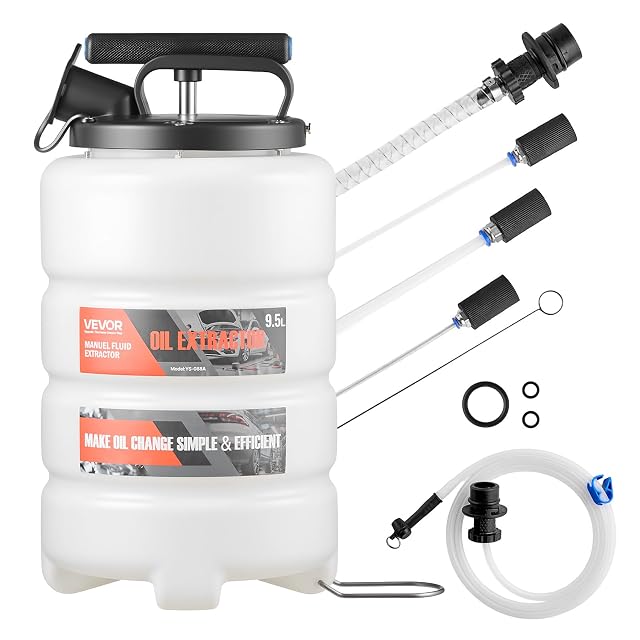
The VEVOR 9.5 l manual extractor needs no power and no compressed air, and its three extension tubes are what get a hose down a narrow dipstick tube. No jacking, no panel removal, no drain plug washer.
If you drain: catch and carry in one container
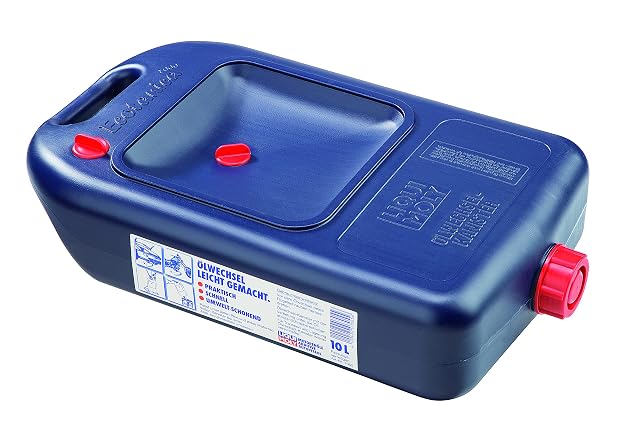
The LIQUI MOLY 10 l canister is 13 cm (5.1 in) tall, sealed, and has a separate breather screw so it pours in a stream rather than glugging. Catching in a tray and pouring into something else afterwards is where driveways get stained.
If you want to know what came out
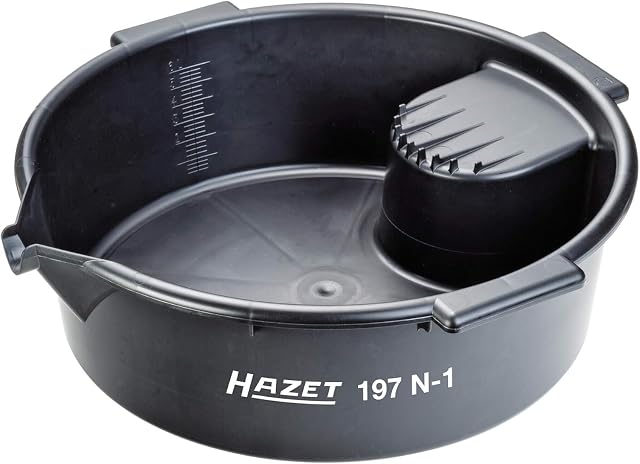
The HAZET 197N-1 has an internal scale in liters and gallons and a molded, anti-slip rest for the filter. Comparing what drained against the capacity in the handbook is a free diagnostic.
Afterwards
Take the oil to a collection point in the container it drained into, and reset the service counter if the car has one — several scanners on this site do it.
Which tool does the job you have?
You want to drain from below
You need lifting and support equipment first: the tools for the oil itself are the cheap part.
Your car has a top-mounted filter housing
An extractor and a cap socket may be all you need, with no lifting at all.
Your filter is a spin-on canister
A filter wrench matched to its diameter, because a strap or chain slips on a tight one.
You want the least mess
The drain pan and the funnel matter more than any tool: this job is judged on what ends up on the floor.
Picking by the job in hand
Draining from the sump
The conventional method. It needs the car raised and supported, a drain plug socket and a pan wide enough to catch a moving stream.
Extracting through the dipstick tube
Possible on many engines, and it avoids lifting the car entirely. Whether it removes as much oil depends on the sump design.
Changing a cartridge filter
Usually a plastic housing accessed from above with a dedicated cap socket. The wrong size rounds the housing, which is an expensive lesson.
Changing a spin-on filter
A cap or band wrench sized to the filter. Access is often the problem rather than force.
What to look at first
The drain plug socket and its condition
Drain plugs are soft and often overtightened by whoever went before. A well-fitting six-point socket is the difference between an easy job and a drilled plug.
Filter wrench type and size
Cap wrenches fit one diameter and grip properly; band and chain wrenches are universal and slip on tight filters. Matching the size is worth the extra tool.
Drain pan capacity and shape
It must hold more than the sump contains and be low enough to fit under the car. A pan with a sealed pouring spout also solves the disposal problem.
A new sump plug washer
Most plugs use a crush washer that is designed to deform once. Reusing it is the commonest cause of a slow drip after an otherwise good job.
A funnel that reaches
Filler necks are often buried. A long or flexible funnel is a small thing that decides whether oil ends up in the engine or on the manifold.
Which figure for which repair
Your engine
The method
The specific tool
Sump plug, filter below
Drain from below
Plug socket and filter wrench
Cartridge filter on top
Extract or drain
Cap socket of the right size
Awkward access
Extraction through the dipstick
A pump and a tube that fits
Any
Refilling
A funnel that reaches the neck
What goes wrong most often
Reusing the sump plug washer
Crush washers are designed to deform once and seal. Reused, they weep, and the drip is blamed on the plug or the thread.
Overtightening the drain plug
Sumps are often aluminum and the thread strips easily. There is a torque figure for this, and it is lower than instinct suggests.
Starting the engine before checking the level
A filter fitted dry or a plug not fully seated shows itself in the first seconds. Checking before starting, and again after, catches both.
Oiling the filter seal and then overtightening it
A spin-on filter is tightened by hand to the point of contact plus the turn the maker specifies. Using a wrench to fit one makes the next change far harder.
By how much you do yourself
The first oil change
Lifting equipment, a plug socket, the right filter wrench, a wide pan and a new washer. That is the whole list.
The no-lift approach
An extractor, if your engine suits it, and a cap socket for a top-mounted filter. Quick and clean, with the level of oil removed as the trade-off.
The regular servicer
Keep a stock of washers and the correct cap socket for your engine: those two items are what turn a job into a routine.
Calibration, storage and working life
The tools for this job are simple; what needs attention is disposal and cleanliness. Used oil and filters are hazardous waste, and a pan left dirty contaminates the next change.
Take used oil and filters to a proper collection point: they must never go to drain or to household waste.
Clean the drain pan and store it covered, so grit does not settle in it.
Wipe the plug socket and filter wrench: oil holds grit that scores fasteners.
Keep a supply of the correct crush washers with the tools, not in a drawer elsewhere.
Safety
Hot oil, a raised vehicle, and a waste product that is harmful to handle and to dispose of badly.
Let the engine cool enough that the oil is warm rather than hot: draining scalding oil onto your forearm is the classic injury.
Never work under a car supported only by a jack.
Wear gloves: used engine oil is an irritant and prolonged skin contact is best avoided.
Dispose of oil and filters at an authorized collection point, never down a drain.
It depends on the engine, and the manufacturer decides. Some specify extraction and design the sump for it; others specify draining. Where both are allowed, extraction wins on convenience and draining on completeness.
Which filter wrench do I need?
A cup for a plastic cartridge housing — anything else cracks it — and a strap, claw or pliers for a metal spin-on filter. The size and flute count are printed on the housing you are about to remove.
How hot should the engine be?
Warm rather than hot. Warm oil flows and carries what has settled; cold oil leaves more behind and makes a working pump look broken.
Do I have to lift the car?
Not always: some engines allow extraction through the dipstick tube. Whether it removes as much oil as draining depends on the sump shape.
How tight should the drain plug be?
To the manufacturer’s torque figure, which is lower than most people assume. Aluminum sumps strip easily and the repair is disproportionate.
Can I reuse the washer?
Better not. Crush washers are made to deform once; a reused one is the usual cause of a slow weep afterwards.
Hot or cold oil?
Warm. Hot oil drains well but burns, and cold oil leaves more behind. A short run and then a wait is the practical compromise.
How tight should a spin-on filter be?
Hand tight to contact, then the additional turn printed on the filter. A wrench is for removal, not for fitting.
Where does the old oil go?
To an authorized collection point, with the old filter. It is hazardous waste and must never go down a drain or into household rubbish.
Adapters, leads and spares from the same aisle, at the price we read. Confirm they suit the tool you choose before ordering: it turns on the connector and the part number, which the product page gives.
CAINCAY c-6 · Screw extractors — HSS 4341 stated · 6 extractors in 5 sizes (#0–#4) · double-ended: drill one end, extract the other · magnetic bit holder and socket adapter
Brennenstuhl 1175590100 · Work lights — 200 lm stated · up to 12 h runtime stated · 5 modes · Li-Po 3.7 V / 450 mAh · rechargeable · $32
PacoLit 1 Head · Work lights — 10,000 lm, 72 LEDs · IP66 · cast aluminum and tempered glass · 120° beam · 5 ft cord · 2-year replacement
Aohoo Q1-T25X-BELB · Trim removal tools — 280 pieces · 11 removal tools · full clip and wedge range · stated professional set
Bojo ATH-I7-INTERIOR · Trim removal tools — 7 pieces · heavy-duty nylon, chemical resistant · fork tip for fir-tree clips · tips for most standard clip sizes · plastic toolbox case
The tools above are taken from the catalog of this site. Specifications come from the manufacturer and the Amazon product page; prices are what Keepa reported on the date shown, and both move. The order uses declared specifications, the weight of stated strengths against stated limits, and price. No tool here has been used by us on a real job, and nothing here claims it has.
Last checked on
Prices quoted in these summaries are dated readings. The live price is shown next to each product.