Brake tools: what the job needs, and where this site stops
Brake work is where this site describes tools and hands over to the workshop manual. Fluid specification, bleeding sequence and every torque value come from the vehicle manufacturer. What follows is the equipment, and the one electronic limitation that catches people out.
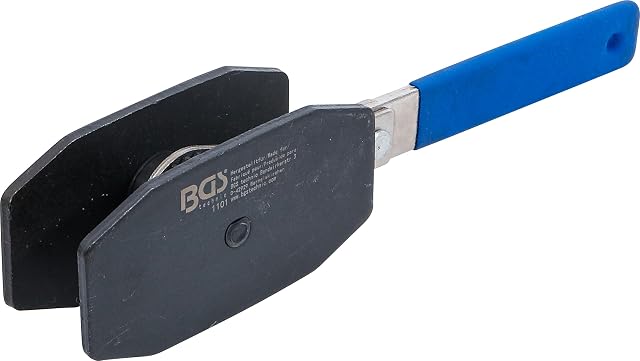
The BGS 1101 ratchets the piston back squarely, which is what protects the seal and the bore. A G-clamp pushes off-center against the pad backing plate, and a piston pushed at an angle scores its bore.
For rear calipers: a rewind set with both spindles
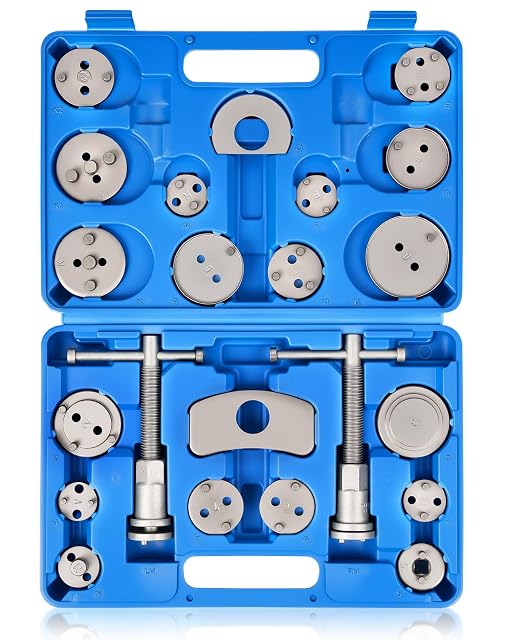
The DAYUAN 22-piece set has eighteen adapter plates and both a right-hand and a left-hand threaded spindle. Rear pistons do not all wind the same way, and a single-direction set fits half the cars it claims to.
For bleeding, if the cap fits: pressure
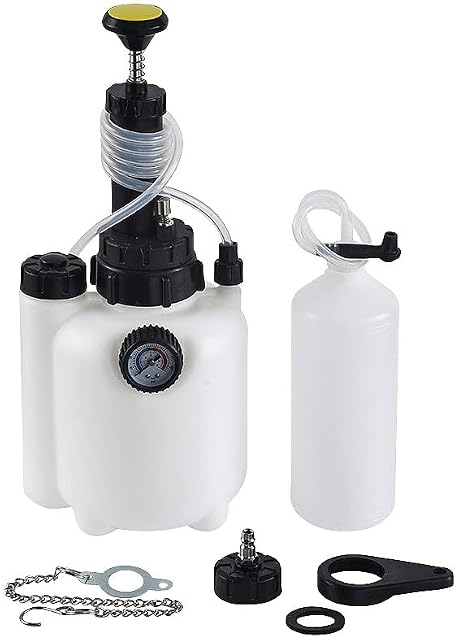
The AGT 3 l bleeder names its adapter — E20 at 45 mm (1.77 in) — which is the fitting most European reservoirs use and the only compatibility question a pressure bleeder has. It comes with a 1 l collection bottle as well as the pressure vessel.
For bleeding any car: vacuum, with a compressor
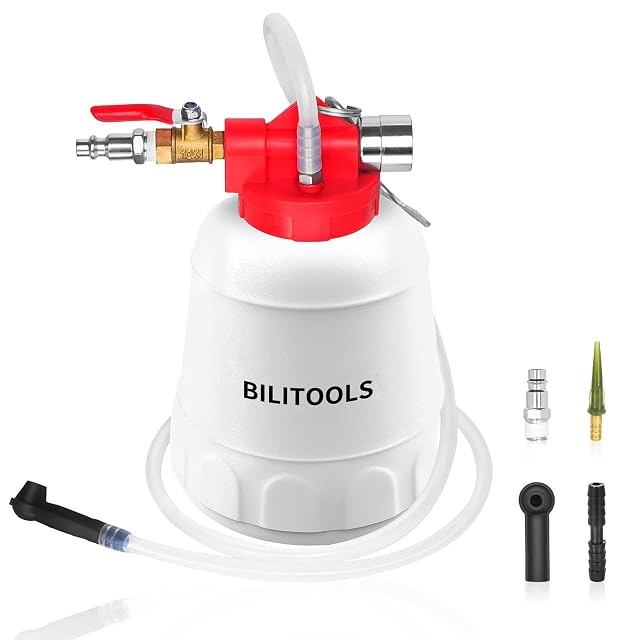
The BILITOOLS 1 l pneumatic bleeder needs no reservoir cap at all — it draws at the nipple, so it fits everything. Expect bubbles that never stop: they arrive past the nipple threads, and a smear of grease reduces them.
Before any of it, on a modern car
The LAUNCH CRP123X reaches the rear caliper motors on cars with an electronic parking brake. That retraction is a manufacturer procedure, and it happens before the mechanical tools come out.
Where this guide ends
At the tool. Sequence, fluid specification and torque values are published by the vehicle manufacturer, and brakes are not the place to improvise.
Which tool does the job you have?
You are changing pads only
A caliper piston tool, a torque wrench and the right sockets cover it on most cars.
The rear calipers have an integrated handbrake
The piston has to be wound in, not pushed. A press alone will damage it.
You are opening the hydraulic system
You add bleeding to the job, and that changes the risk level entirely.
The car has an electric parking brake
The calipers usually need a diagnostic tool to retract. Without it, the job cannot be completed.
Picking by the job in hand
Pad replacement
The commonest brake job, and the one most within reach. The specific tools are the piston retractor and a torque wrench.
Disc replacement
Adds a carrier bolt, often very tight and sometimes seized. A breaker bar and penetrating fluid become the real tools.
Bleeding
Needed whenever the hydraulic system is opened. A one-person bleeder or a helper, and a clear procedure.
Seized guide pins
The hidden part of most brake jobs. Cleaning and regreasing the slides is what actually restores braking, and it needs almost no tools.
What to look at first
The right piston tool for your calipers
Front pistons are usually pushed straight back; many rear pistons with an integral handbrake must be rotated as they retract. Using the wrong one damages the seal or the adjuster.
A torque wrench in the right range
Caliper and carrier bolts have specified torques, and they are load-bearing. This is not a place for feel.
Access to the correct fasteners
Brake fasteners are often Torx, triple square or hex rather than hexagonal. A missing bit ends the job at the first bolt.
A means of bleeding
If the system is opened, air has to come out. A one-person bleeder makes this feasible alone; without one, you need a helper and a method.
Cleaning and lubrication supplies
Brake cleaner and the correct high-temperature grease for slides and shims. The wrong grease attacks rubber boots and causes the problem it was meant to prevent.
Which figure for which repair
The job
The specific tool
The trap
Front pads
Piston press
Overflowing the reservoir
Rear pads with handbrake
Wind-back tool
Pressing instead of winding
Electric parking brake
Diagnostic tool
No retract, no job
Discs
Breaker bar, penetrating fluid
Seized carrier bolts
What goes wrong most often
Pressing a wind-back piston
On rear calipers with an integral handbrake, the piston is on a threaded adjuster. Forcing it in damages the mechanism, and the handbrake never works properly again.
Ignoring the fluid reservoir
Retracting pistons pushes fluid back up the system. If the reservoir was topped up over worn pads, it overflows, and brake fluid strips paint.
Skipping the guide pins
Most uneven pad wear comes from seized slides, not from bad pads. Fitting new pads onto a seized caliper wastes the parts.
Reusing single-use fasteners
Some caliper and carrier bolts are stretch bolts meant to be replaced. The manual says so, and it is the sort of instruction that is worth following on brakes.
By how much you do yourself
The first brake job
Pads on the front, with a piston press, a torque wrench and the right bits. A well-bounded job with a clear result.
The complete refresh
Discs and pads, with a breaker bar, penetrating fluid and new fasteners where specified.
The modern car
Check for an electric parking brake before starting. Without the means to retract it, the rear brakes are simply not a home job.
Calibration, storage and working life
Brake tools live in a dusty, salty environment and are used on fasteners that seize. Keeping them clean matters less than keeping the right greases separate, because using a petroleum grease on a rubber boot destroys it.
Keep brake-specific grease clearly separate from general-purpose grease.
Clean piston tools after use: brake dust and fluid together corrode.
Replace worn Torx and triple-square bits before they round a bolt head.
Check bleed nipple caps are present: a missing cap is why the nipple seizes.
Safety
Brakes are a safety system, and a mistake here is not recoverable at the roadside.
Never let the fluid reservoir run dry while bleeding: air in the system means no brakes.
Torque caliper and carrier bolts to the manufacturer’s figures, and replace stretch bolts.
Brake fluid damages paint and skin: rinse spills immediately with water.
Press the pedal repeatedly to seat new pads before moving the car, and test brakes at low speed first.
The tool where the update policy is the headline: LAUNCH states lifetime free updates on a four-system scanner with a touchscreen and seven service resets.
Best for: Someone who works on several cars, or on one car with an ABS light.
A front caliper almost always presses straight back. Many rear calipers thread back because the parking brake works through them. If the piston face has slots or pins, it winds.
What about an electronic parking brake?
The caliper motor has to be retracted with a diagnostic tool before anything mechanical happens. No rewind set substitutes for it, and forcing the piston damages the actuator.
Pressure or vacuum bleeding?
Pressure pushes fluid down from the reservoir and gives the cleanest result where the adapter cap fits your car. Vacuum draws from the nipple, fits every car, and pulls air past the nipple threads — which looks like a bubble that never clears.
Can I do brakes without a torque wrench?
You should not. Caliper and carrier bolts carry braking loads and have specified figures; guessing risks both stripped threads and loose fasteners.
Why will my rear piston not push back?
Because it is almost certainly on a threaded adjuster for the handbrake and must be wound in while pressing. Forcing it destroys the mechanism.
Do I need to bleed after changing pads?
Not if the hydraulic system was never opened. Retracting the pistons pushes fluid back but does not introduce air.
What about an electric parking brake?
Its calipers usually need a diagnostic tool to enter service mode and retract. Without that, the rear brakes are not a home job on that car.
Do discs always need replacing with pads?
No, but they need checking against the minimum thickness stamped on them, and for scoring or lipping. Worn discs undo the benefit of new pads.
Why did my new pads wear unevenly?
Almost always seized caliper slides. Cleaning and regreasing the guide pins is part of the job, not an optional extra.
Adapters, leads and spares from the same aisle, at the price we read. Confirm they suit the tool you choose before ordering: it turns on the connector and the part number, which the product page gives.
CAINCAY c-6 · Screw extractors — HSS 4341 stated · 6 extractors in 5 sizes (#0–#4) · double-ended: drill one end, extract the other · magnetic bit holder and socket adapter
Brennenstuhl 1175590100 · Work lights — 200 lm stated · up to 12 h runtime stated · 5 modes · Li-Po 3.7 V / 450 mAh · rechargeable · $32
PacoLit 1 Head · Work lights — 10,000 lm, 72 LEDs · IP66 · cast aluminum and tempered glass · 120° beam · 5 ft cord · 2-year replacement
Ansbell CNBJ · 12 V circuit testers — 6–36 V DC · backlit LCD, ±0.2 V stated · 14.7 ft lead · overload buzzer · built-in LED light · continuity and polarity
BGS 723 · 12 V circuit testers — 3–48 V · diode test lamp with LED indication · piercing function for insulated cables · $33
The tools above are taken from the catalog of this site. Specifications come from the manufacturer and the Amazon product page; prices are what Keepa reported on the date shown, and both move. The order uses declared specifications, the weight of stated strengths against stated limits, and price. No tool here has been used by us on a real job, and nothing here claims it has.
Last checked on
Prices quoted in these summaries are dated readings. The live price is shown next to each product.