What you are getting
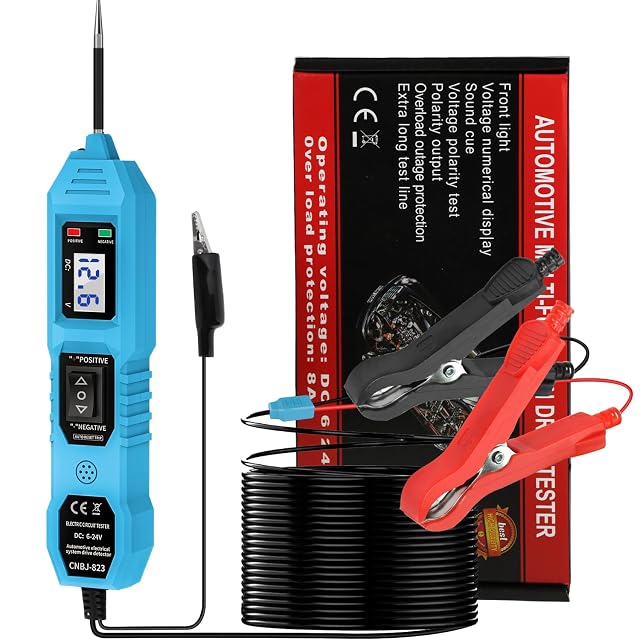
A circuit probe for 6 to 36 V DC with a backlit LCD stated accurate to ±0.2 V, a 14.7-foot flexible extension cord, red and black battery clips, a built-in LED light, a buzzer that sounds on overload, and stated detection of short circuits, open circuits, bad grounding and abnormal voltage, plus continuity and polarity. $17.99.
“Equipped with a backlit high-definition LCD screen, it provides real-time and accurate voltage readings with a margin of error as low as ±0.2V — making even small voltage fluctuations easy to detect.”
| Tool | Figure published | What kind |
|---|
| This tester | ±0.2 V | accuracy |
| WINAMOO ×2 | 0.1 V | resolution |
| XENIVO · VIREVO | 0.01 A | resolution |
| FEAOXYO · Qwork · BGS · Kaisal · Xastro, published · CrysGuard | none | — |
That distinction decides what a reading is worth. Resolution is the smallest step a display shows; accuracy is how close that step is to the truth. A tester with 0.1 V resolution and unstated accuracy can show 12.4 V on a 12.0 V circuit all day.
±0.2 V is the figure that makes a voltage drop measurable. A healthy earth or a healthy switch drops well under 0.2 V; a corroded one drops half a volt or more. This is the only tool on this shelf whose published specification lets you tell those apart — which is, in practice, the most useful thing a 12 V tester does.
And the lead is fourteen and a half feet, which is the longest here
“With a 14.7ft flexible extension cord, you can reach the front engine bay or rear trunk with ease — test multiple areas without repositioning your battery connections.”
14.7 feet is 4.48 meters. The introduction asks for exactly this: “the lead length to reach a battery from a rear light.”
| Tool | Lead length |
|---|
| This tester | 14.7 ft (4.48 m) |
| WINAMOO WITL111A | 96 in (2.44 m) |
| FEAOXYO | 39 in (0.99 m) |
| CrysGuard · WINAMOO WITL111B · the four published testers | not published |
Three of the eleven tools on this shelf publish a length, and this is twice the next one. Four and a half meters reaches from a battery under a bonnet to a tail light on a saloon, which is the whole reason the figure matters: the alternative is moving the clip, which means climbing back out and starting again.
The buzzer is a function nothing else on this shelf has
“If an overload is detected, the buzzer will sound immediately to alert you — helping protect both your battery and the tester.”
An audible overload warning is unusual on a tool this simple, and it covers the mistake this kind of probing actually produces: a probe that touches a live feed and an earth at the same time. A light you may not be looking at; a buzzer you cannot miss, and your hand moves before the tester does.
The built-in LED light is the other practical inclusion: “allows for hassle-free testing in dark environments or tight spaces”. The VIREVO draw tester here is the only other tool on this shelf with one.
The introduction’s third requirement: “whether the tool also reads continuity on a dead circuit.”
“Simply touch the probe to a circuit point to check continuity, voltage status, and polarity.”
Two of the eleven tools publish continuity: this, and the CrysGuard tracer with its named CONT mode. The published Qwork page records the absence as a reserve — “no continuity function”.
Continuity is how an open circuit is found. A dead circuit tested with a lamp tells you only that it is dead; continuity across the suspect length tells you whether the wire is intact.
Polarity is the third function, and the published Kaisal page explains its value: polarity indication “removes the most common confusion when probing an unfamiliar loom”.
The procedure is published, which is rare on this shelf
“Connect the red clip to the battery’s positive terminal and the black clip to the negative. Once powered on, the voltage value will instantly appear. Simply touch the probe to a circuit point to check continuity, voltage status, and polarity.”
Four steps, in order, with what to expect at each. Of the eleven tools on this shelf, this is the only listing that sets out how to use the tool — the rest list features.
It also tells you what kind of instrument it is: a tester powered from the battery through its own clips, which is how it can light an LCD and sound a buzzer without an internal cell. The trade is that it must be clipped to a battery before it reads anything.
But the voltage range is published twice, differently
The title and the first bullet say 6V/12V/24V DC. The last bullet says “Wide Compatible with 6V–36V DC systems”.
Six to thirty-six volts covers 6 V classics, 12 V cars, 24 V trucks and the 36 V end of some auxiliary systems; 6, 12 and 24 V is a list of three nominal systems. The two statements are not contradictory — 36 V is the ceiling and 6, 12 and 24 are the systems — but they are two different claims about the same tool, and the broader one is in the smaller print.
On this shelf the ranges run from the published Xastro tester’s 3–24 V to the WINAMOO WITL111B’s 3–120 V. Starting at 6 V means the 3 V sensor and signal circuits two other tools here reach are below it.
What is not published
No lamp, incandescent or LED, which is what the shelf’s first paragraph is about — this is a digital reader, so it will not prove a circuit can carry a load. No probe tip description: whether it back-probes or pierces is not stated, and the buying advice wants the former. No current measurement, which the XENIVO and VIREVO testers here provide. No overload threshold for the buzzer. No resolution, only the accuracy. No case.
At $17.99 it is the only tester on this shelf whose reading has a published tolerance, and the only one you can clip up once and walk the length of the car with.
Availability
On sale at around $18 on the American Amazon store at the time of checking.
Prices and availability are what Keepa reported on the date this page was updated; both move.
Prices quoted in this text were read on 6 October 2026. The live price is at the top of the page.