The last word Fits any car, needs a compressor. The threads are where the bubbles come from.
What lands on the bench
A one liter pneumatic vacuum bleeder that connects to the bleed nipple and to a compressor at 6 to 12 bar.
The advantage over pressure bleeding
No adapter cap. Pressure bleeders live or die on whether the cap seals your reservoir; a vacuum bleeder connects to the nipple, and every car has one of those.
The disadvantage, stated plainly
Air past the threads. It looks exactly like air coming out of the system and it is not, which is the single most confusing thing about vacuum bleeding. Grease on the threads helps.
What has not changed
Keep the reservoir full, and follow the manufacturer’s sequence and fluid specification.
Availability
On sale at around $27 on the American Amazon store at the time of checking.
Prices and availability are what Keepa reported on the date this page was updated; both move.
Prices quoted in this text were read on 4 September 2026. The live price is at the top of the page.
What it does, and what it misses
Strengths
No reservoir adapter means no compatibility question — it fits every car
Hands-free once connected, so the job is genuinely one-person
A one liter bottle is enough for a full fluid change on a car
Compromises
Needs a compressor at 6–12 bar, which this site does not cover
Vacuum draws air past the nipple threads, which looks like an endless bubble
Smaller capacity than the pressure bleeders here
Specifications
Capacity
1 l collection bottle, stated
Method
Vacuum at the bleed nipple; no reservoir cap needed, stated
Air supply
Compressor at 6–12 bar, stated
Operation
One person, hands-free once hung in place, stated
Stated safety
Even suction at the nipple, described by the maker as ABS-safe
Amazon reference
B0FNWW7CGB
EAN
6974676372737
The questions that reach us
Why do bubbles never stop with a vacuum bleeder?
Because air is drawn past the threads of the bleed nipple itself, not out of the brake line. A smear of grease on those threads reduces it dramatically — and it is why pressure bleeding gives a cleaner picture.
Do I still have to top up the reservoir?
Yes, constantly. Vacuum bleeding empties the master cylinder as fast as anything else, and running it dry means starting again.
Our score
8.1/ 10
Fits any car, needs a compressor. The threads are where the bubbles come from.
This one’s price among garage tools
A reference exists on these Amazon stores: France, Germany, Italy, Spain, United Kingdom, United States. Listed is not the same as in stock — availability changes daily.
Details checked on September 4, 2026.
Who should pick this one, among garage tools
A garage with a compressor, and any car whose reservoir cap is unusual.
Amazon reports what buyers took in the month before this page was last checked: at least 600.
The figure is a floor, rounded by Amazon, and read through Keepa — it says what buyers picked, not what a maker claims.
Sources
Specifications: the manufacturer sheet for garage tools and the matching Amazon product page. Prices and availability: Keepa. Every figure on this page names its source.
3 l pressure vessel · manual pressure system · integrated gauge · one-person operation stated
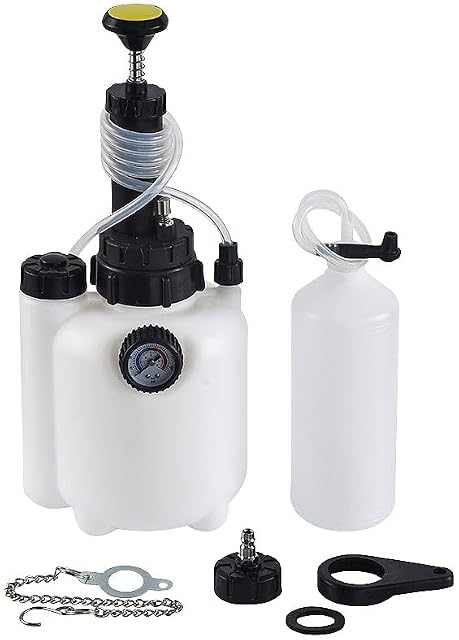
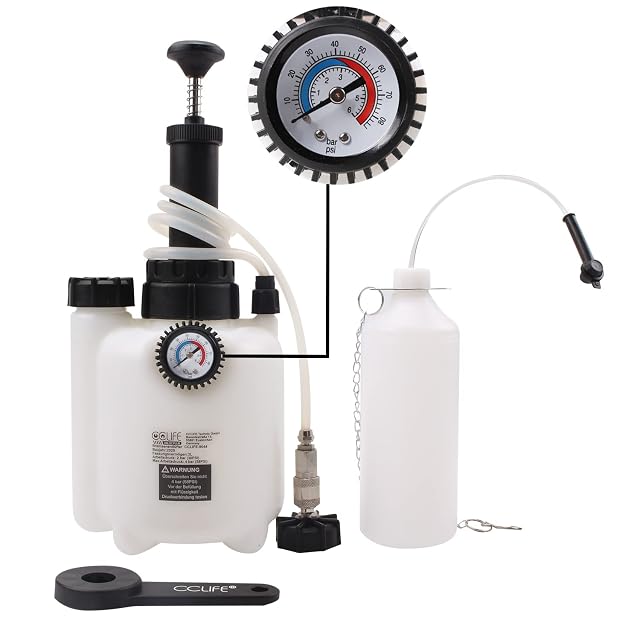
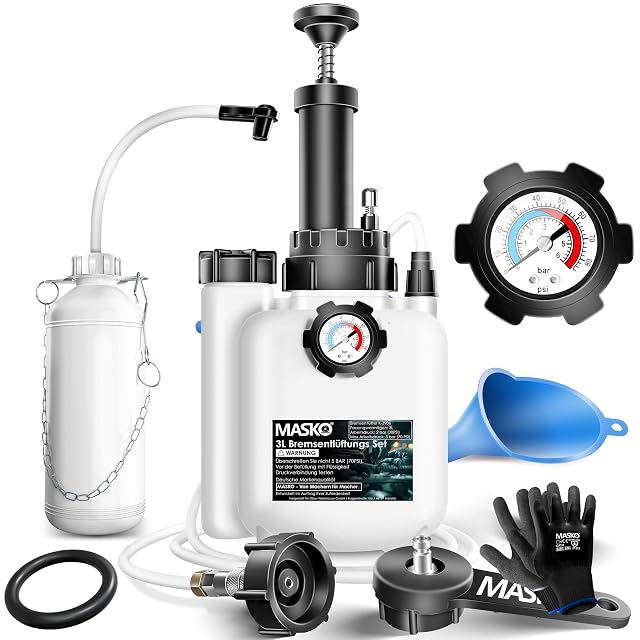
A 3 liter manual pressure bleeder with a gauge: fluid is pushed down from the reservoir, which is the method that gives the most consistent result alone.
Best for: Bleeding brakes alone, on a car whose reservoir the supplied cap fits.