The first diagnostic tool: reader, dongle or scanner
Every petrol car sold in the EU since 2001 and every diesel since 2004 has the same 16-pin socket, so reading an engine code is not what separates these tools. What separates them is which systems they reach past the engine, whether they can reset a service counter, and what the updates cost after the first year.
The question to answer first: is the warning light an engine light, or something else?
If you only need engine codes: a wired reader
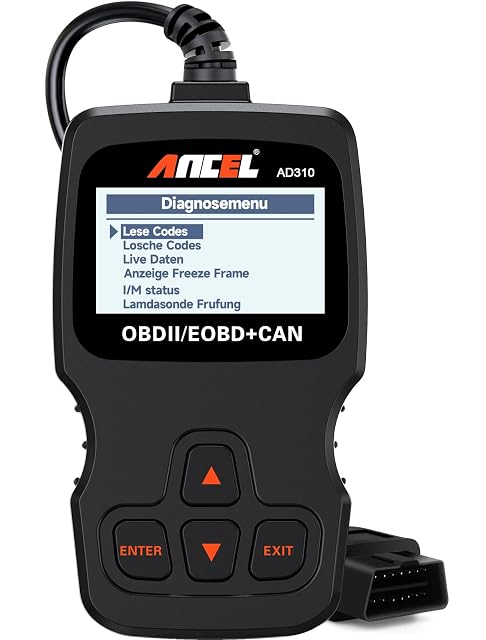
The ANCEL AD310 states its own limits in its first bullet point — no ABS, no airbag, no SRS — and names the pre-2004 vehicles it does not support. It draws power from the socket, has no battery and no app, and its thick cable is the part that survives a decade.
If you already reach for a phone: an adapter
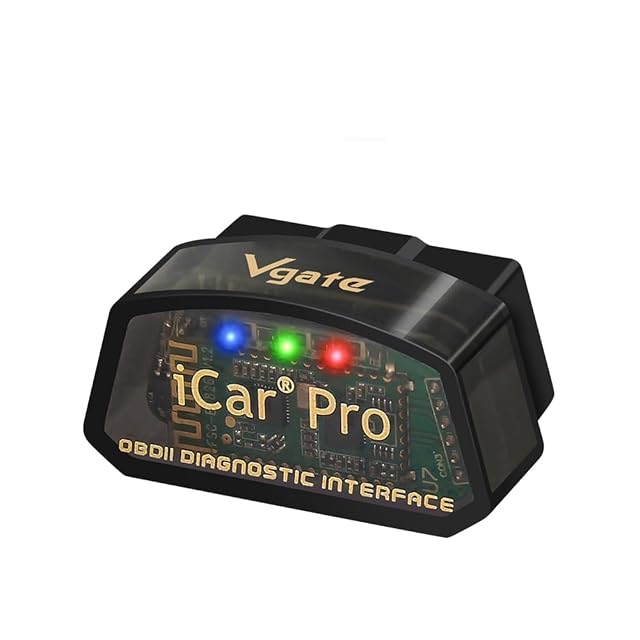
The Vgate iCar Pro is Bluetooth Low Energy, which is what makes an adapter work with an iPhone at all — ordinary ELM327 clones pair with Android and are invisible to iOS. It states a power-saving mode, which is the specification that decides whether it can be left plugged in. The app is a separate purchase.
If you want to reset things: a service-capable tool
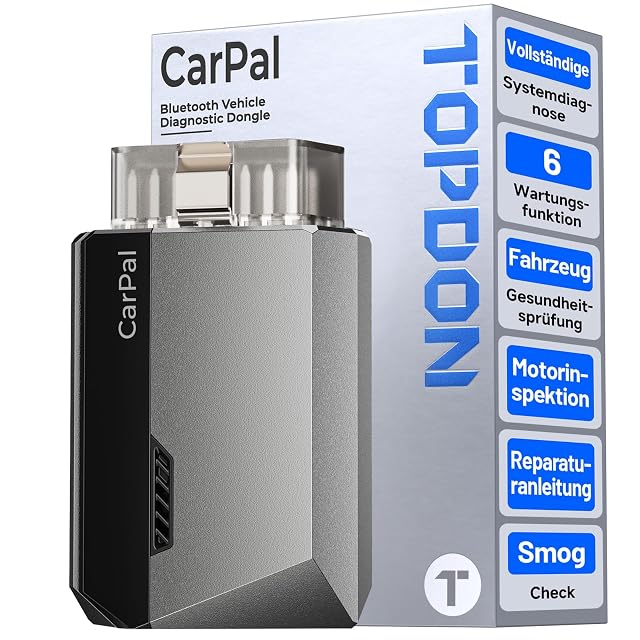
The TOPDON CarPal-A adds six reset services and a scan across vehicle systems, driven from a phone rather than a screen. That is the step from reading a fault to closing a service interval.
If the light is not an engine light: a four-system scanner
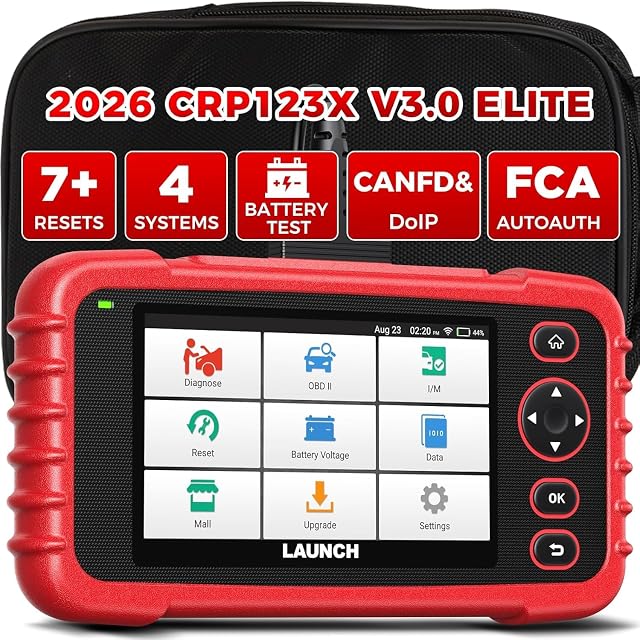
The LAUNCH CRP123X reaches engine, ABS, airbag and transmission, graphs four live parameters at once, and states lifetime free updates. On a car with an ABS light, everything above it is silent — and silence looks exactly like “no fault found”.
What none of them do
Tell you what is wrong. A code names a circuit and a symptom; the cause is still an open question when the code is on the screen.
Which tool does the job you have?
You just want to read a warning light
A basic code reader answers that, and it is the cheapest useful tool in the garage.
You want to know why the code appeared
You need live data, because a code names a circuit, not a cause.
Your car is more than a decade old
Check the protocol it uses: coverage on older vehicles varies a great deal between tools.
You want manufacturer-level access
That usually means a brand-specific tool or software, and a very different budget.
Picking by the job in hand
Reading and clearing a light
The starting point, and the reason most people buy one. Clearing without understanding is where it goes wrong.
Live data while driving
Where a diagnostic tool earns its keep: a sensor that reads plausibly at idle can be obviously wrong under load.
Pre-purchase checks
Reading readiness monitors and stored codes on a car you are considering. A cleared memory just before viewing is itself information.
Emissions readiness
Useful before a test: readiness monitors tell you whether the car has completed its self-checks since the last reset.
What to look at first
Whether it reads more than engine codes
Basic readers only see the emissions-related engine system. ABS, airbag and transmission faults need a tool that explicitly covers them.
Live data, and how it is displayed
A list of numbers is far less useful than a graph. Reading a sensor’s behavior over time is what turns a code into a diagnosis.
Vehicle coverage
Coverage varies by make, model and year, especially outside the engine system. The maker’s coverage list is worth reading before buying.
Updates and their cost
Some tools receive free updates, others charge annually. Over several years that changes the real cost more than the purchase price.
Wired or wireless
A dongle plus phone is compact and cheap; a standalone unit does not depend on an app that may stop being supported.
Which figure for which repair
What you want
The tool
The limit
Read a warning light
Basic code reader
Says which circuit, not why
Diagnose a fault
Live data with graphing
Needs interpretation
ABS or airbag codes
A tool that covers them
Coverage varies by car
Manufacturer functions
Brand-specific tool
Cost and complexity
What goes wrong most often
Clearing the code and driving away
Clearing removes the evidence and resets the readiness monitors. If the fault is real, the light returns, and you have lost the freeze-frame data that would have helped.
Replacing the part the code names
A code for an oxygen sensor circuit often means a wiring or exhaust leak problem, not a failed sensor. The code names a circuit, and the diagnosis is separate work.
Assuming coverage
A tool that reads engine codes on everything may read nothing else on your car. Coverage beyond the emissions system is the thing to verify before buying.
Ignoring freeze-frame data
The snapshot stored when the code set tells you the conditions: temperature, load, speed. It is often more useful than the code itself.
By how much you do yourself
The light-on-the-dash owner
A basic reader is enough to know whether you are dealing with something urgent or a loose fuel cap.
The owner who fixes things
Live data with graphing, and coverage for ABS and airbag on your specific car.
The buyer
Any reader that shows readiness monitors, used before money changes hands.
Calibration, storage and working life
A diagnostic tool needs almost no physical care, but it does need its software kept current and its connector kept clean. A tool left plugged in can also drain a battery on some vehicles.
Unplug the tool when you finish: some draw current with the ignition off.
Keep the connector pins clean and straight; a bent pin in the car’s port is an expensive repair.
Apply updates when they are free, and know what they cost when they are not.
Store it away from heat: a dashboard in summer is not a storage place.
Safety
The risks here are to the car’s systems and to your judgment, more than to you.
Do not clear codes before recording them and their freeze-frame data.
Never use a tool to disable a safety system such as ABS or airbags.
Do not attempt live data readings while driving alone: it needs a passenger or a recording function.
Treat any airbag-related fault with care: that system stores energy and has its own procedures.
Engine system only · 2.5 ft thick cable · no batteries needed · maker states ABS and airbag are NOT supported
The reader that has been on this shelf for a decade, and the one whose listing is most explicit about what it cannot do: the maker states in the first line that ABS, airbag and SRS codes are not supported.
Best for: The glovebox tool for an older car, where reliability matters more than features.
ELM327 · Bluetooth Low Energy 4.0 · iOS and Android · power-saving mode stated · works with most OBD apps
The adapter most often recommended for iPhone users, and the one whose listing names the thing that matters when a dongle lives in the socket: a power-saving mode.
Best for: iPhone owners, who have far fewer working options than Android users.
Full-vehicle scan stated · 6 reset services · Bluetooth 5.0, 10 m (33 ft) stated · AutoVIN · battery voltage monitoring
A Bluetooth box driven by its app rather than a screen, sold on two things a plain reader does not have: a scan across vehicle systems and six of the common service resets.
Best for: A home mechanic who already reaches for a phone and wants resets rather than just codes.
The tool where the update policy is the headline: LAUNCH states lifetime free updates on a four-system scanner with a touchscreen and seven service resets.
Best for: Someone who works on several cars, or on one car with an ABS light.
For generic engine codes, almost certainly — that is what the standard guarantees. What it will not do is talk to ABS, airbag or transmission modules, which is where a large share of warning lights live.
Handheld or phone adapter?
A phone adapter is cheaper, shows more on a bigger screen and updates itself. A handheld boots in seconds and works when the phone is flat. Households with one car usually keep the adapter.
What actually ages a scanner?
Updates. Several ranges include a year and charge a subscription afterwards, and coverage of newer cars stops when it lapses. The price on the box is not the price of the tool.
Does clearing a code fix anything?
No. It removes the light and the stored evidence. If the fault is present, the code returns, usually within a few drive cycles.
What is freeze-frame data?
A snapshot of engine conditions at the moment the code was set. It often tells you more about the cause than the code itself.
Do I need live data?
If you want to diagnose rather than just read, yes. A sensor that looks fine at idle can be plainly wrong under load, and only live data shows that.
Dongle and phone, or a standalone tool?
A dongle is cheaper and compact; a standalone unit does not depend on an app remaining supported. Both read the same data.
Why did my light come back?
Because the underlying fault was never addressed. The code names a circuit; finding the cause in that circuit is the actual work.
Adapters, leads and spares from the same aisle, at the price we read. Confirm they suit the tool you choose before ordering: it turns on the connector and the part number, which the product page gives.
Ansbell CNBJ · 12 V circuit testers — 6–36 V DC · backlit LCD, ±0.2 V stated · 14.7 ft lead · overload buzzer · built-in LED light · continuity and polarity
BGS 723 · 12 V circuit testers — 3–48 V · diode test lamp with LED indication · piercing function for insulated cables · $33
Brennenstuhl 1175590100 · Work lights — 200 lm stated · up to 12 h runtime stated · 5 modes · Li-Po 3.7 V / 450 mAh · rechargeable · $32
PacoLit 1 Head · Work lights — 10,000 lm, 72 LEDs · IP66 · cast aluminum and tempered glass · 120° beam · 5 ft cord · 2-year replacement
The tools above are taken from the catalog of this site. Specifications come from the manufacturer and the Amazon product page; prices are what Keepa reported on the date shown, and both move. The order uses declared specifications, the weight of stated strengths against stated limits, and price. No tool here has been used by us on a real job, and nothing here claims it has.
Last checked on
Prices quoted in these summaries are dated readings. The live price is shown next to each product.