Three bodywork jobs are genuinely achievable at home, and each has a limit that no equipment removes. Polishing removes clear coat, and there is a finite amount of it. Headlight restoration works only if the coating is replaced. And dent pulling works on smooth, shallow dents with intact paint — nothing else.
Correction: a machine with the right throw, and graded pads
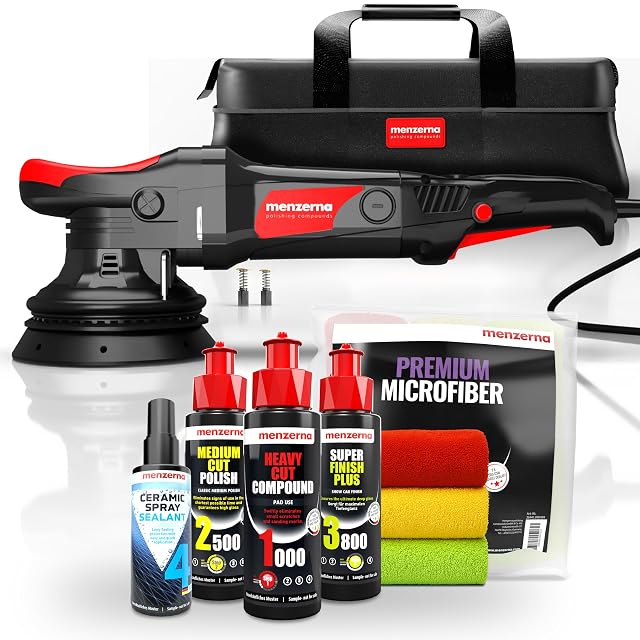
The Menzerna MZ-XR is a 720 W corded machine with a 15 mm (0.59 in) throw — the general-purpose size, fast enough on a panel and controllable on a curve — supplied with heavy cut, medium cut and finishing polishes so the sequence is available on day one.
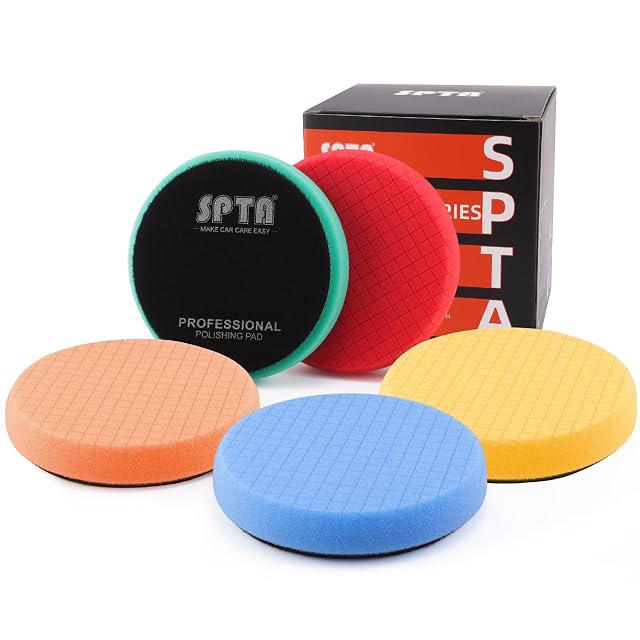
Pads decide as much as the machine. The SPTA set names its foam densities and what each is for, which is what turns colored discs into a sequence: least aggressive first, on a test area, stepping up only when it fails to correct.
If cordless matters more than speed
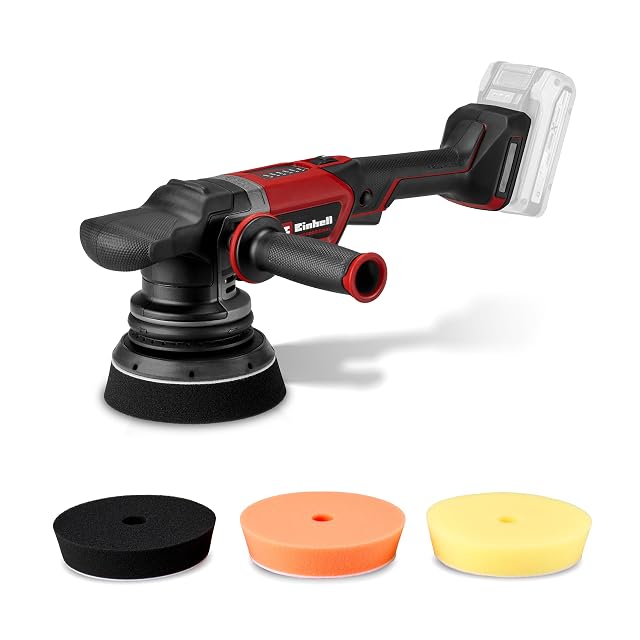
The Einhell CP-EP has an 8 mm (0.31 in) orbit — the fine, forgiving throw — on a battery platform shared across a wide tool range. It corrects more slowly and it is far harder to make a mistake with.
Headlights: four stages, and the coating is the point
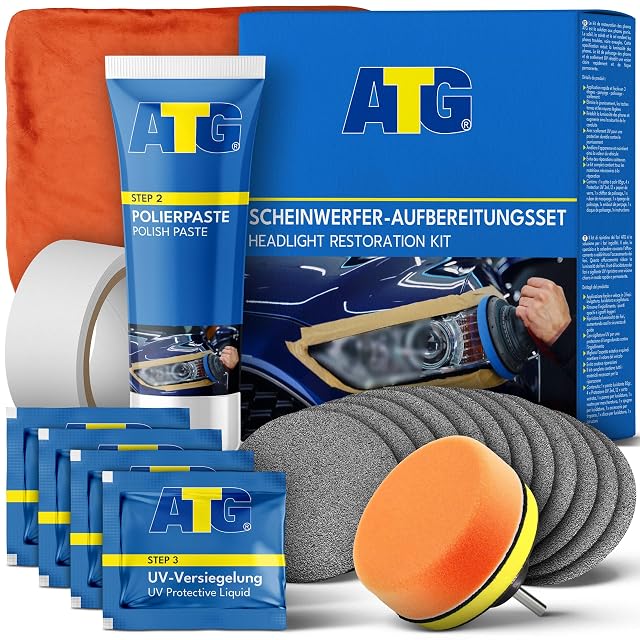
The ATG kit cleans before it sands, which prevents road grit being dragged across polycarbonate; then wet sands through graded papers, polishes, and applies a UV coating. That last stage is the difference between a result that lasts a season and one that lasts months.
Dents: glue pulling, where nothing reaches behind the panel
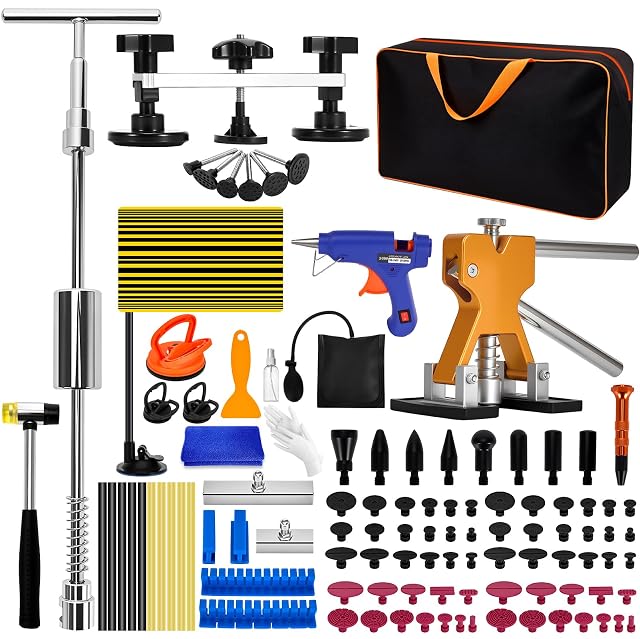
The Ofeace 120-piece kit works from outside with a hot glue gun and a T-handle puller. Warm the panel first — glue failure in a cold garage looks exactly like a defective kit — and check the paint for cracks before pulling.
The limit that applies to all three
Clear coat is finite, a coating cannot fix a badly prepared lens, and a crease does not come out. Knowing where to stop is the skill.
Which tool does the job you have?
You want to deal with stone chips and small rust spots
Abrasives, primer and patience. No specialist tooling is needed for this.
You want to remove a dent without paint damage
Paintless dent removal tools, and a realistic view of what they can reach.
You want to repair rust properly
That means cutting and welding, which is a different scale of equipment and skill.
You intend to paint outdoors
Be honest about dust, wind and temperature: they decide the result far more than the gun does.
Picking by the job in hand
Chips and scratches
The most rewarding driveway job: cheap, low risk, and it stops corrosion starting.
Small dents
Pullers and rods where the panel is accessible. The limit is access behind the panel, not the tool.
Surface rust
Removing it back to sound metal and sealing it properly. Painting over rust simply delays and hides it.
Panel preparation
Sanding and masking, which is most of the work and almost none of the cost.
What to look at first
Abrasive grades and a plan for them
Bodywork is a sequence of grades, and skipping one leaves marks that show through paint. The abrasives matter more than the tools.
Whether you can control the environment
Dust, wind, humidity and temperature decide a paint finish. A driveway offers control over none of them, which is the real constraint.
Rust treatment approach
Converters and encapsulators have their place on light surface rust; they do not repair perforation. Knowing which you have is the whole decision.
Color matching
Paint codes get you close; age and fade mean a panel rarely matches exactly. Blending into adjacent panels is what makes a repair invisible, and it is skilled work.
Dust extraction on sanders
Sanding old paint produces dust you do not want to breathe, and on older vehicles the coatings may contain harmful substances.
Which figure for which repair
The damage
What it takes
The honest limit
Stone chip
Touch-up and abrasives
Visible up close
Small dent, paint intact
Dent puller or rods
Access behind the panel
Surface rust
Abrasives and primer
Only if metal is sound
Perforated rust
Cutting and welding
Not a driveway job
What goes wrong most often
Painting over rust
A converter changes the surface chemistry; it does not restore metal. Paint over active corrosion and it reappears, usually worse, within a season.
Skipping abrasive grades
Going from a coarse grade straight to paint leaves scratches that the gloss magnifies. The sequence is the job.
Painting in the wrong conditions
Cold, damp or windy conditions ruin a finish regardless of the product. Temperature and humidity ranges are printed on the tin for a reason.
Underestimating masking
Overspray travels much further than expected, and it lands on glass, trim and the car parked next door.
By how much you do yourself
The tidy-up
Chips, scratches and light surface rust. Real value, minimal equipment, low risk.
The dent removal
Pullers or rods on an accessible panel, accepting that some dents cannot be reached.
The serious repair
Cutting, welding and painting are shop work. Recognizing that is not a failure; it is the correct assessment.
Calibration, storage and working life
Bodywork consumables age, and using aged product is the commonest cause of a poor result. Filler that has begun to cure and paint that has separated will not be rescued by technique.
Keep filler and hardener sealed and check them before mixing a batch.
Store paints and primers within their stated temperature range.
Clean sanding blocks and pads: embedded grit from a coarse grade ruins a fine one.
Dispose of solvent-soaked rags safely: they are a genuine fire risk when balled up.
Safety
The hazards here are the dust and the vapors, and both are underrated because the work looks tidy.
Wear proper respiratory protection when sanding or spraying, not a dust mask.
Older vehicle coatings can contain harmful substances: avoid creating dust from unknown paint.
Ventilate: solvent vapors accumulate and are both harmful and flammable.
Never ball up solvent-soaked rags; lay them flat to dry or store them in a metal container.
720 W · 15 mm (0.59 in) throw · 6 speeds · 125 mm (4.92 in) plate · 2.8 kg (6.2 lb) · 8 m (26 ft) cable · 3 × 100 ml polishes included
A corded 15 mm (0.59 in) dual action machine sold with three graded polishes — cut, medium and finish — from a maker whose compounds are the reference.
Best for: A first machine polish, where having the right compounds matters as much as the machine.
A dual action machine, yes. It spins and oscillates at once, so heat spreads and the pad stalls under pressure rather than digging in. A rotary is the one that punishes hesitation.
Why do restored headlights yellow again?
Because polishing removes what is left of the factory UV coating along with the oxidized surface. Only a kit that reapplies a coating has a claim to lasting.
Which dents come out?
Smooth, shallow ones in flexible panels with the paint intact. A crease has stretched the metal permanently, and cracked paint lifts with the tab.
Can I really paint on a driveway?
For small touch-ups, yes. For a panel, dust and wind make a good finish unlikely, and that is a limit of the location rather than of the equipment.
Does a rust converter fix rust?
It stabilizes light surface rust chemically. It does not restore metal, and it does nothing useful on perforation.
Will my paint code match?
It gets you close, but panels fade with age and exposure. An exact match on an older car usually needs blending into adjacent panels.
How do I avoid sanding marks showing?
By working through the abrasive grades in sequence and not skipping any. Gloss magnifies every scratch you leave behind.
What temperature do I need to paint?
Within the range printed on the product, and with humidity in mind. Outside that, the finish suffers no matter how careful you are.
Is sanding old paint dangerous?
It can be: dust from older coatings may contain harmful substances. Use proper respiratory protection and avoid dry sanding unknown paint.
Adapters, leads and spares from the same aisle, at the price we read. Confirm they suit the tool you choose before ordering: it turns on the connector and the part number, which the product page gives.
Griot’s Garage B120F6 · Polishing pads — 6.5 in · firm Euro foam · center cooling hole · low profile · thermo-set bonding · machine washable · pack of 2
Griot’s Garage BMF5 · Polishing pads — 5.5 in · 9 mm microfibre face · 1/4 in high-rebound foam interface · moderate to severe defects · pack of 2
3M 39194 · Headlight restoration kits — Trizact 1000 and 3000 grit, 76 mm (2.99 in) · 2 Quick Headlight Clear Coat Wipes · 76 mm (2.99 in) foam pad with Hookit · 1 glove · drill optional · 70 g (2.5 oz)
Aohoo Q1-T25X-BELB · Trim removal tools — 280 pieces · 11 removal tools · full clip and wedge range · stated professional set
Bojo ATH-I7-INTERIOR · Trim removal tools — 7 pieces · heavy-duty nylon, chemical resistant · fork tip for fir-tree clips · tips for most standard clip sizes · plastic toolbox case
The tools above are taken from the catalog of this site. Specifications come from the manufacturer and the Amazon product page; prices are what Keepa reported on the date shown, and both move. The order uses declared specifications, the weight of stated strengths against stated limits, and price. No tool here has been used by us on a real job, and nothing here claims it has.
Last checked on
Prices quoted in these summaries are dated readings. The live price is shown next to each product.