The only microfibre here, and the only published pad thickness
Griot’s Garage 5.5 in BOSS microfibre, pack of 2
The only microfibre pad on this shelf, with both its face and its foam layer measured.
What you are getting
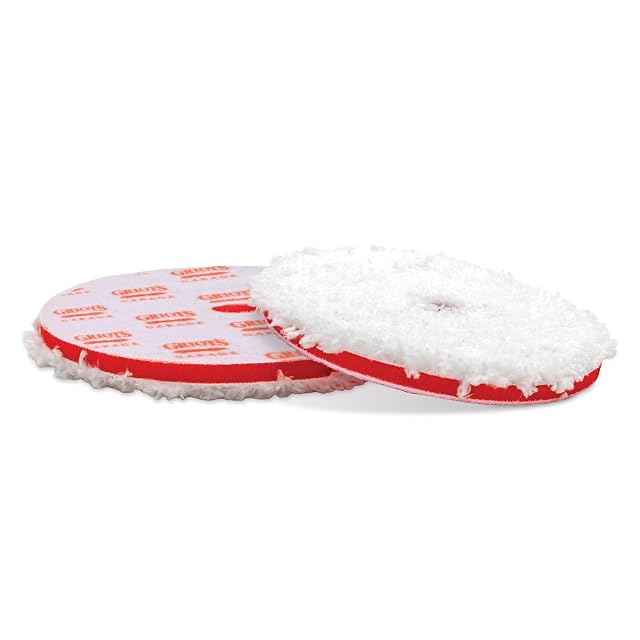
Two 5.5-inch microfibre cutting pads with a 9 mm white microfibre face stated to resist matting, built on an integrated euro-foam interface and a 1/4-inch high-rebound foam layer. Stated for moderate to severe scratches and oxidation, with BOSS creams. Also offered in 1, 2, 3, 5 and 6-inch sizes. Cleanable by hand or machine. 35 g. $26.91.
It is the only microfibre pad on this shelf
The introduction treats this as a separate category from foam: “Microfibre and wool pads cut faster and finish rougher, which suits hard clear coats.”
| Item | Face material |
|---|
| This pad | microfibre, 9 mm (0.35 in) |
| Kshineni, published | 8 foam pads + 1 wool buffer |
| Meet You, published | 8 foam pads + wool pads |
| Huifoo · Lompyeu, published · the four other Griot’s items | foam |
So the shelf has foam, two sets with wool, and one microfibre pad. The three are not interchangeable: foam abrades with the compound, wool cuts with its own fiber tips and is the most aggressive, and microfibre sits between them — it cuts harder than foam and finishes far better than wool.
Hard clear coat is the case for it. Modern ceramic and scratch-resistant clears resist foam almost entirely: the compound breaks down before the defect does, and three passes achieve nothing. A microfibre face carries the compound into the clear instead of skating on it.
And it publishes two thicknesses, which nothing else here does
The third bullet states a 1/4-inch high-rebound foam layer that “ensures fast pad rotation on orbital polishers”; the fourth states 9 mm (0.35 in) of white microfibre that “resists matting”.
Those are the only thickness figures on this shelf. The published Lompyeu set calls its foam “thick”, the Meet You set “extra thick”, the Kshineni set “thickened for durability” — three adjectives and no millimeter.
Both figures do work:
- 9 mm (0.35 in) of pile is enough to hold compound and keep cutting as the tips wear, and short enough not to fold over. A matted microfibre face is a dead pad, which is why “resists matting” is the claim beside it.
- 1/4 inch (6.4 mm) of high-rebound foam under the face is what keeps the pad turning. On a dual action polisher rotation is driven by friction alone, and a pad that compresses and stays compressed stops rotating — which is the stall described on the conversion kit page on this shelf. High-rebound foam pushes back.
The Innerflex interface is a published answer to body lines
“These orbital polisher pads feature an integrated Innerflex euro-foam interface that enhances flexibility across body lines and contours, helping maintain consistent contact for more even correction.”
A microfibre face is a cloth: it has almost no give of its own. Over a swage line or a wheel arch, a stiff pad touches at two points and lifts in the middle, and the correction follows the pad rather than the panel.
An interface layer is the standard fix — a softer foam between plate and face that lets the pad take the shape of the panel — and it is normally sold separately. Having it integrated is the difference between one pad and a pad plus a $15 interface disc.
The conversion kit on this shelf solves the same problem at the plate instead, with a “flexible, chamfered edge that hugs body lines”. Two answers, one at each end of the stack.
Five and a half inches, which matches the only plate on this shelf
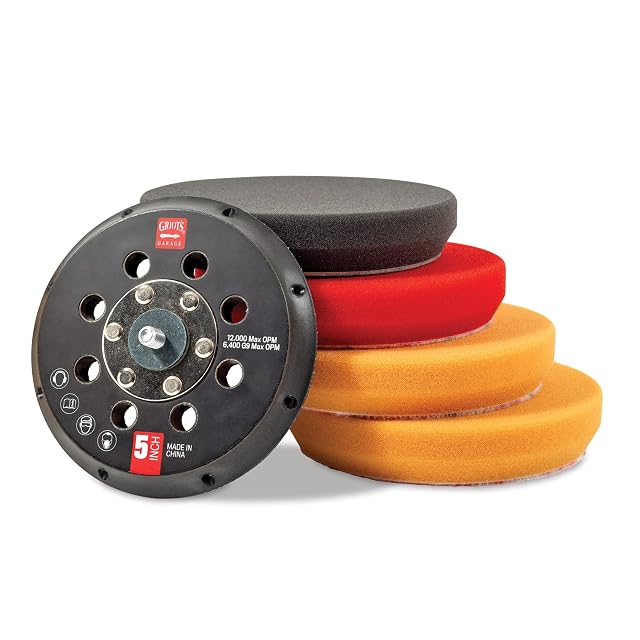
5.5 inches is the size the 5-inch plate in the conversion kit here is built for — a half-inch of overhang, which the introduction makes its first rule: “the pad must be slightly larger than the backing plate so the edge does not catch.”
So of the six Griot’s items on this shelf, this and the kit’s own pads are the two that fit the kit’s plate. The 6.5-inch correcting pad wants a 6-inch plate and the 3-inch pads want a 2-inch one.
Griot’s also publishes the rest of the ladder: “available in 1”, 2”, 3”, 5”, and 6” sizes.”
Cleanable, with a named product rather than a washing machine
“Deep clean these car polish pads by hand or machine using our Microfibre and Foam Pad Cleaner to maintain performance and durability.”
The other five Griot’s items on this shelf say “machine washable” flatly. This one says machine with a cleaner, which is a narrower claim and an honest one: microfibre loaded with spent compound does not come clean in water, because the compound is an abrasive suspended in oil.
The introduction lists washability as one of its four comparisons, and none of the four published sets on this shelf mentions it at all.
What is not published
No density for the foam interface beyond “high-rebound”. No cut level in numbers — “moderate to severe” is the grade, which the introduction accepts as the norm while noting that “no two brands agree”. No fiber composition or weight per square meter for the microfibre. No maximum speed. No intended plate size, though 5.5 in implies a 5-inch plate. No washing temperature.
At $26.91 for two it is the pad for a clear coat that foam will not touch, and the only one here that tells you how thick it is.
Availability
On sale at around $27 on the American Amazon store at the time of checking.
Prices and availability are what Keepa reported on the date this page was updated; both move.
Prices quoted in this text were read on 6 October 2026. The live price is at the top of the page.