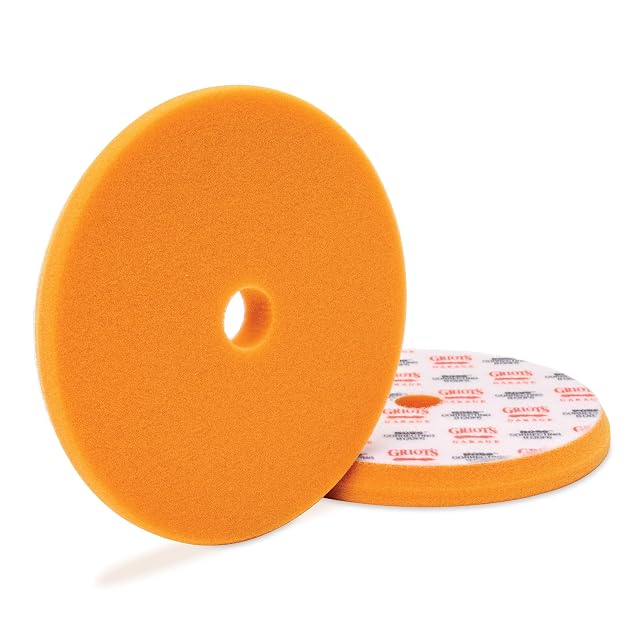
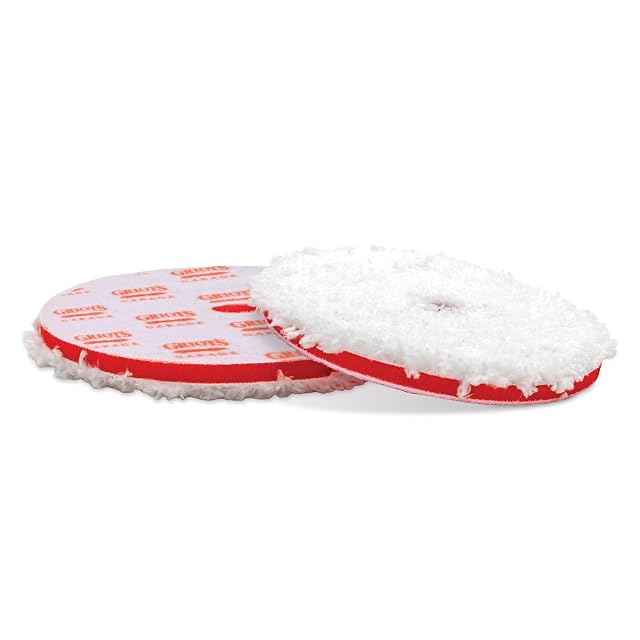
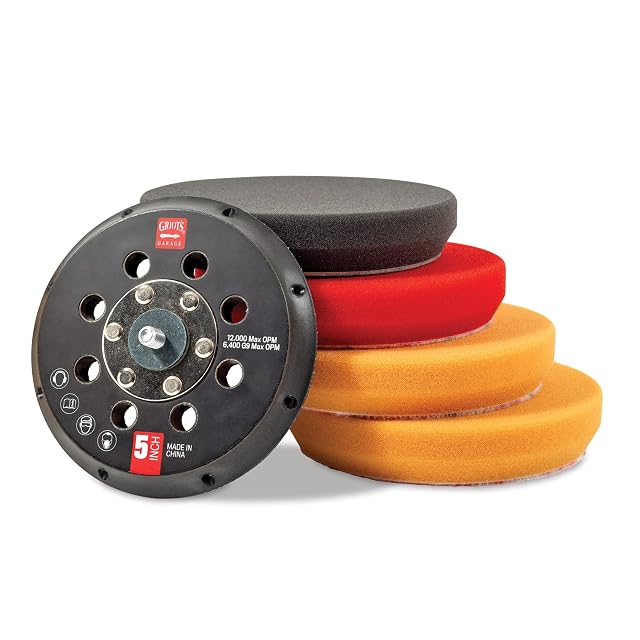
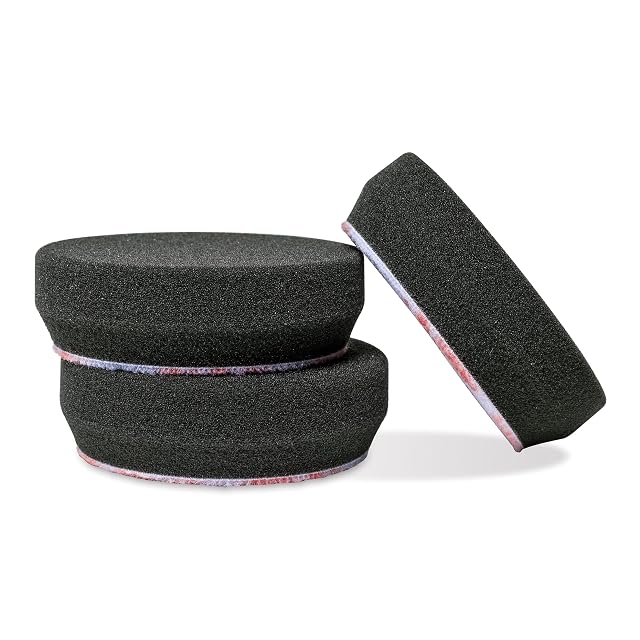
What you are getting
Two 6.5-inch correcting pads in firm Euro foam, with a low-profile build, a cooling hole through the middle stated to reduce heat build-up, a thermo-set bonding system that resists separation, and a premium loop backing. Stated for light to moderate defects, with BOSS correcting creams. Also offered in 1, 2, 3 and 5.5-inch sizes. Machine washable. $28.99.
It is the largest pad on this shelf, and the hole in it is the point
| Item | Diameter |
|---|
| This pad | 6.5 in (165 mm) |
| Lompyeu, published | 150 mm (6 in) |
| Griot’s microfibre · conversion kit pads | 5.5 in (140 mm) |
| Huifoo · Meet You, published | 125 mm (4.9 in) |
| Griot’s 3-inch pads | 3 in (76 mm) |
| Kshineni, published | 80 mm (3.1 in) |
Six and a half inches is a pad for bonnets, roofs and doors — one pass covers ground, and it is unwieldy on a wing mirror.
And the second mechanical rule on this shelf is about what happens when a big pad works: “the hook-and-loop face has to hold under heat.”
“Built to last with a center intercooling hole that reduces heat buildup and a thermo-set bonding system that resists separation.”
A hole through the middle of a foam pad does two things: air moves through the pad as it spins, and the hottest part of a rotating pad — the dead center, which has the least surface speed and the most compression — is simply not there. It is the only pad on this shelf with one, and it is the direct answer to the rule the introduction states.
Thermo-set bonding is the other half: the glue between the foam and the loop backing is the layer that fails under heat, and a thermoset adhesive does not soften again once cured.
Low profile, which is a statement about energy rather than thickness
“The low-profile design of these car polishing pads maximizes energy transfer, delivering consistent pressure and effective defect removal.”
A thick pad absorbs the machine’s movement in the foam; a thin one passes it to the paint. On a dual action polisher, which has very little to give away, that matters — a tall soft pad on a DA machine stalls, which is the failure described on the conversion kit page on this shelf.
So a firm, low-profile pad is the cutting configuration, and it is the opposite of what the published sets here describe. The Lompyeu set states “thick, flexible and absorbent” foam and the Meet You set “extra thick, durable and elastic” — which lasts longer and cuts more slowly.
No actual thickness is published for this pad. The BOSS microfibre pad on this shelf publishes a 1/4-inch foam layer, which is the only thickness figure in the Griot’s range here.
Firm Euro foam, which is a grade named rather than measured
“Firm Euro Foam construction makes these car buffing pads ideal for eliminating swirls, haze, and light scratches.”
The introduction: “Foam is graded by density rather than by color — although every brand uses color, and no two brands agree on it — running from cutting through polishing to soft finishing foam.”
“Firm” is a density statement in words. It is more than the four published sets on this shelf manage — their own pages record “no density grading published” twice and “color-coded density is not standardized between brands” once — and it is less than a number.
What makes the Griot’s range on this shelf usable is that the grades are consistent across the brand: orange corrects, black finishes, red waxes, microfibre cuts hard, and this firm foam corrects at 6.5 inches. One maker’s internal scale, applied the same way on every item.
It removes the same defects as the 3-inch orange pad, at twice the diameter
Both are stated for “light to moderate” defects. The difference is reach:
- 6.5 in — bonnet, roof, doors, boot lid; too big for a bumper corner or a mirror
- 3 in — bumpers, mirrors, pillars, around badges; four passes to cross a door
Griot’s publishes the whole ladder in the same bullet: “come in 1”, 2”, 3”, 5.5”, and 6.5” sizes to help you easily tackle tight areas or wide panels.”
That is the one thing a graded range buys that a mixed bag cannot: the same foam, in the size the panel needs.
Machine washable, which the published sets do not claim
“Each foam polishing pad is machine-washable, while the premium loop backing ensures strong adhesion to the backing plate without slippage.”
The introduction compares “washability” as one of its four criteria. All six Griot’s items on this shelf state it; none of the four published sets mentions washing at all.
It matters more than it sounds, and the buying advice explains why: “A saturated pad stops cutting long before it looks used.” A pad that can be washed and dried is a pad that comes back; one that cannot is a consumable at the price of a consumable, which is what the €8 to €20 published sets are.
What is not published
No foam density figure or pore grade. No pad thickness. No hole diameter for the cooling hole. No backing plate size it is intended for — a 6.5-inch pad wants a 6-inch plate under this shelf’s half-inch rule, and the only plate on this shelf is 5 inches. No maximum speed. No pack of more than two, where the published sets run to twenty-two pieces.
At $28.99 for two it is the pad for flat panels, and the only one here built to shed its own heat.
Availability
On sale at around $29 on the American Amazon store at the time of checking.
Prices and availability are what Keepa reported on the date this page was updated; both move.
Prices quoted in this text were read on 6 October 2026. The live price is at the top of the page.