A jack lifts a car and axle stands hold it. That single sentence organizes this whole guide, and nothing on this site describes working under a vehicle supported by a jack alone. Ramps are the third option and they exclude anything involving a wheel — because the wheels are what sits on them.
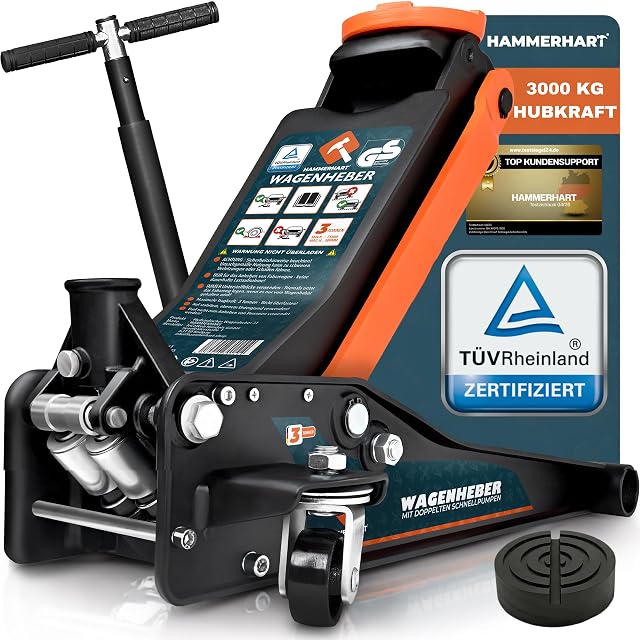
The HAMMERHART 3 t is the only jack here that names its standard: TÜV Rheinland and GS certification stated to EN 1494, the European standard for mobile jacks and associated lifting equipment. It enters at 75 mm (2.95 in) and lifts to 505 mm (19.9 in), and it carries a stated five-year warranty.
The stands, chosen on their locking
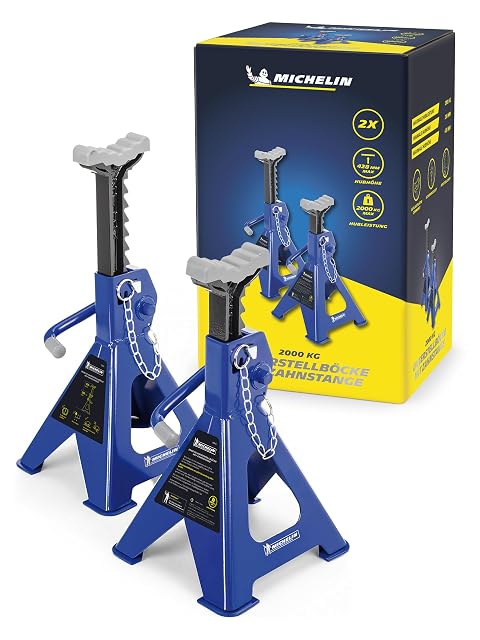
The MICHELIN pair uses a rack and pawl with an integrated locking handle and a safety pin. Two independent mechanisms on the one tool whose entire job is not to fail is the right kind of redundancy.
The ramps, for jobs that keep the wheels on
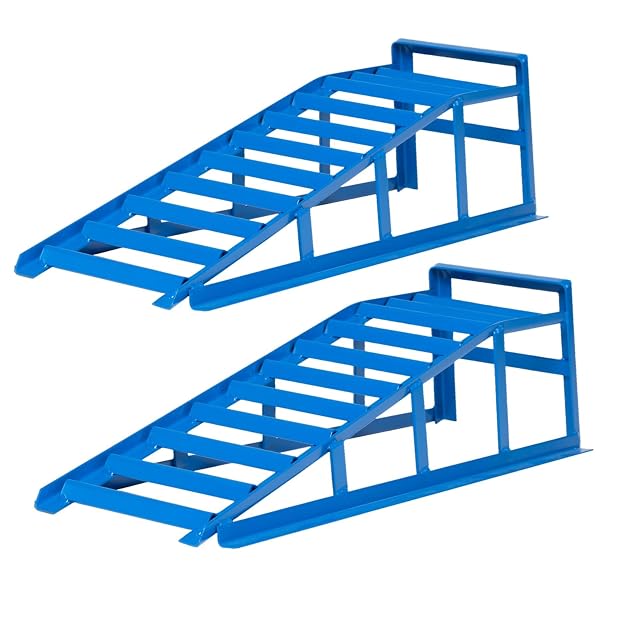
The cartrend set is the only ramp listing here that publishes an approach angle — 17° — and a tire width limit of 225 mm (8.86 in). It also has an over-run stop, which prevents driving off the end. Read its 1.6 t per pair carefully against your axle load.
The bottle jack, for a van or a trailer
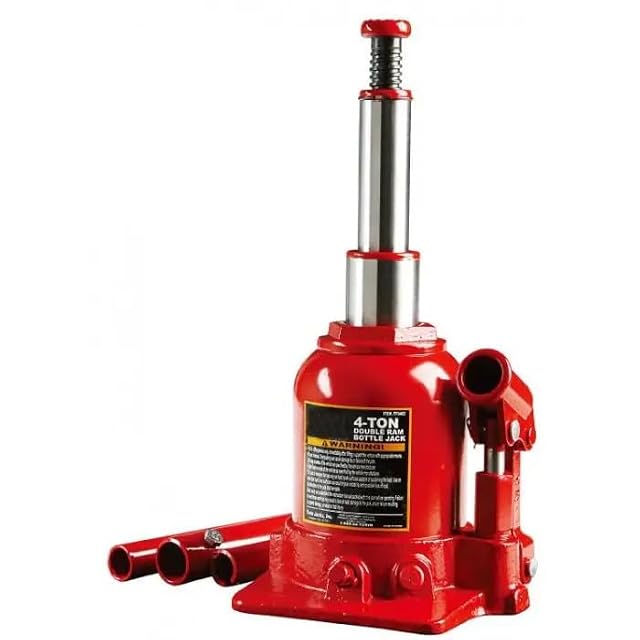
The Torin Big Red is a double-ram design: 160 mm (6.30 in) closed, 390 mm (15.4 in) extended, a stated 6.4 kg (14.1 lb). That combination is what makes a bottle jack usable on a car rather than only on a van.
The budget answer
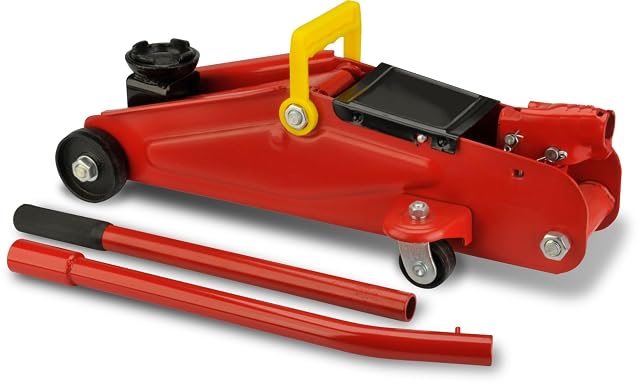
The UNITEC 2 t is a plain steel trolley jack with four castors and a carry handle. It publishes no heights, which is the one thing to measure against your own car before ordering.
The sequence, every time
Level ground. Chock the wheels that stay down. Lift at the manufacturer’s jacking point. Lower onto stands at the manufacturer’s support points, both at the same notch. Push the car firmly at the wing before going anywhere near it.
Which tool does the job you have?
You need to remove a wheel
A jack to lift and axle stands to support. Ramps cannot be used because the wheel has to come off.
You only need access underneath
Ramps are quicker and inherently stable, and they keep the wheels on.
Your car sits low
Check the jack’s minimum height and the ramp’s approach angle before buying: many will not fit under.
You work on a sloped driveway
The honest answer is not to. Lifting equipment is designed for level, solid ground.
Picking by the job in hand
Wheel removal
Jack plus axle stands, every time. The jack raises, the stands carry, and the wheel comes off only once the stands are loaded.
Oil change and underside inspection
Ramps suit this well: quick, stable, and the wheels stay on to help hold the car.
Roadside emergency
The car’s own jack is for changing a wheel at the roadside, and nothing else. It is not a workshop tool.
Longer work sessions
Anything that keeps you under the car for a while argues for stands and chocks together, not for the minimum that works.
What to look at first
Rated capacity against your vehicle
The rating applies to the equipment, and a jack lifts only part of the car’s weight. Choosing with margin costs little and matters a lot.
Minimum and maximum height
The two numbers that decide whether the equipment fits your car at all: low enough to go under, tall enough to reach working height.
The saddle and the lifting points
Cars have designated jacking points, and a saddle that does not match them damages sills and floorpans. A rubber pad is not a detail.
Axle stand locking mechanism
A pin or a ratchet with a secondary lock is what stops a stand collapsing. This is the part to look at, not the height range.
Base area and stability
A wide base is what stops the whole thing from tipping on imperfect ground. On a driveway that matters more than on a workshop floor.
Which figure for which repair
What you are doing
The right method
What not to use
Removing a wheel
Jack plus axle stands
Ramps
Access underneath
Ramps
Bricks or blocks
Roadside puncture
The car’s own jack
Anything improvised
Long session under the car
Stands, chocks, level ground
A jack alone
What goes wrong most often
Going under a car on a jack alone
A jack can lose pressure, slip off its point or sink into soft ground. The stands exist precisely because a jack is not a support, and this is the mistake that kills people.
Improvising supports
Bricks, blocks and wheels stacked under a car are not rated for the load and fail without warning. Purpose-made stands are inexpensive next to the consequence.
Lifting on the wrong point
Jacking on a sill, a sump or a floorpan bends the car and can drop it. Every manufacturer designates jacking points and the handbook shows them.
Forgetting the wheels that stay down
Chocks stop the car rolling off its supports. On a driveway with any slope at all, this is not optional.
By how much you do yourself
The home driveway
A trolley jack, a pair of axle stands, and chocks. That combination covers almost every job safely.
The quick oil change
Ramps: faster to set up, stable by design, and no wheels to remove.
The low car
A low-profile jack and low ramps, chosen on their minimum height rather than their capacity.
Calibration, storage and working life
Lifting equipment is safety equipment, and it is checked rather than merely stored. A hydraulic jack that leaks or sinks under load has told you something, and the right response is to stop using it.
Check a hydraulic jack for leaks and for slow sinking under load before each session.
Inspect axle stands for cracks and for a worn locking pin or ratchet.
Keep the equipment dry: surface rust on a ratchet tooth is not cosmetic.
Retire any item that has been damaged, overloaded or dropped rather than repairing it.
Safety
This is the subject where shortcuts are fatal, and the rules are short and absolute.
Never work under a vehicle supported only by a jack.
Use the manufacturer’s designated jacking and support points.
Level, solid ground only, with the remaining wheels chocked.
Test the load by rocking the car gently before going underneath.
Rated 2 t · pair · rack-and-pawl adjustment · locking handle and safety pin stated
A pair of 2 t stands with a rack adjustment, a locking handle and a safety pin — the belt-and-braces locking arrangement, from a brand people recognize.
Best for: A cautious buyer who wants two independent locking mechanisms.
Rated 1.6 t per pair stated · 17° approach angle · tires to 225 mm (8.86 in) · 20.5 cm (8.1 in) high, 93.5 cm (36.8 in) long · over-run stop
The only ramp here that publishes an approach angle and a tire width limit — and the only one whose rating, at 1.6 t per pair, has to be read carefully.
Best for: A light or mid-weight car with tires up to 225 mm (8.86 in), where the published figures can actually be checked.
Rated 4 t · 160–390 mm (6.30 to 15.4 in) · double ram · 6.4 kg (14.1 lb) stated · low profile for a bottle jack
A double-ram 4 t bottle jack at 6.4 kg (14.1 lb) with a 160 mm (6.30 in) closed height — the most car-friendly bottle jack here, and the only one that publishes its weight.
Best for: An estate, an SUV or a van whose owner wants a bottle jack that also fits under a car.
A jack lifts one corner, so a 2 t rating is comfortable for a family car. The figure that actually decides the purchase is minimum saddle height — whether it fits under the car at all.
Per stand or per pair?
Both conventions exist, and the same box can read 3 t or 6 t depending which the maker used. Reading it the wrong way halves your margin, so find the sentence rather than the headline.
Can I use ramps for a brake job?
No. The wheels sit on the ramps, so they cannot come off. Ramps are for oil changes and underbody inspection; anything involving a wheel needs a jack and stands.
Can I use the jack that came with the car?
For a roadside wheel change, yes, that is what it is for. It is not intended to support a car while you work under it.
Jack and stands, or ramps?
Ramps when the wheels can stay on and you just need access; jack and stands when a wheel has to come off. They are not interchangeable.
Where do I place the jack?
On the jacking points the manufacturer designates, which the handbook shows. Anywhere else risks bending the structure or dropping the car.
How much capacity do I need?
More than you think you need, because equipment is rated with a margin that you should not eat into. Buying above the requirement costs little.
Is a sloped driveway usable?
It is the wrong surface for lifting a car, and no amount of chocking makes it right. Find level ground or do not lift.
How do I know the stands are properly loaded?
Lower the car onto them, check they sit square on their points, then rock the car firmly before going underneath. If anything shifts, start again.
What sets these bands apart: Rated capacity — Entry level 3 · Mid range 5 · Upper range 20
What else the job needs
Adapters, leads and spares from the same aisle, at the price we read. Confirm they suit the tool you choose before ordering: it turns on the connector and the part number, which the product page gives.
Brennenstuhl 1175590100 · Work lights — 200 lm stated · up to 12 h runtime stated · 5 modes · Li-Po 3.7 V / 450 mAh · rechargeable · $32
PacoLit 1 Head · Work lights — 10,000 lm, 72 LEDs · IP66 · cast aluminum and tempered glass · 120° beam · 5 ft cord · 2-year replacement
Allstar Performance ALL44047 · Tire pressure gauges — 0–30 PSI · 4 in glow face · 14 in hose, 360° swivel chuck · release valve · no accuracy stated
AstroAI T3 · Tire pressure gauges — ANSI B40.1 · ±2 PSI from 80–120, ±3 below 80 · dual-head chuck · 1/4 in quick-connect · −10 to 50 °C (14 to 122 °F)
Straight to it
If the job demands the price → look at Unitec 10008
The tools above are taken from the catalog of this site. Specifications come from the manufacturer and the Amazon product page; prices are what Keepa reported on the date shown, and both move. The order uses declared specifications, the weight of stated strengths against stated limits, and price. No tool here has been used by us on a real job, and nothing here claims it has.
Last checked on
Prices quoted in these summaries are dated readings. The live price is shown next to each product.