What you are getting
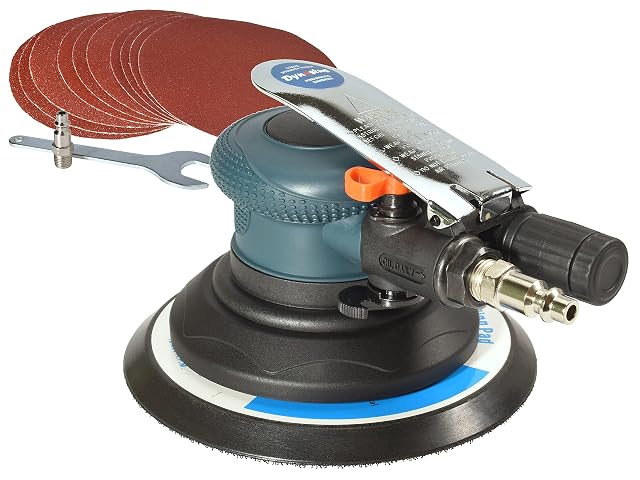
A 6-inch dual action random orbit air palm sander with a 10,000 rpm free speed, 4.5 CFM air consumption at 90 PSI operating pressure through a 1/4-inch inlet, a suggested 2-horsepower compressor, two 6-inch backing plates — one for PSA discs and one for hook-and-loop — a thumb-controlled lever for air regulation, heavy-duty ball bearing construction, heat-treated steel components, a rubber hand grip, and a coupler plug, lubricating oil, wrench and manual. 1.89 lb (857 g). $49.99.
It is the only sander on this shelf that says what compressor it needs
Every powered sander on this shelf runs on compressed air. One of them publishes what that means.
“Air Inlet: 1/4”; Air Consumption: 4.5 Cfm; Operating Air Pressure: 90 Psi; Free Speed: 10,000 Rpm; Suggested Air Compressor: 2 Horsepower.”
The three published pages that discuss it all record the absence as a reserve: the Qwork page says “needs a compressor with sufficient air delivery, which is not published”; the Anesty page “no numerical air consumption figure”; the Si Fang page “no air consumption figure”.
Why it decides the purchase: 4.5 CFM continuous is more air than a small domestic compressor delivers. A typical 24-liter, 1.5 hp consumer unit produces around 3 to 4 CFM at 90 PSI and does it in bursts — which means a sander like this runs for thirty seconds and then waits for the tank. TCP’s 2 hp suggestion is the honest minimum, and it is the figure that tells you whether the tool will work in your garage before you buy it.
Nothing else on this shelf lets you make that check.
And it is the only one that ships both kinds of backing plate
“Includes Two Different Styles of 6” Backing Plate Pads, One For PSA (Pre-Stuck Adhesive) Sanding Discs and One For Hook and Loop Sanding Discs.”
That is the answer to the buying advice on this shelf, which is about exactly this incompatibility: “match the pad hole pattern to your abrasive discs before buying either.”
PSA discs have an adhesive back and stick straight to a smooth plate: cheaper per disc, single-use, and they will not come off halfway through a pass. Hook-and-loop discs cost more and can be taken off and put back, which is how you keep a part-used 400-grit disc.
A body shop uses PSA for volume work and hook-and-loop for everything else. Having both plates means the box fits whatever abrasives are already on the shelf — and on a shelf where nobody publishes a hole pattern, having two plate types is the closest thing to compatibility insurance available.
The TCP longboard on this shelf takes the same two-way approach by hand: “PSA sticky longboard paper or dry longboard paper with clips”.
Under two pounds, with the bearing claim that goes with it
“A lightweight less than 2-pound sander… Net Weight: 1.89 Lbs.” That is 857 g (30.2 oz).
| Sander | Stated weight |
|---|
| Dynastus 6 in | 1.85 lb (839 g) |
| This sander | 1.89 lb (857 g) |
| Stahlwerk, published | 1 kg (2.2 lb) |
| KUIMIT | 3.1 lb (1.41 kg) |
| The other six | not published |
Four of the ten publish one, and the two lightest are within 18 grams of each other. The published Stahlwerk page says why the figure matters: a published weight “is the specification that decides a two-hour session”.
“Heavy-Duty Ball Bearing Construction For Vibration-Free Performance… Heat-Treated Steel Components To Resist Wear” is the durability half. The introduction asks for “low stated vibration”, and no sander on this shelf publishes a number — this one claims “vibration-free”, the published Qwork “precision balanced”, the KUIMIT “minimal vibration”. All words.
The air regulation is on a thumb lever, which is the usable place for it
“a thumb-controlled lever for air regulation to adjust the sanding pads speed while the sander is in use.”
The introduction: “Variable speed matters for the last passes.”
A thumb lever adjusts without stopping and without taking a hand off the tool. The DATOUBOSS sander here uses a knob, which is set and left; the KUIMIT has a built-in regulator stated as adjustable “in real time”; the Dynastus a “metal touch control trigger” that modulates with finger pressure.
What this one does not publish is a range — 10,000 rpm is the free speed and the bottom of the adjustment is not stated. KUIMIT is the only sander on this shelf that publishes both ends, at 2,500 to 12,000.
Oil in the box, which is the maintenance nobody mentions
“Includes A Coupler Plug, Lubricating Oil, Wrench, and An Instruction Manual.”
An air motor needs a drop of oil down the inlet before use. Run dry it loses power over months and then seizes, and it is the single commonest way a cheap air tool dies.
Of the ten sanders on this shelf, this is the only listing that supplies oil. The ZFE and Si Fang kits supply a wrench and a screwdriver; the Dynastus a wrench and a plug.
Six inches, and what it is stated for
“Metal, Wood, Fiberglass, Composites, and Most Types of Substrates… Ideal For Automotive Body Shops For Sanding Prep Before Car Refinishing.”
Six inches (152 mm) is the body-shop standard for panels. The Dynastus sander here is the same size; the published Qwork and Stahlwerk sanders are 125 mm (4.92 in); the ZFE and published Anesty and Si Fang are mini tools at 25 to 75 mm (0.98 to 2.95 in).
What is not published
No orbit size. On this shelf only the published Qwork sander publishes one, at 5 mm, and the introduction makes it the first criterion: “small orbits (2 to 3 mm) for finishing, larger ones for leveling.” No pad hole pattern, though both plate types are supplied. No speed range below the 10,000 rpm free speed. No vibration figure. No noise figure, where the Dynastus sander states “internal silencing”. No abrasive discs included, where four sanders on this shelf supply them. No warranty term.
At $49.99 it is the only sander here you can match to your own compressor before buying, and the only one that fits both kinds of disc.
Availability
On sale at around $50 on the American Amazon store at the time of checking.
Prices and availability are what Keepa reported on the date this page was updated; both move.
Prices quoted in this text were read on 6 October 2026. The live price is at the top of the page.