What you are getting
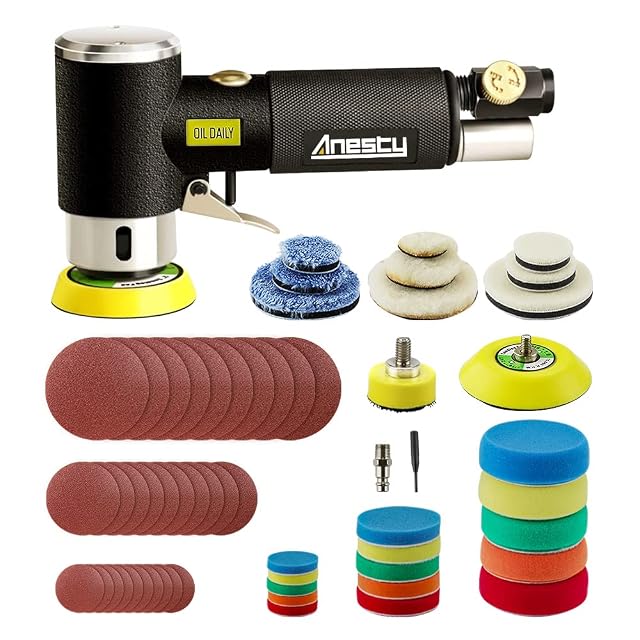
A mini pneumatic random orbital sander running at 15,000 rpm, with three backing plates at 1, 2 and 3 inches, 15 buffing pads, 18 abrasive sheets, a screw and a screwdriver. Stated as low vibration and low air consumption, using an eccentric double-rotation action. 1,048 g (37 oz), 255 × 150 × 105 mm (10 × 5.91 × 4.13 in). $49.99.
Three plate sizes is what makes a mini sander worth owning
1, 2 and 3 inches — 25, 50 and 76 mm.
| Tool | Pad sizes |
|---|
| This sander | 25, 50, 76 mm (2.99 in) |
| Anesty, published | 25, 50, 75 mm (2.95 in) |
| Qwork · Stahlwerk, published | 125 mm (4.92 in) |
| KUIMIT | 125 mm (4.92 in) |
| Dynastus · TCP SA7336 | 152 mm (5.98 in) |
| DATOUBOSS | square, not published |
| Si Fang, published | three plates, sizes not published |
| TCP longboard | 419 × 70 mm (16.5 × 2.76 in) board |
The published Anesty page states the case: three sizes “cover repairs from a coin to a hand”. A 25 mm (0.98 in) disc gets inside a door shut, round a badge plinth and into the corner of a lamp aperture; a 76 mm (2.99 in) disc does a stone chip repair and the blend around it.
It is the same range as the Anesty kit — and this one adds thirty-three consumables to it.
Fifteen thousand rpm is the highest speed here, and that is the catch
| Sander | Stated speed |
|---|
| This sander · Si Fang, published | 15,000 rpm |
| KUIMIT | 12,000 (from 2,500) |
| Qwork, published | 12,000 |
| Stahlwerk, published | 11,000 |
| DATOUBOSS · TCP SA7336 | 10,000 |
A small pad has to turn fast to have any surface speed at all — 15,000 rpm on a 25 mm (0.98 in) disc is a lower rim speed than 10,000 on a 152 mm (5.98 in) one, so the number is a consequence of the size rather than an aggression claim.
What it does mean is heat. A 25 mm (0.98 in) patch of abrasive concentrates everything into a coin-sized area, and paint and filler are both poor conductors. On a thin edge it is possible to burn through a clear coat in seconds, which is why the published Anesty and Si Fang pages both describe mini sanders as “a spot-repair tool rather than a panel tool” and warn that “a panel takes a long time”.
No speed range is published, so whether it can be slowed is unknown. The KUIMIT sander here is the only one on this shelf that publishes a bottom end, at 2,500 rpm.
Thirty-three consumables, which is the most on this shelf
15 buffing pads and 18 abrasive sheets, plus the three plates.
| Item | Consumables supplied |
|---|
| Si Fang, published | 30 polishing discs, 15 sheets, 3 plates |
| This sander | 15 buffing pads, 18 sheets, 3 plates |
| DATOUBOSS | 15 sheets at 1500/2000/3000 |
| Dynastus | 10 discs |
| KUIMIT | 3 contour sponges, 2 cloths, 1 mitt |
| TCP SA7336 · TCP longboard · Qwork · Anesty · Stahlwerk | none |
Two of the ten come with more than thirty pieces, and both are mini sanders — which makes sense, because a 25 mm (0.98 in) disc is used up in minutes.
No grits are published for the 18 sheets. The DATOUBOSS sander here states 1500, 2000 and 3000, which is the only grit statement on this shelf. Without grits, what the kit can do — level or finish — is unknown.
“Eccentric double-rotation”, which is what dual action means
“ZFE air polisher adopts eccentric double-rotation polishing method to make the polishing effect more uniform and smooth.”
That is a description of a random orbital: the pad spins on its own axis and the axis itself travels in a circle, so no point on the abrasive follows the same path twice. It is why these machines leave no swirl pattern, and the published Dynastus listing says the same thing as “the orbital action provides the smoothest swirl free finish”.
What neither says is the orbit size. On this shelf of ten, only the published Qwork sander publishes one, at 5 mm (0.20 in) — and the introduction makes it the first criterion: “small orbits (2 to 3 mm (0.08 to 0.12 in)) for finishing, larger ones for leveling.”
On a 25 mm (0.98 in) pad the orbit has to be very small, which puts this at the finishing end whether it says so or not.
Low air consumption, stated and not measured
“High stability, low vibration rate and low energy consumption.”
The published Anesty page praises the same claim — “low air consumption stated, which matters more on small tools used continuously” — and records the same gap: “no numerical air consumption figure”.
The TCP SA7336 on this shelf is the only sander of ten that publishes one: 4.5 CFM at 90 PSI, with a 2 hp compressor suggested. A mini sander will want considerably less, which is genuinely the argument for one in a garage with a small compressor — and the figure that would prove it is not here.
No air fitting is named either, where four of the six American sanders supply or state one.
What it is stated for, which is wider than bodywork
“Ideal for spot sanding focus areas, removing solder joints and rust spots on metal products, deburring furniture and woodwork, mold manufacturing, polishing automotive and detailing work.”
Solder joints and deburring are the giveaway: this is a general small-tool-work sander that happens to suit paint repairs. The published Si Fang and Anesty kits are described the same way.
For the panel work this shelf is mostly about, the 6-inch sanders here and the TCP longboard are the tools; this is what finishes the parts they cannot reach.
What is not published
No orbit size. No speed range. No grits for the 18 sheets. No air consumption figure, despite the claim. No air fitting. No pad hole pattern. No dust extraction — only the DATOUBOSS sander here has any. No weight from the maker — the 1,048 g above is the shipping record. No vibration figure. No warranty term.
At $49.99 it is the best-stocked mini kit on this shelf by plate range, and it will burn a clear coat if you stay in one place.
Availability
On sale at around $50 on the American Amazon store at the time of checking.
Prices and availability are what Keepa reported on the date this page was updated; both move.
Prices quoted in this text were read on 6 October 2026. The live price is at the top of the page.