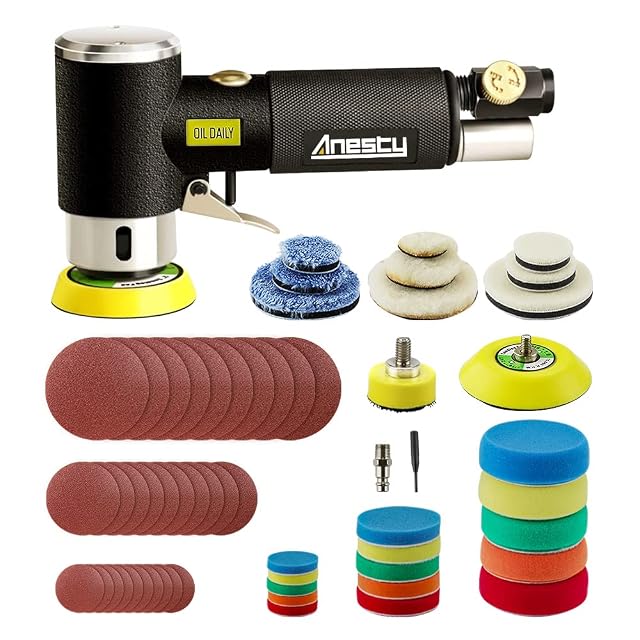
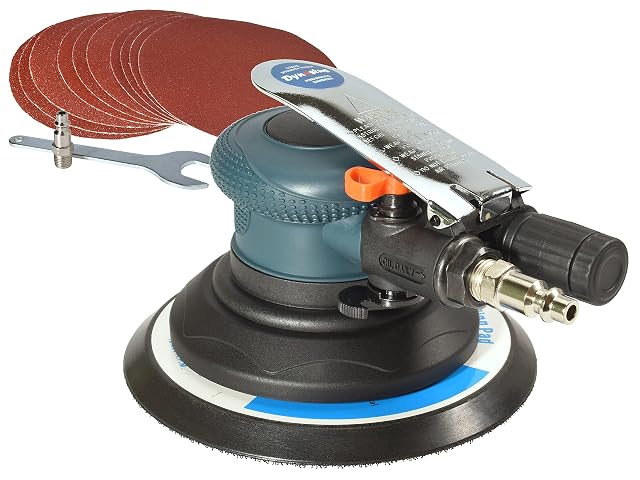
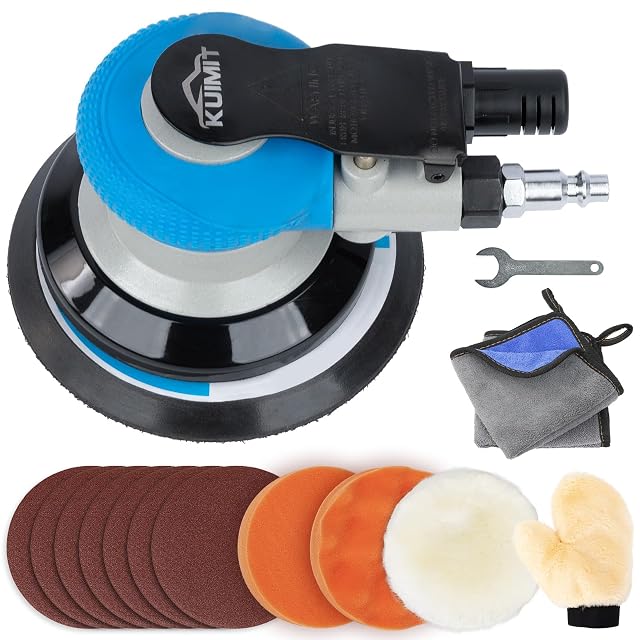
What you are getting
A square pneumatic palm random orbital sander running at 10,000 rpm, with an extraction hose and a dust collection bag, a push-to-open switch, a knob for speed, a counterweighted ergonomic body, a US-standard connector, a cushioning pad and 15 sheets of abrasive at 1500, 2000 and 3000 grit. $49.99.
It is the only sander on this shelf that extracts its own dust
The introduction does not hedge about this: “The specification that decides the result is dust extraction: a multi-hole pad matched to an extractor keeps the abrasive cutting instead of clogging, and it keeps the dust out of what you are about to spray.”
“EFFICIENT CLEANING SYSTEM — Portable random orbital sander is equipped with a hose for removing dust and a bag for collecting dust. When the product produces debris or produces exhaust gases, the exhaust hose connected to the sander will automatically absorb the debris from the bottom into the suction tube and collect it in the dust bag.”
Of the ten sanders on this shelf — six here and four published earlier — this is the only one with any extraction at all. The four published pages each carry the absence as a reserve: “no dust extraction mentioned”, “no dust extraction port mentioned”.
And read how it works, because it is unusual: the extraction is driven by the tool’s own exhaust air. A pneumatic sander has to vent its spent air somewhere, and piping that exhaust through a venturi creates the suction that pulls dust off the pad. It costs nothing in extra equipment — no shop vacuum, no separate motor — which is why it is the only extraction on a shelf of air tools.
The limitation is in the same sentence. A self-driven venturi makes less suction than a vacuum, and the bag it fills is a bag rather than a filter: it holds the coarse dust and passes the fine.
Both halves of the extraction argument matter, and the second is the paint
“keeps the abrasive cutting instead of clogging” is the first. Filler and primer dust is soft and it loads an abrasive disc within a panel’s worth of work; a loaded disc polishes the surface instead of cutting it, and the operator presses harder, which heats the filler.
“keeps the dust out of what you are about to spray” is the second, and it is the one that costs money. Primer dust settling on a panel between flatting and spraying is nibs in the topcoat, and the only fix is to flat and respray.
This site’s hvlp spray guns shelf is the other end of that job.
Three grits, and they are all finishing grits
“three models of high-quality professional sandpaper 15 sheets (1500, 2000, 3000)” — and the contents list confirms 5 sheets of each.
Those are very fine grades. 1500 is for flatting a clear coat or de-nibbing; 2000 and 3000 are pre-polish, the step before this site’s polishing pads and dual action polishers shelves take over.
What is not in the box is anything that levels. Filler is cut with 80 to 180 grit and primer with 320 to 600; nothing here goes coarser than 1500. So the kit supplied is the paint-finishing half of the job, and the abrasives for the bodywork half are a separate purchase.
The introduction’s own framing: “small orbits (2 to 3 mm (0.08 to 0.12 in)) for finishing, larger ones for leveling.” The grits supplied say which end this is aimed at — and the orbit is not published, so the match cannot be checked.
Ten thousand rpm, with speed on a knob
| Sander | Stated speed |
|---|
| ZFE mini · Si Fang, published | 15,000 rpm |
| KUIMIT | 12,000 rpm, adjustable from 2,500 |
| Qwork, published | 12,000 rpm |
| Stahlwerk, published | 11,000 rpm |
| This sander · TCP SA7336 | 10,000 rpm |
| Anesty, published · TCP longboard | not published |
Ten thousand is the lowest powered figure on this shelf, and on a finishing sander that is the right direction — a slower pad on 2000 grit removes less and burnishes less.
“By turning the knob to adjust the speed, you can get the most suitable speed” — so it is variable, and no range is published. The KUIMIT sander on this shelf is the only one here that publishes both ends of its range (2,500 to 12,000), which is what the introduction asks for: “variable speed matters for the last passes.”
A square pad, which is a real difference on this shelf
Every other powered sander here is round. A square or rectangular palm pad reaches into a corner, follows a swage line and works up to a trim edge in a way a 150 mm (5.91 in) disc cannot.
What it loses is the random orbital’s forgiveness at the edges: a square pad has corners, and a corner that digs in leaves a mark that then has to be flatted out.
No pad dimensions are published, which on a square pad is the figure that would tell you what it reaches.
And the connector is named for this market
“1x US-standard connector.”
On a shelf where every powered tool runs on compressed air, the fitting is the thing that stops a tool working on arrival. The Dynastus sander here publishes 1/4 NPT female; the TCP SA7336 publishes a 1/4-inch air inlet and supplies a coupler plug; the KUIMIT kit includes an “industrial quick-connect air fitting”.
Four of the six American sanders say something about the fitting. None of the four published sanders does.
What is not published
No orbit size, which is the introduction’s first criterion and which only the published Qwork sander answers on this whole shelf, at 5 mm. No pad hole pattern — the buying advice is entirely about it: “match the pad hole pattern to your abrasive discs before buying either. A mismatched pattern turns an extraction sander into an ordinary one that also blocks its own pad.” On the only extraction sander here, that absence is the one that matters most. No air consumption, where the TCP SA7336 publishes 4.5 CFM at 90 PSI. No speed range. No weight. No pad dimensions. No vibration figure — “reduced vibration” is the claim.
At $49.99 it is the only sander on this shelf that answers the specification the shelf opens with, and it does not say what discs fit its pad.
Availability
On sale at around $50 on the American Amazon store at the time of checking.
Prices and availability are what Keepa reported on the date this page was updated; both move.
Prices quoted in this text were read on 6 October 2026. The live price is at the top of the page.