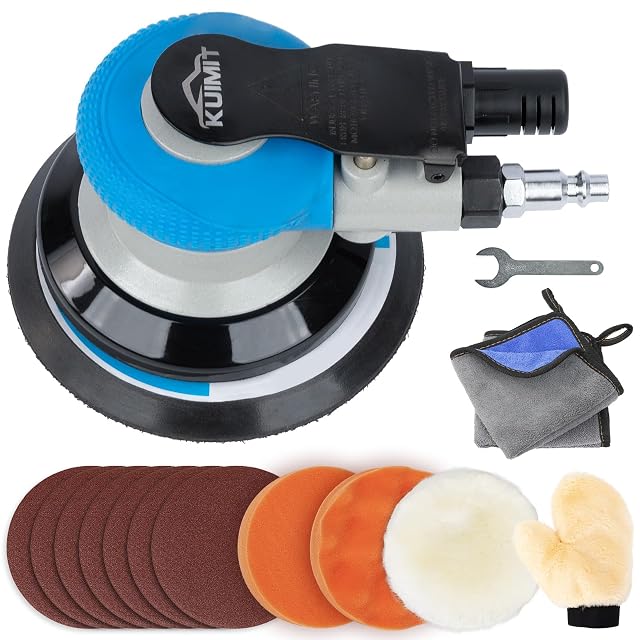
What you are getting
A 6-inch random orbit air palm sander with a composite body and a rubberized overmould, internal silencing stated to reduce tool noise, a built-in regulator, a hook-and-loop pad, a metal touch control trigger, and 10 sanding discs, a wrench and a 1/4 NPT female plug. 1.85 lb (839 g). 245 × 155 × 132 mm (9.65 × 6.10 × 5.20 in). $37.97.
It is the lightest published weight on this shelf
1.85 lb is 839 g. The TCP longboard here is lighter at 582 g, which is a shipping record rather than a maker figure — and a hand board rather than a tool you hold against a panel under air pressure.
| Sander | Stated weight |
|---|
| This sander | 1.85 lb (839 g) |
| TCP SA7336 | 1.89 lb (857 g) |
| Stahlwerk, published | 1 kg (2.2 lb) |
| KUIMIT | 3.1 lb (1.41 kg) |
| The other six | not published |
Eighteen grams separates it from the TCP SA7336 and 161 g (5.7 oz) from the published Stahlwerk sander, whose own page makes the case: a published weight “is the specification that decides a two-hour session”, and light enough means “genuine one-handed use on a door or a wing”.
The composite body is how: a plastic housing over a metal motor, where most air sanders are cast aluminum. the description calls it a low-weight housing with a rubberized overmould for comfort — the overmould being the part that insulates the hand from cold metal and from vibration.
What a composite housing gives up is being dropped on concrete, and nothing is published about impact.
And it is the only sander here that addresses noise
“The internal silencing greatly reduces tool noise.”
Air tools are loud, and this shelf’s published pages say so twice: “air tools are loud in a domestic garage”. A pneumatic motor’s noise is mostly the exhaust, and silencing means routing it through a muffler rather than straight out of a port.
Of the ten sanders here, this is the only one to claim it. The TCP SA7336 claims “vibration-free” instead, which is a different complaint, and the published Qwork sander claims precision balancing “for low vibration and noise” without saying how.
No decibel figure is published by any sander on this shelf, including this one. So the claim is directional — quieter than it would be — and not a number.
The trigger modulates, which is a different kind of speed control
“Metal Touch Control Trigger allows user to apply reliable amount of power” and “the built-in regulator allows you to match the speed of the tool to the job.”
Two controls doing two things. The regulator sets a ceiling; the trigger modulates underneath it with finger pressure.
The introduction: “Variable speed matters for the last passes.”
| Sander | Speed control |
|---|
| This sander | regulator ceiling plus a modulating trigger |
| TCP SA7336 | thumb lever, adjustable in use |
| DATOUBOSS | knob |
| KUIMIT | built-in regulator, 2,500–12,000 rpm published |
| The published four | not described |
No speed is published at all here — neither a free speed nor a range, which is unusual: seven of the ten sanders on this shelf publish at least a maximum. On a tool whose selling points are weight and quietness, the figure that would place it among the others is missing.
A hook-and-loop pad, and the pattern question nobody answers
“Velcro Pad for quick and easy changeover.”
Hook-and-loop only — where the TCP SA7336 on this shelf ships a PSA plate as well, and the TCP longboard takes PSA or clipped paper.
The buying advice: “match the pad hole pattern to your abrasive discs before buying either. A mismatched pattern turns an extraction sander into an ordinary one that also blocks its own pad.”
No hole pattern is published — not here and not on any of the ten sanders on this shelf, which is the single most consistent absence in this category. Ten discs come in the box, so it works on arrival; the eleventh disc is the one to check against the pad.
It publishes its fitting, which half this shelf does not
“1/4 NTP female plug” — NPT, the American tapered pipe thread, in the quarter-inch size that is standard for air tools.
| Sander | Fitting published |
|---|
| This sander | 1/4 NPT female plug supplied |
| TCP SA7336 | 1/4 in inlet, coupler plug supplied |
| DATOUBOSS | US-standard connector supplied |
| KUIMIT | industrial quick-connect fitting supplied |
| ZFE · the published four | not published |
Four of the six American sanders state it and none of the four published ones does — which on a shelf of air tools is the difference between sanding on the day it arrives and waiting for an adapter.
What is not published is the air consumption. Only the TCP SA7336 gives one, at 4.5 CFM at 90 PSI with a 2 hp compressor suggested, and a 6-inch sander of this type will want something close to that. The three published pages that mention it all list the absence as a reserve.
What is published about what it is for
“designed for surface preparation and final finish sanding of metals, plastics, composites, fillers and glass fiber used on autos and recreational vehicles. The orbital action provides the smoothest swirl free finish possible.”
Fillers named explicitly is useful — it is the material this shelf exists for, and the published Qwork page draws the line that matters: a fine orbit “is a paint-preparation throw, not a woodworking one”.
No orbit size is published here either, so which end of that line this sits on is unknown. On this shelf of ten, the published Qwork sander is the only one that states an orbit, at 5 mm.
What is not published
No orbit size. No speed or speed range. No air consumption and no operating pressure. No pad hole pattern. No noise figure, on the sander that sells itself on silencing. No vibration figure. No dust extraction — only the DATOUBOSS sander here has any. No disc grits for the ten supplied. No warranty term.
At $37.97 it is the lightest and the quietest claim on this shelf, with no number behind either.
Availability
On sale at around $38 on the American Amazon store at the time of checking.
Prices and availability are what Keepa reported on the date this page was updated; both move.
Prices quoted in this text were read on 6 October 2026. The live price is at the top of the page.