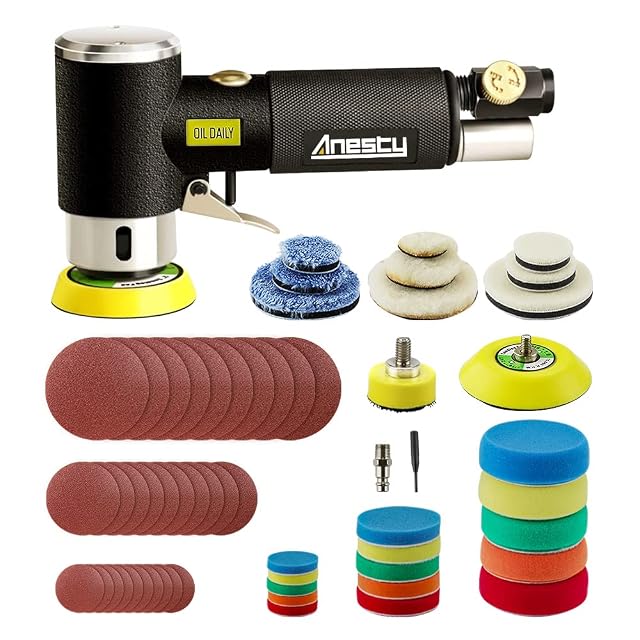
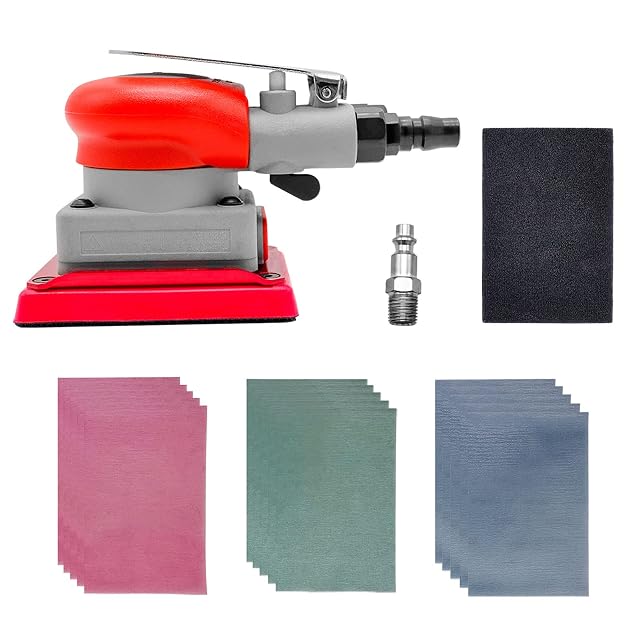
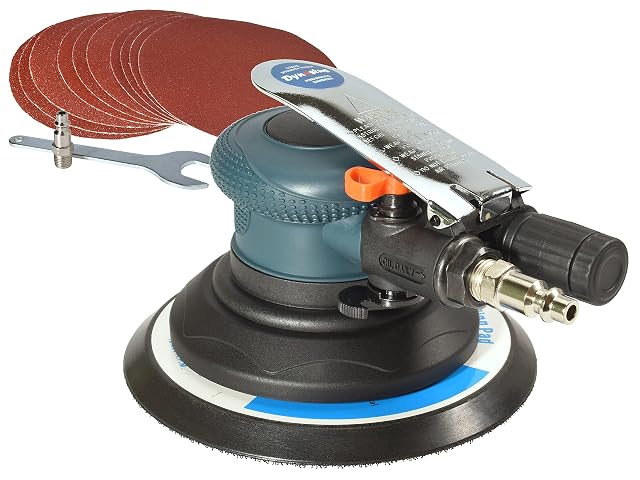
What you are getting
A palm-sized air dual action sander with a 12,000 rpm maximum and a built-in regulator adjustable from 2,500 rpm without stopping, a 5-inch hook-and-loop pad, a cushioned grip, and a kit: two microfibre cloths, a three-step contour sponge set in coarse, medium and fine, a washing mitt, an industrial quick-connect air fitting, a maintenance wrench and a manual. 3.1 lb (1.41 kg). 1,329 g (46.9 oz) packed. $35.99.
It is the only sander on this shelf that publishes both ends of its speed range
“Smart Speed Control — Built-in regulator allows real-time RPM adjustment (2,500-12,000) without stopping work.”
The introduction asks for exactly this: “Variable speed matters for the last passes.”
| Sander | Speed published |
|---|
| This sander | 2,500–12,000 rpm |
| ZFE mini · Si Fang, published | 15,000 rpm maximum |
| Qwork, published | 12,000 rpm maximum |
| Stahlwerk, published | 11,000 rpm maximum |
| DATOUBOSS · TCP SA7336 | 10,000 rpm maximum |
| Dynastus · Anesty, published · TCP longboard | none |
Seven sanders publish a maximum and one publishes a range. The bottom end is the half that matters on paint: 2,500 rpm is slow enough to flat a clear coat on 2000 grit without burnishing it, and the sanders that publish only a maximum do not tell you whether they go there.
Real-time adjustment is the other half — a regulator you can turn mid-pass rather than one you set and leave. The TCP SA7336 here does the same with a thumb lever; the DATOUBOSS uses a knob.
And the three-step contour sponge set is the useful part of the kit
“3-Step Contour Sponge Pad System (Coarse/Medium/Fine).”
Contour sponges are flexible abrasive blocks for the places a 5-inch disc cannot sit flat: a swage line, the radius round a lamp, the inside of a door shut. A graded set of three is the hand-finishing sequence that follows machine work.
Of the ten items on this shelf, four supply abrasives — the ZFE kit (18 sheets, 15 buffing pads, 3 backing plates), the DATOUBOSS (15 sheets at 1500/2000/3000), the Dynastus (10 discs) and the published Si Fang kit (30 polishing discs, 15 sheets, 3 plates). Only this one supplies anything for the contours.
What the rest of the kit is doing is less clear. Two microfibre cloths and a washing mitt are car-washing items; this site’s polishing pads shelf and a bucket are where they belong, not in a body-sanding kit. They are not bad inclusions; they are not sanding.
Three point one pounds, which is the heaviest hand sander here
3.1 lb is 1.41 kg.
| Sander | Stated weight |
|---|
| Dynastus 6 in | 1.85 lb (839 g) |
| TCP SA7336 | 1.89 lb (857 g) |
| Stahlwerk, published | 1 kg (2.2 lb) |
| This sander | 3.1 lb (1.41 kg) |
That is 68% heavier than the lightest sander on this shelf, on a tool described as “palm-sized” and “weighs less than a 6-pack”.
The published Stahlwerk page sets the standard the other way: 1 kg (2.2 lb) is “light enough for genuine one-handed use on a door or a wing”. At 1.41 kg (3.1 lb), one-handed use on a vertical panel is a shorter session.
KUIMIT’s own copy is worth reading for what it is: “so smooth, you could sand one-handed drinking coffee” is an image, not a specification, and the sentence next to it — “weighs less than a 6-pack” — is a comparison to a quantity of beer.
And the title and the reference disagree about the pad size
The title says “KUIMIT 5” Air Sander Kit” and the first bullet “5” Hook & Loop Pad”. The published reference is “DMJ-Black-6in”.
Five inches is 125 mm (4.92 in) and six is 152 mm (5.98 in) — the two standard sizes, and the difference between them is which discs fit.
The bullets say five twice and the reference says six once, so five is the better reading. It is still worth confirming before ordering discs, because on this shelf no sander publishes a hole pattern and the diameter is the only compatibility figure there is.
Twelve thousand rpm, and what a maximum means on a paint job
“delivers 12,000 RPM max speed with minimal vibration. The compact palm design ensures full control.”
Twelve thousand matches the published Qwork sander and sits below the two mini tools here at 15,000. On a 5-inch pad it is a fast tool, which suits leveling rather than finishing — and the range down to 2,500 is what lets it do both.
“Minimal vibration” is a claim without a figure, as every vibration claim on this shelf is. The introduction asks for “low stated vibration”; no sander here publishes a number.
The fitting is supplied, which four of six American sanders manage
“Industrial Quick-Connect Air Fitting” and a maintenance wrench in the box.
Four of the six American sanders supply or name a fitting and none of the four published ones does. On a shelf where every powered tool is pneumatic, that is the difference between working on arrival and waiting for an adapter.
No air consumption is published — only the TCP SA7336 gives one, at 4.5 CFM at 90 PSI with a 2 hp compressor suggested.
What is not published
No orbit size, this shelf’s first criterion, answered only by the published Qwork sander at 5 mm. No pad hole pattern. No air consumption or operating pressure. No dust extraction — only the DATOUBOSS sander here has any. No vibration or noise figure. No abrasive discs in a kit that contains sponges, cloths and a mitt. No warranty term.
At $35.99 it is the only sander here that tells you how slowly it will go, in a kit that includes a washing mitt.
Availability
On sale at around $36 on the American Amazon store at the time of checking.
Prices and availability are what Keepa reported on the date this page was updated; both move.
Prices quoted in this text were read on 6 October 2026. The live price is at the top of the page.