What you are getting
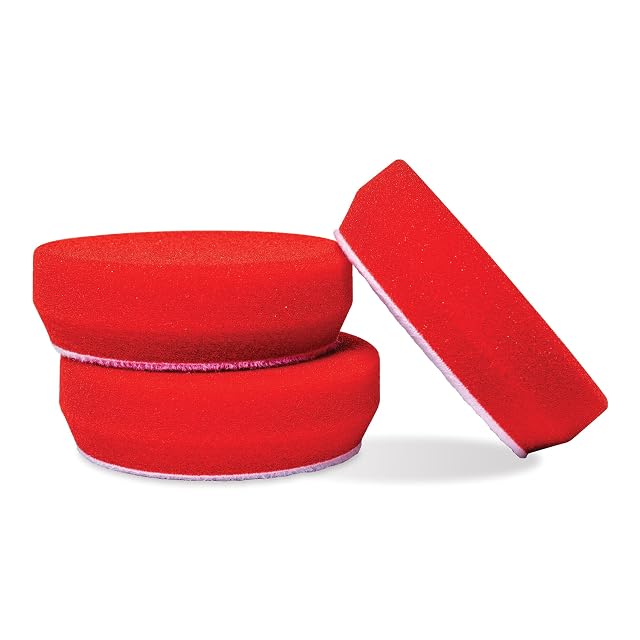
Three 3-inch wax pads in premium open-cell foam with a flat beveled face, an upgraded micro hook-and-loop backing and thermoset bonding, stated for precise, even application of waxes and sealants with easy product removal and no high spots. Machine washable. By hand or on a random orbital. 23 g. $18.89.
It is the only pad on this shelf with no cutting claim at all
Read the five bullets and the absence is the specification. There is no mention of swirls, scratches, haze, defects or correction anywhere in the listing — only “even, streak-free application”, “uniform coverage”, “easy wipe-off with no high spots or missed areas”.
That is deliberate, and it is the most useful thing about it.
| Item | Stated cut |
|---|
| Griot’s microfibre 5.5 in | moderate to severe scratches |
| Griot’s orange 3 in · 6.5 in | light to moderate defects |
| Griot’s black 3 in | fine swirls, delicate paint |
| Griot’s red 3 in | none |
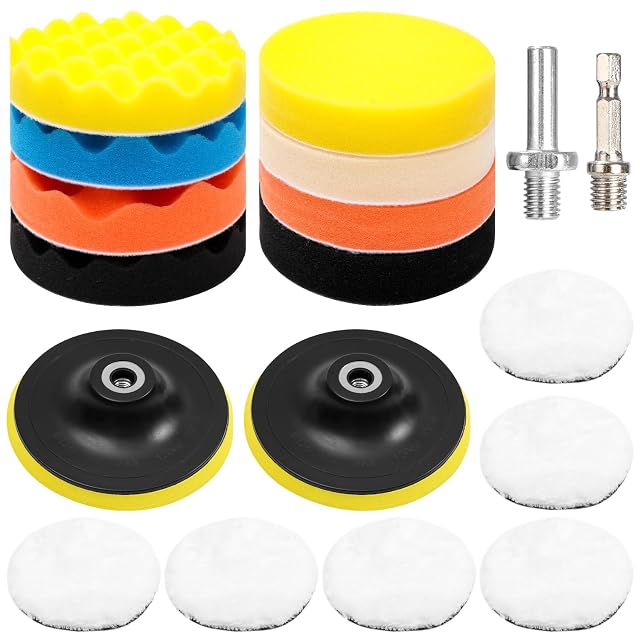
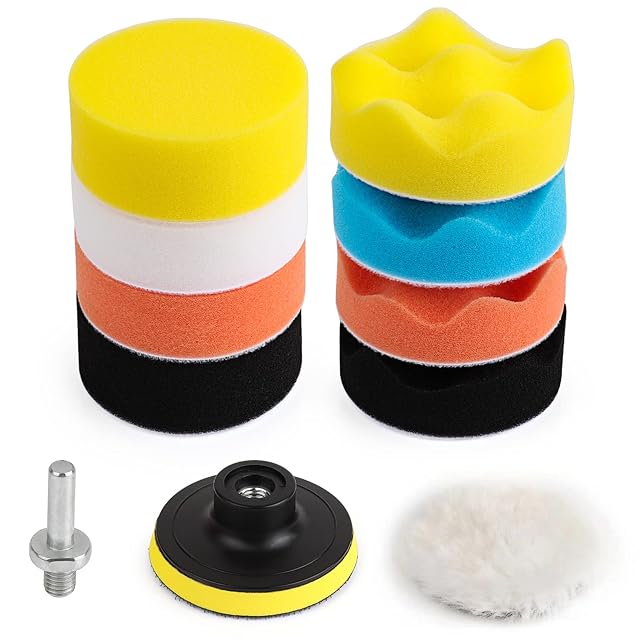
| Huifoo · Kshineni · Lompyeu · Meet You, published | none stated |
The four published sets also state no cut level — but by omission rather than by design. Their own pages record it as the gap: “no density grading published”, “color-coded density is not standardized”. This pad states no cut because it is not meant to cut.
And that is why a wax pad should never be in the correction rotation
A pad that has carried wax or sealant has silicone, polymer or oil in its foam, and no amount of washing takes all of it out. Put that pad back on a cutting job and it fills the paint instead of correcting it — defects look better for a week and come back.
Keeping the two separate is the reason a graded system has a color for application. The introduction notes that “every brand uses color, and no two brands agree on it”; within this maker’s range the rule is consistent and it is the one worth obeying: red is for the last step and nothing else.
On this shelf the published mixed sets make that impossible to enforce, because nothing identifies which pad was which.
Open-cell foam, which is the same structure as the correcting pad
“Crafted from premium open-cell foam, these waxing pads offer improved durability and tear resistance.”
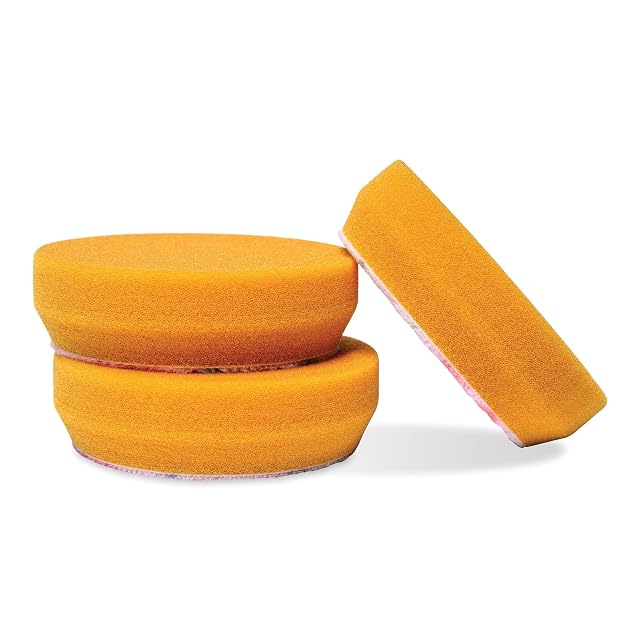
The orange correcting pad on this shelf states the same structure; the black finishing pad states only “premium foam construction”.
So on published information these two pads differ by color, job and nothing else: same size, same foam type, same beveled flat face, same thermoset bonding, same washability, both sets of three — $19.99 for the orange, $18.89 for the red.
That is a dollar and ten cents, and the difference the maker is selling is density, which neither listing publishes. The introduction’s whole first paragraph is about that gap: foam “is graded by density rather than by color”, and the number is not there.
What can be said: a wax pad is normally the softest foam in a range, because spreading wants compliance and not bite.
The micro hook-and-loop face, as on the finishing pad
“Upgraded micro hook-and-loop system ensures firm grip and fast pad changes.”
This and the black finishing pad state the micro version; the orange correcting pad states a plain hook-and-loop. Denser, finer hooks spread the shear load and keep the stack thin, which is the introduction’s second rule — “the hook-and-loop face has to hold under heat.”
On a wax pad the heat case is weaker, because applying wax is a low-pressure, low-speed pass. The grip case is not: a wax pad is run at the lowest machine setting, and a pad that creeps on the plate at low speed throws product.
Three inches, and the published reason for the bevel
76 mm, for bumpers, mirror caps, pillars, around badges.
“These car wax applicator pads feature a flat beveled face that spreads waxes and sealants smoothly and evenly for uniform coverage and easy wipe-off with no high spots or missed areas.”
A high spot is where too much product sat and cured — the thing that makes wax hard to remove and leaves a smear. A flat face with a bevelled rim lays an even film and does not deposit a ridge at the edge of the pass, which is what a square-edged pad does.
Three in the pack is generous for this job: a wax pad is loaded with product rather than with spent compound, and it lasts.
Machine washable, and this is the pad that most needs it
“Durable thermoset bonding makes these car wax buffing pads strong enough for machine washing and repeated use without falling apart.”
Wax and sealant set. A pad left loaded goes hard, and a hard pad does not spread — it drags. Washing is what keeps it usable, and the thermoset bond is why washing does not delaminate it.
Washability is one of the introduction’s four comparisons, and none of the four published sets on this shelf mentions washing at all.
What is not published
No density figure, which is the only thing that separates this from the orange pad on published information. No pad thickness. No intended plate size — a 3-inch pad wants a 2-inch plate, and the only plate on this shelf is 5 inches. No maximum speed, on a pad meant for the lowest setting. No washing temperature. No statement of which products it suits beyond Griot’s own waxes and sealants.
At $18.89 for three it is the cheapest item on this shelf, and the only pad here that is honest about doing nothing to the paint.
Availability
On sale at around $19 on the American Amazon store at the time of checking.
Prices and availability are what Keepa reported on the date this page was updated; both move.
Prices quoted in this text were read on 6 October 2026. The live price is at the top of the page.