The only backing plate here, and the only listing that sizes a pad to it
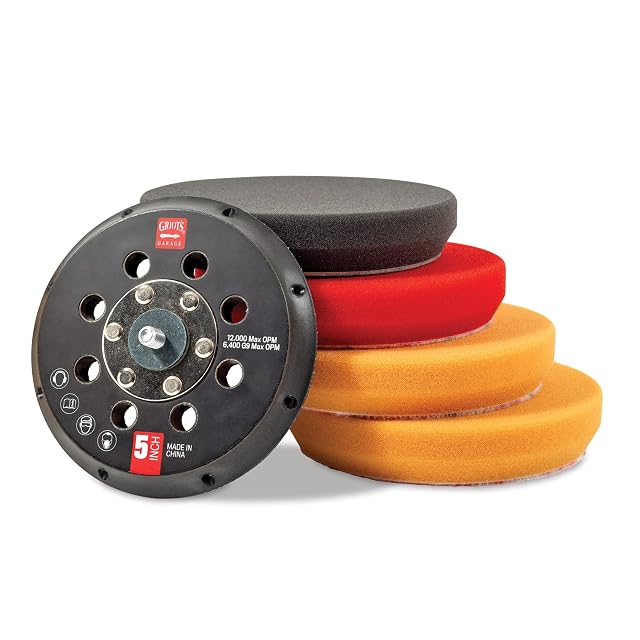
Griot’s Garage 5 in conversion kit, plate and three pads
The only item here that includes a backing plate, with pads a half-inch larger than it.
What you are getting
A 5-inch vented backing plate with a flexible, chamfered edge, plus two 5.5-inch orange correcting pads, one 5.5-inch black finishing pad and one 5.5-inch wax pad. Stated to fit Griot’s Garage 6-inch random orbitals, the G9 polisher, and dual action polishers with a 5/16-inch-24 threaded shaft. 191 g (6.7 oz), 292 × 140 × 102 mm (11.5 × 5.51 × 4.02 in). $50.99.
It is the only item on this shelf that answers the sizing rule
The introduction states two mechanical rules and puts them above the foam grade: “Two mechanical details matter more than the grade: the pad must be slightly larger than the backing plate so the edge does not catch, and the hook-and-loop face has to hold under heat.”
This kit is a 5-inch plate sold with 5.5-inch pads. A published half-inch of overhang — a quarter-inch all round.
That is the rule applied rather than described, and no other listing on this shelf touches it. The four pad sets published earlier state a pad diameter and leave the plate to you: 80 mm (3.15 in), 125 mm (4.92 in), 125 mm (4.92 in), 150 mm (5.91 in). The other five Griot’s items on this shelf state a pad size and no plate.
Why the overhang matters: a pad flush with its plate puts the plate’s rigid edge at the contact patch, and on a curved panel that edge digs in. Half an inch of foam beyond the plate means the pad flexes before the plate reaches the paint.
It is also the only item on this shelf that includes a plate at all, which on an unconverted polisher is the part that is missing.
And it publishes the thread, which is the compatibility question
“fits Griot’s Garage 6” Random Orbitals, G9 orbital polisher, and dual action polishers with a 5/16”- 24 threaded shaft.”
That matters on this shelf more than it looks:
| Item | Fitting published |
|---|
| This kit | 5/16 in-24 threaded shaft |
| Huifoo 18-piece, published | M10 drill adapter |
| Kshineni 80 mm (3.15 in), published | drill adapter with shank |
| The other four Griot’s items | hook-and-loop face only |
5/16-24 is the common American polisher thread; M10 is metric. They are not interchangeable, and a pad set bought for one machine will not mount on the other without the right plate. This site’s dual action polishers shelf is where the machine comes from, and the thread is the first thing to read off it.
The plate is vented and chamfered, with the reason given
“Features a flexible, chamfered edge that hugs body lines for better pad control and feedback from the paint… helps reduce surface tension, increase pad rotation, and speed up defect removal.”
Three claims, and they are connected. Venting lets air through the plate, which carries heat out of the foam — the other half of the introduction’s heat rule. Reducing surface tension is the real mechanism behind a vented plate: a solid plate presses a flat pad against a flat panel and the pad stops rotating, because a dual action polisher’s rotation is driven only by friction. Holes break that seal.
Pad rotation is the thing that does the cutting on a DA machine. A pad that stops turning is a pad that oscillates in place and polishes nothing, and it is the commonest reason a first attempt at correction does nothing.
A chamfered, flexible edge is the same idea as the half-inch overhang, built into the plate.
Three grades in one box, which is what the shelf’s own line describes
The line at the top of this shelf: “Cut, polish, finish — three pads for one machine.”
| Pad | Color | Stated job |
|---|
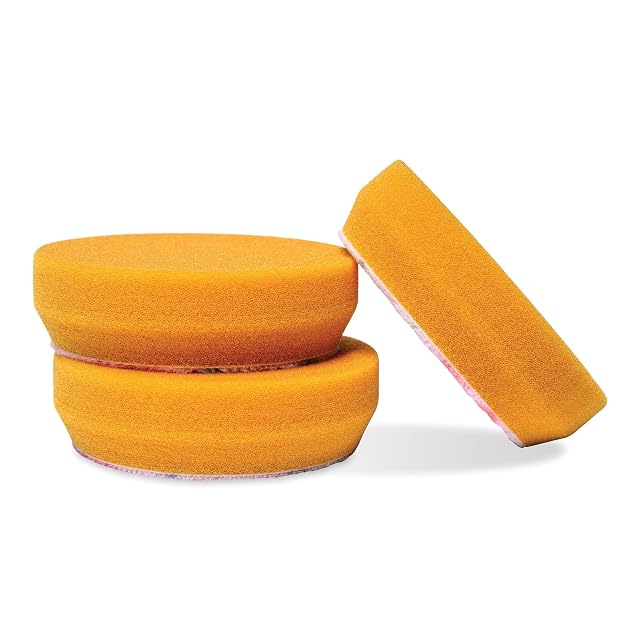
| ×2 | orange | light to moderate defects, with any Griot’s polish |
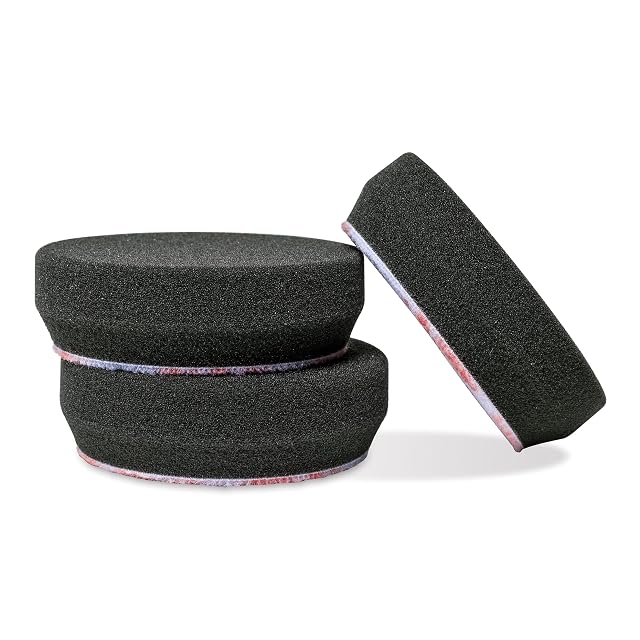
| ×1 | black | fine swirls and scratches on delicate finishes |
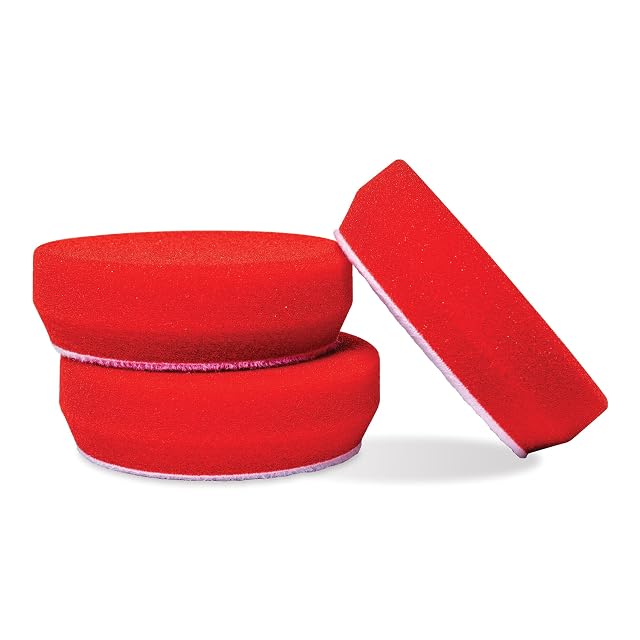
| ×1 | red | even application of waxes and sealants |
That is the full sequence, and two of the orange are supplied rather than one — which is the buying advice on this shelf, published as a pack: “buy several of the pad you use most, not one of each. A saturated pad stops cutting long before it looks used.”
The correcting pad is the one that saturates, because it is the one that carries compound. Griot’s has put the second one in the box.
And it is the only Griot’s item here that mixes grades
The other five are single-grade packs: three 3-inch pads of one color, two microfibre, two 6.5-inch correcting. This is the only one that covers the whole job.
It is also the most expensive item on this shelf at $50.99, against €8 to €20 for the four published multi-pad sets — which contain eight to twenty-two pads of unstated density and no plate. The comparison is a graded system with a plate against a bag of foam, and the price reflects it.
What is not published
No foam density figures — the grades are named by color and job, not by a measured density, which the introduction notes is universal: “every brand uses color, and no two brands agree on it.” No plate thickness or hole pattern. No pad thickness, where the BOSS microfibre pad on this shelf publishes a 1/4-inch foam layer and the published Lompyeu set calls its foam “thick”. No washability for these pads, which the other five Griot’s items state explicitly. No maximum speed for the plate.
At $50.99 it is the only way onto this shelf without already owning a plate, and the only listing that sizes a pad against one.
Availability
On sale at around $51 on the American Amazon store at the time of checking.
Prices and availability are what Keepa reported on the date this page was updated; both move.
Prices quoted in this text were read on 6 October 2026. The live price is at the top of the page.