What you are getting
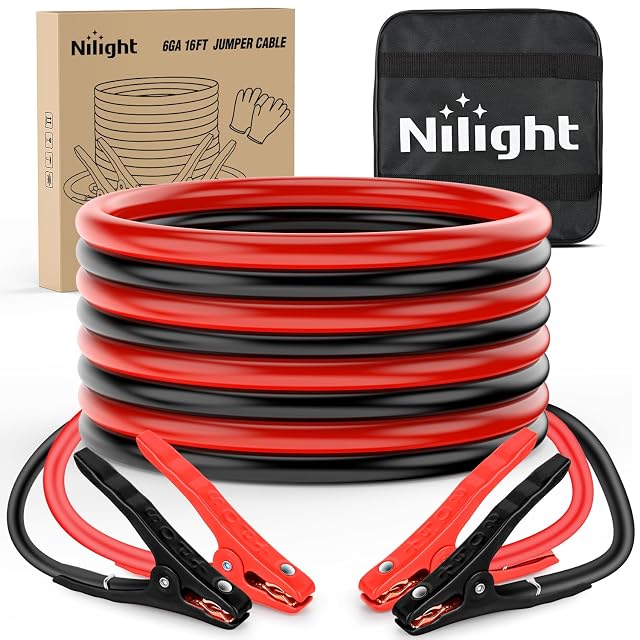
Sixteen feet (4.9 m) of 6-gauge red and black cable in a premium PVC sheath, copper-coated aluminum (CCA), stated to withstand 450 A of instantaneous current, with clamps fully wrapped in PVC insulation and strong jagged teeth and spring; flexible from −40 °C / −40 °F to a stated maximum working temperature of 75 °C / 167 °F; a storage bag and gloves. $23.99.
Six gauge is 13.3 mm (0.52 in)², which is the thinnest section on this shelf
The introduction asks for the figure directly: “the conductor cross-section in mm²… A thick-looking cable can be mostly insulation.”
Six AWG is 13.3 mm (0.52 in)² on the standard wire table.
| Lead | Cross-section |
|---|
| IWH, published | 50 mm (1.97 in)² |
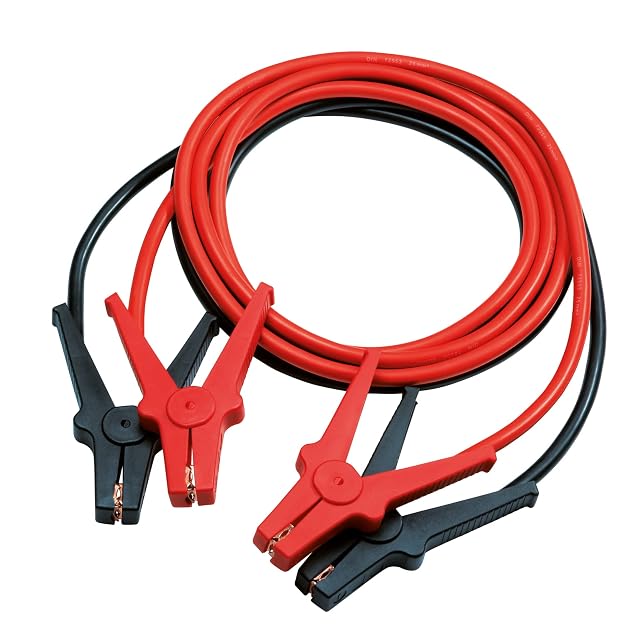
| Hella, published | 35 mm (1.38 in)² |
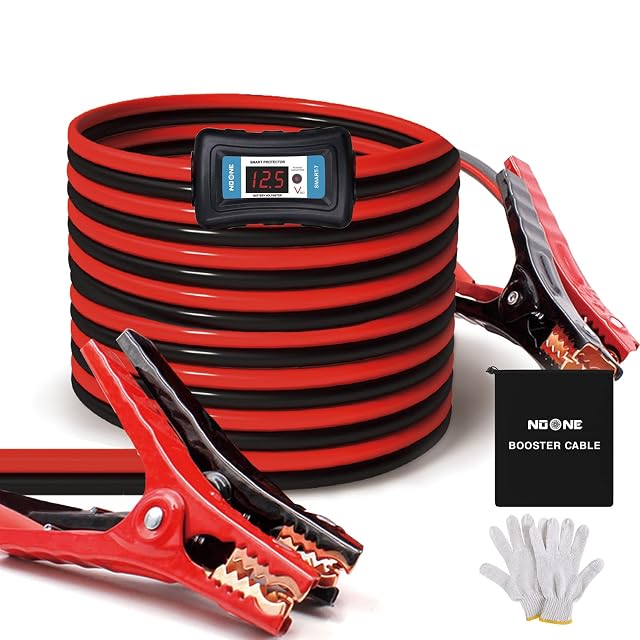
| Noone | ≈ 33.6 mm (1.32 in)² (2 AWG) |
| Einhell, published | 31.4 mm (1.24 in)² |
| AEG, published | “equivalent to 25 mm (0.98 in)² copper” |
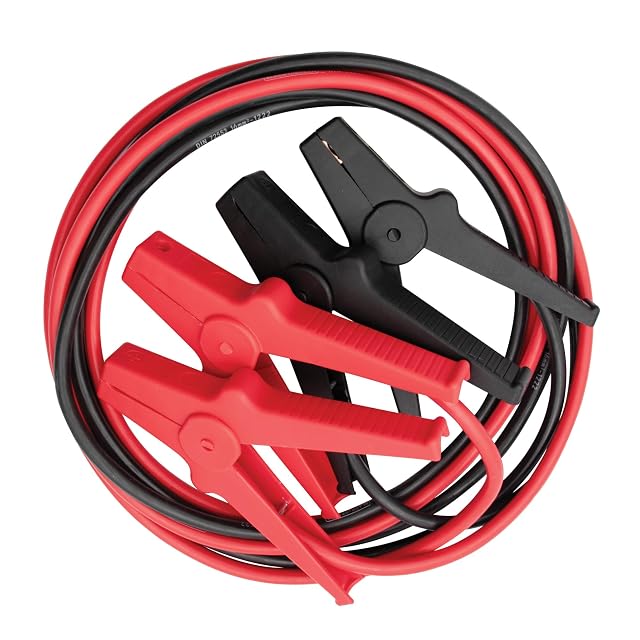
| Schumacher, published | 16 mm (0.63 in)² |
| This lead · Energizer · K KRIËGER · CARTMAN | ≈ 13.3 mm (0.52 in)² (6 AWG) |
Four of the five American leads on this shelf are 6 gauge, and all four sit below the thinnest published lead. That is the single most useful thing to know about this half of the shelf: the American leads are cheaper and thinner, and $23.99 against €76 for the published IWH pair at 50 mm (1.97 in)² is roughly the shape of the difference.
What 13.3 mm (0.52 in)² means in practice: it will start a small or mid-size petrol car from a healthy donor. The listing says so — “perfect for small/compact cars, coupe, sedan, motorcycle” — and that is a narrower claim than the Energizer and K KRIËGER pairs make on the same gauge, which both list “trucks, SUVs, full-size cars”.
On the same section and almost the same length, the honest claim and the broad one differ by a sentence.
It is the only lead on this shelf to publish both temperature limits
“The tangle-free PVC-insulation wires remain flexible even in extreme temperatures (max work temperature: 75℃/167°F, low temperature: −40°C (-40 °F)/−40°F).”
The introduction makes cold the clamp question: “insulation that does not crack in the cold — which is when they are used.”
| Lead | Cold limit | Hot limit |
|---|
| This lead | −40 °C (-40 °F) | 75 °C (167 °F) / 167 °F |
| Noone | −40 °F (= −40 °C) | 140 °F (60 °C) |
| Energizer · K KRIËGER | −40 °C (-40 °F) | not stated |
| CARTMAN | −25 °C (-13 °F) | not stated |
| The five published leads | not stated | not stated |
Seventy-five degrees Celsius is the figure nobody else goes near, and it is the relevant one for a lead left clamped to a terminal while an engine runs — an engine bay at idle in summer is well past 60 °C (140 °F) near the block.
The CARTMAN pair on this shelf stops at −25 °C (-13 °F), fifteen degrees short of the rest, which is the kind of difference that only shows up on the morning it matters.
Four hundred and fifty amps, which the shelf says is not a specification
“6 gauge cables can withstand up to 450 Amp of instantaneous current.”
The introduction: “Jump leads are sold on an amp rating that no standard governs.”
Two of the nine leads here publish one: this at 450 A and the Noone pair at 600 A on 2 gauge. No duration, no temperature, no method, on either. Read them as the makers’ relative claims rather than as measurements — and note that 600 against 450 is a 1.33× ratio for a 2.5× difference in conductor area.
The five published leads give engine sizes instead, which is at least a claim about a vehicle: petrol to 7000 cc, diesel to 4000 cc on the Hella and IWH pairs.
The clamps are fully wrapped, with the teeth described
“The clamp is fully wrapped with PVC insulation coating to prevent short circuits accidental contact, and protect against rust and corrosion… Strong jagged teeth and spring provide excellent force grip and outstanding conductivity.”
The introduction’s clamp test has three parts: “jaws that reach around a terminal, springs strong enough to hold, and insulation that does not crack in the cold.”
This answers two of the three. The jagged teeth are the grip on a lead post that is already soft and corroded; the spring is the force behind them; and full PVC wrapping is what stops a dropped clamp shorting. No jaw opening is published, which is the first of the three and the one that decides whether a clamp reaches around a side-post terminal — and no lead on this shelf publishes it.
The published IWH pair answers the question differently with “solid cast clamps” rather than pressed sheet, which its page calls “the part that fails on cheap leads”.
Gloves, which two leads here supply and no published lead does
“Package Includes: 6 Gauge 16 FT jumper cables with clamps, storage bag and gloves.”
This and the Noone pair are the two. They are work gloves, not electrical gloves, and the point is cold steel rather than insulation: the whole procedure happens at the temperature where the cable’s −40 °C (-40 °F) rating is relevant.
The bag is the other inclusion and it is nearly universal here — four of the five American leads and two of the five published leads state one. The published AEG page gives the reason: a bag “is what stops the clamps biting through their own insulation in a boot”.
The second bullet names the conductor outright: high-quality conductive copper-coated aluminum, abbreviated CCA.
The introduction: “aluminum carries roughly two-thirds of what copper carries for the same section.”
So 13.3 mm (0.52 in)² of CCA behaves like roughly 9 mm (0.35 in)² of copper. That is the real number behind the price, and this listing is one of three American leads here that name the material at all — the Energizer and K KRIËGER pairs name copper-clad aluminum in their fourth bullet, while the Noone and CARTMAN listings say “excellent conductivity” and “high-density CCA” respectively.
Not one of the nine leads on this shelf is solid copper.
What is not published
No cross-section in mm² — gauge only. No engine size claims, where four published leads give petrol and diesel figures. No clamp jaw opening. No voltage range, where three published leads state 24 V. No cable weight or stored size. No warranty term, where the Noone pair states three years.
At $23.99 it is the only lead on this shelf that tells you how hot its insulation may get, on the thinnest section the shelf offers.
Availability
On sale at around $24 on the American Amazon store at the time of checking.
Prices and availability are what Keepa reported on the date this page was updated; both move.
Prices quoted in this text were read on 6 October 2026. The live price is at the top of the page.