What you are getting
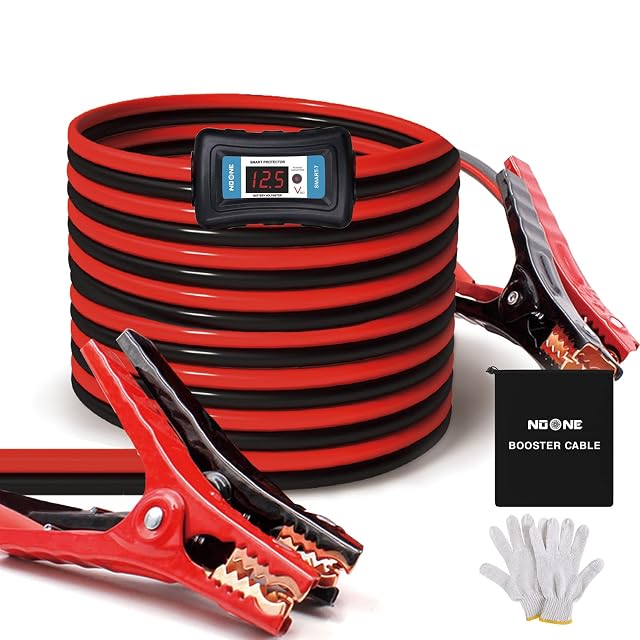
Twenty feet (6.1 m) of 2-gauge cable in a thick vinyl coating, stated to withstand 600 A of instantaneous current and to work from −40 °F to 140 °F; a Smart-7 protector with an LCD voltage display and reverse-polarity protection that lights a red indicator on a wrong connection; UL-listed clamps, patented, covered in non-conducting rubber; a carry bag and gloves; 3 years of after-sales service. $34.98.
Two gauge is 33.6 mm (1.32 in)², which puts it with the published leads rather than the American ones
The introduction to this shelf is unusually specific about what to buy on: “the conductor cross-section in mm² and whether that conductor is copper or copper-clad aluminum. A thick-looking cable can be mostly insulation.”
American leads are sold in AWG. The conversion is a standard table:
| Lead | Gauge | Cross-section | Length |
|---|
| IWH, published | — | 50 mm (1.97 in)² | 6 m (20 ft) |
| Hella, published | — | 35 mm (1.38 in)² | 4.5 m (15 ft) |
| This lead | 2 AWG | ≈ 33.6 mm (1.32 in)² | 6.1 m (20 ft) |
| Einhell, published | — | 31.4 mm (1.24 in)² | not stated |
| AEG, published | — | “equivalent to 25 mm (0.98 in)² copper” | 2 × 3.5 m (7 × 11 ft) |
| Schumacher, published | — | 16 mm (0.63 in)² | 3 m (10 ft) |
| Nilight · Energizer · K KRIËGER | 6 AWG | ≈ 13.3 mm (0.52 in)² | 4.9 m (16 ft) |
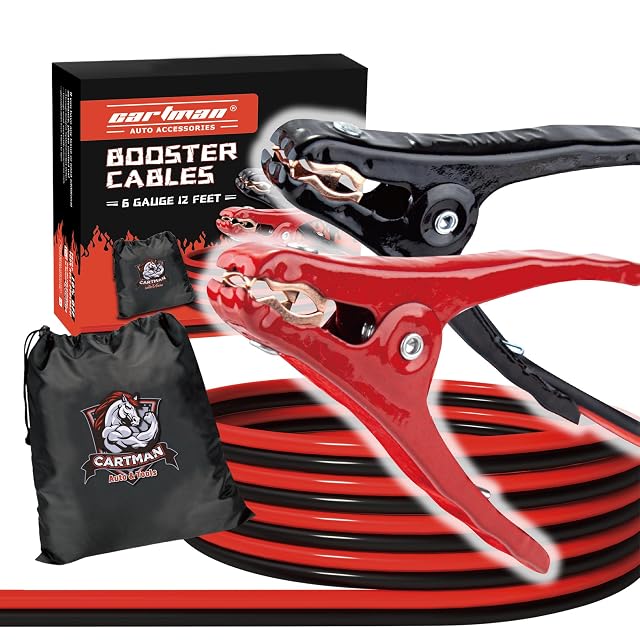
| CARTMAN | 6 AWG | ≈ 13.3 mm (0.52 in)² | 3.7 m (12 ft) |
This is the only American lead on this shelf that is not 13.3 mm (0.52 in)², and at 33.6 mm (1.32 in)² it sits between the published Einhell and Hella pairs — with 6.1 meters (20 ft), the second-longest cable here after the published IWH set.
That combination is the whole purchase. The introduction warns that “length is a trade, since every extra meter costs voltage” — and the way out of the trade is section. Twenty feet of 2-gauge loses less than sixteen feet of 6-gauge, because the conductor is two and a half times the area.
And the clamps are UL listed, which nothing else on this shelf is
“UL LISTED CLAMPS — Patented design clamps covered with non-conducting rubber, which makes NOONE jumper cables safer and more durable, and provides additional drop resistance and insulated protection.”
The introduction puts the clamps second: “jaws that reach around a terminal, springs strong enough to hold, and insulation that does not crack in the cold — which is when they are used.”
A UL listing means a recognized laboratory tested the part against the applicable standard. Of the nine leads on this shelf, this is the only one with any third-party mark — the published IWH pair is “stated to meet DIN requirements, which is a compliance claim by the maker rather than a listing, and nothing else states either.
Non-conducting rubber over the whole clamp is the other half. A fully covered clamp that slips off a terminal and lands on a wing does not short; a bare-backed clamp does. The published Einhell pair states “4 fully insulated pole clamps” for the same reason.
The voltage display is the feature that is actually unusual
“LCD Digital Display can effectively monitor the battery voltage during charging. Reverse Polarity Protection aims to protect the connection from short-circuiting and connection error, when wrong connection, the red indicator will on.”
Two functions in the module between the cables. The display tells you what the flat battery is doing while the donor car runs — whether it is rising towards 13 volts or sitting dead at 10, which is the difference between waiting another five minutes and calling someone.
The reverse-polarity warning is the one that matters more. Connecting red to negative across two batteries is how alternators, ECUs and fuses are destroyed, and a red light before the current flows is worth more than the cable.
Of the nine leads here, the published Einhell pair is the only other one with any electronics — LEDs in the clamps, which its page calls “the one genuinely useful innovation in this category”. Lighting the terminal and reading its voltage are two different answers to the same roadside problem.
Six hundred amps, on a rating the shelf says means nothing
“These booster cables can withstand up to 600Amp of instantaneous current.”
The introduction’s first clause: “Jump leads are sold on an amp rating that no standard governs.”
Two of the five American leads here publish one — this at 600 A and the Nilight pair at 450 A — and none of the five published leads publishes any. There is no test method behind either figure, no duration, no temperature. What the figures do tell you is the ratio the makers believe: 600 against 450 for 33.6 mm (1.32 in)² against 13.3 mm (0.52 in)², which is a smaller ratio than the sections.
The published leads answer the same question differently, in engine sizes: the Hella and IWH pairs state petrol to 7000 cc and diesel to 4000 cc. That is also a maker’s claim, and it is at least a claim about a car.
Minus forty, and a stated upper limit
“works well in extreme environments (−40℉ ~ 140℉).”
Minus forty Fahrenheit is minus forty Celsius — the one point where the two scales meet. Four of the five American leads here state it, and this is the only one that also states an upper limit, 140 °F (60 °C), which is an engine bay in August with the clamps on the terminals.
The published leads state no temperature at all. The outlier is the CARTMAN pair on this shelf, flexible only to −25 °C (-13 °F), which is 15 degrees short of the rest.
Gloves, a bag and three years
“2 Gauge x 20 Ft smart-7 protector Jumper Cables ×1, Carry Bag ×1, Gloves ×1. NOONE provides 3 years After-sales Service.”
Two of the five American leads supply gloves — this and the Nilight pair. None of the published leads does. They are thin work gloves rather than electrical gloves, and what they are for is the cold: handling steel clamps at minus ten with bare hands is the part nobody plans for.
Three years of after-sales service is the longest term on this shelf. The CARTMAN pair states “a hassle-free warranty” with no period; nothing else states one.
But it is copper-clad aluminum, like every lead on this shelf
The listing says “excellent conductivity and power transmission” and never says copper.
The introduction: “whether that conductor is copper or copper-clad aluminum… aluminum carries roughly two-thirds of what copper carries for the same section.”
Not one of the nine leads on this shelf is solid copper. The five American ones are CCA; the published five are “aluminum”, “copper-aluminum”, “copper-coated aluminum” and “aluminum-copper”. So the material question has one answer across the shelf, and the section is what separates them — which is why 33.6 mm (1.32 in)² against 13.3 mm (0.52 in)² is the number that matters here.
What is not published
No cross-section in mm² — the gauge is published and the conversion is left to you. No material named, beyond “excellent conductivity”. No engine sizes, where four published leads state petrol and diesel capacities. No clamp jaw opening, which decides whether it reaches around a side-post terminal. No cable weight. No voltage range — 12 V is implied and 24 V is not mentioned, where three published leads state 24 V.
At $34.98 it is the most expensive American lead here, the only one with a UL listing, and the only one that tells you what the battery is doing.
Availability
On sale at around $35 on the American Amazon store at the time of checking.
Prices and availability are what Keepa reported on the date this page was updated; both move.
Prices quoted in this text were read on 6 October 2026. The live price is at the top of the page.