What you are getting
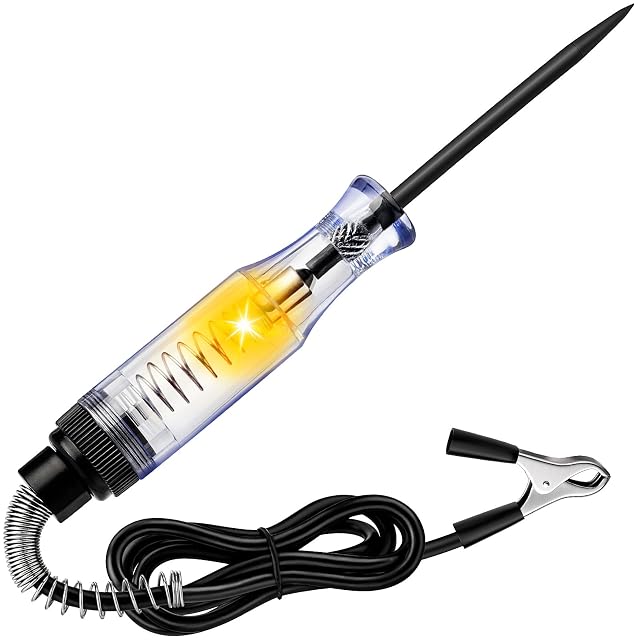
A test light for 6 to 24 V DC with a quality bulb whose brightness varies with the measured voltage, a 39-inch PU wire lead, a long sharp stainless steel probe, an insulated handle, a transparent non-slip body and large alligator clips. $4.95.
It has a bulb, which is the distinction this shelf opens with
The introduction’s first comparison: “The old incandescent probe draws enough current to prove a circuit can carry a load, which is exactly what makes it unsuitable near sensitive control modules; an LED tester draws almost nothing and is the safer default on modern cars.”
| Tool | Indicator |
|---|
| This tester | filament bulb |
| Qwork, published | incandescent-style lamp |
| WINAMOO ×2 · Ansbell · Kaisal · Xastro, published | LED or digital |
| BGS, published | LED diode lamp |
| CrysGuard · XENIVO · VIREVO | neither — tracer and ammeters |
Two of the eleven tools on this shelf are lamps, and this is one of them. That is not a defect; it is a different instrument.
What a bulb does that a diode cannot: it draws real current — a few hundred milliamps — so it proves the circuit can actually supply something. A corroded connection with a high resistance will show full voltage to a digital tester drawing microamps and collapse the moment a bulb is put across it. That collapse is the fault. A digital reading of 12.4 V on a circuit that cannot light a 2 W bulb is a true reading and a useless one.
What it costs: those same few hundred milliamps through a control module output can damage it. Modern body modules switch lights electronically and are rated for the lamp they drive, not for a test lamp wired across them.
So this is the tool for lights, motors, horns, fuses and feeds — and not for anything that comes out of a module.
And its brightness varies with voltage, which is a published function
“The bulb’s brightness varies with different measured voltages, offering intuitive circuit signal indication and making it easy to assess circuit conditions.”
That is the old method stated as a feature, and it works. A bulb at full brightness is a healthy feed; a bulb that glows dull orange is a feed with a volt drop in it — a bad earth, a corroded crimp, a tired switch. No number, no display, and a decision made in half a second.
The digital testers on this shelf read the same fault as a number: the Ansbell’s ±0.2 V accuracy is the only published figure fine enough to measure it. Two ways to the same answer, and the bulb is the one that also proves the circuit can carry current.
A thirty-nine-inch lead, which is the shortest here
39 inches is 0.99 meters.
| Tool | Lead length |
|---|
| Ansbell | 14.7 ft (4.48 m) |
| WINAMOO WITL111A | 96 in (2.44 m) |
| This tester | 39 in (0.99 m) |
| The other eight | not published |
One meter is enough to clip to a battery post and reach the fuse box above it, or to clip to a bracket and reach the lamp beside it. It is not enough to work a circuit from one end to the other, which means moving the clip — and the introduction names the lead length as one of the things that matter for exactly that reason.
What is published about the lead is good: “39 inch PU wire is both flexible and lightweight, yet more robust than standard cables.” Polyurethane stays flexible when cold, where PVC stiffens — which on a tool used in a January engine bay is the difference between a lead that lies where you put it and one that fights you.
Six volts at the bottom, which leaves signal circuits out
6 to 24 V DC covers 6 V classics, 12 V cars and 24 V commercial systems.
What it does not cover is below 6 V. Three tools on this shelf read from 3 V — the two WINAMOO testers and the published Xastro — and that is where sensor references and analog outputs live.
For a lamp tester that is consistent: a bulb needs several volts to glow at all, so a 3 V range would be meaningless on this kind of tool. It is a limit of the instrument rather than an omission.
The probe is long, sharp and insulated at the handle
“a long, sharp stainless steel probe that easily pierce wire insulation and access tight spaces… while the insulated handle enhances safety.”
The introduction asks for a tip that can “back-probe a connector without piercing insulation”, and this is a piercing probe like most on this shelf. The published BGS page states the cost: a hole “must be sealed afterwards”, and water finds the ones that are not.
The insulated handle is the part worth having at this price: a metal-handled probe in a hand that is also touching bodywork is a short circuit through you.
No probe sleeve is published, where both WINAMOO testers here state an integrated anti-lost sleeve. A loose sharp probe in a tool bag is the other hazard.
| Tool | Price |
|---|
| This tester | $4.95 |
| WINAMOO WITL111A | $8.95 |
| VIREVO | $12.99 |
| WINAMOO WITL111B | $13.99 |
| XENIVO | $16.99 |
| Ansbell | $17.99 |
| CrysGuard | $23.99 |
The published Qwork page makes the argument for this end of the shelf: it “answers is there power here, right now for the price of a coffee”, and “nothing to charge, nothing to configure”.
That is the right way to own one. A test lamp is a tool you leave in the car and lose, and at $4.95 losing it is not a decision.
What is not published
No accuracy or voltage reading — it indicates, it does not measure. No bulb rating in watts or amps, which is the figure that would tell you how much current it puts through a circuit, and therefore where it is safe. No continuity function. No probe sleeve. No polarity indication, which three tools here have. No case.
At $4.95 it is the cheapest tool on this shelf and one of two that will prove a circuit can do work, and it should stay away from anything a module switches.
Availability
On sale at around $5 on the American Amazon store at the time of checking.
Prices and availability are what Keepa reported on the date this page was updated; both move.
Prices quoted in this text were read on 6 October 2026. The live price is at the top of the page.