What you are getting
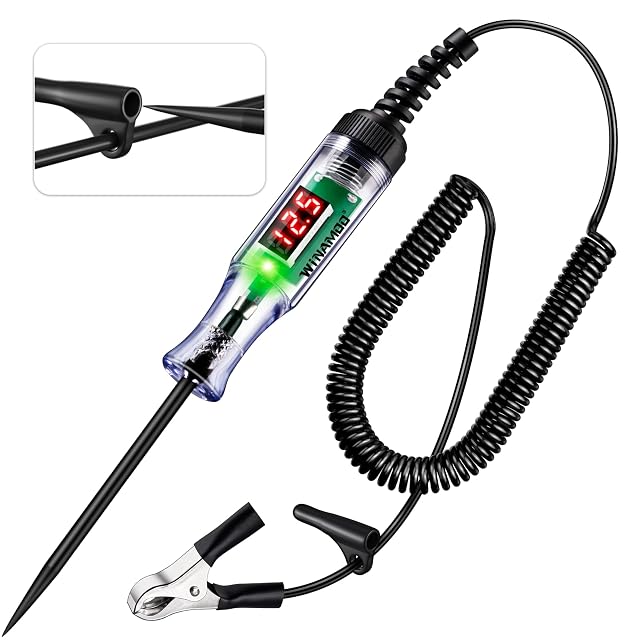
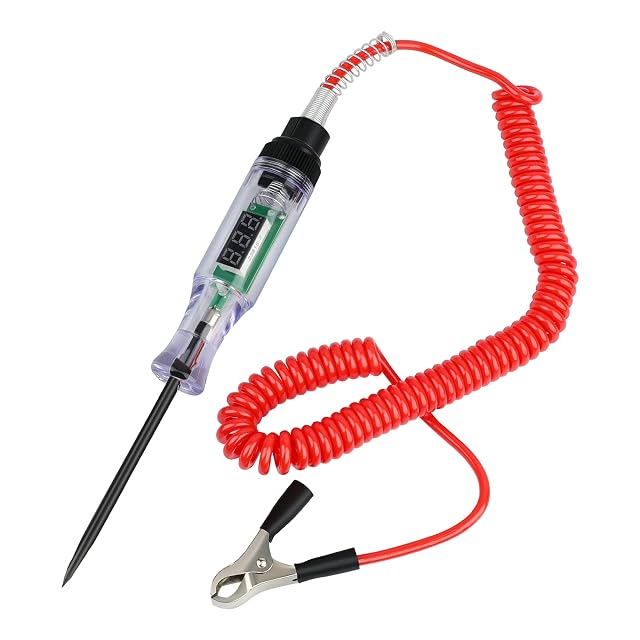
A test light reading 3 to 48 V DC on a bright LED display with 0.1 V resolution, a dual-color polarity indicator, a sharp stainless steel probe with an anti-lost protective sleeve, a 96-inch spring wire lead and a large alligator clip, in a transparent ABS body. 200 g (7.1 oz), 282 × 107 × 36 mm (11.1 × 4.21 × 1.42 in). $8.95.
“High quality 96 inch long enough spring wire increases flexibility to access across broad areas when testing.”
Ninety-six inches is 2.44 meters. The introduction names it as one of the things that matter: “the lead length to reach a battery from a rear light.”
| Tool | Lead length |
|---|
| Ansbell | 14.7 ft (4.48 m) |
| This tester | 96 in (2.44 m) |
| FEAOXYO | 39 in (0.99 m) |
| WINAMOO WITL111B · CrysGuard · the four published testers | not published |
Three of eleven publish one. Two and a half meters reaches from a battery to most of an engine bay and the front half of a cabin; it does not reach a tail light, which is what the Ansbell’s 4.48 m (15 ft) is for.
Spring wire is the other half of the description: a coiled lead that extends and retracts, so it is 2.44 m when needed and short when stowed. A straight 2.44 m lead in a tool drawer is a tangle.
And it is the figure its own dearer sibling drops: the WITL111B at $13.99 publishes a wider range, a second probe, and no lead length at all.
Three volts at the bottom, which is the half that matters
3 to 48 V.
| Tool | Bottom of range |
|---|
| This tester · WITL111B · Xastro, published | 3 V |
| FEAOXYO · Ansbell · Kaisal, published · Qwork, published · CrysGuard | 6 V |
Three volts reaches sensor and signal circuits. A 5 V reference feed to a throttle position sensor, a 0.5–4.5 V analog output, a pull-up on a switch input — none of those can be read by a tester that starts at 6 V, and all of them are where a modern fault actually lives.
Forty-eight volts at the top covers 24 V commercial systems and 48 V mild hybrids, which is the same ceiling as the published BGS tester.
So this covers the whole of ordinary automotive electrics from the lowest signal to the highest system, for $8.95. The WITL111B extends to 120 V, which on a conventional car is headroom rather than capability.
Dual-color polarity on one diode
“Bidirectional light emitting diode on the circuit board for easy battery load testing, red light indicates positive polarity, green light indicates negative polarity.”
The published Kaisal page states the value: polarity indication “removes the most common confusion when probing an unfamiliar loom”.
It is the cheapest useful feature on this shelf and three tools have it — this, the WITL111B and the published Kaisal. The two inline draw testers show the equivalent as a DC / −DC sign.
And the probe sleeve is a small, published detail
“Integrated anti-lost protective sleeve to secure the probe during storage and safeguarding against damage, making sure no stab and wound and won’t be lost wherever you go.”
Two problems in one part. A sharp probe loose in a tool bag finds a hand; a sleeve that is integrated rather than a separate cap is a sleeve that is still there in a year.
Both WINAMOO testers publish it. Nothing else on this shelf mentions protecting the probe at all.
But the probe pierces insulation, which this shelf argues against
“Sharp stainless steel probe for piercing insulation with ease, also for hard to reach tight areas.”
The introduction wants a tip “sharp enough to back-probe a connector without piercing insulation”, and the published BGS page records what piercing costs: it “leaves a hole in the insulation, which must be sealed afterwards.”
That hole lets water into a copper conductor. In a door, a wheel arch or under a sill it becomes a corroded break, which is the fault you will come back to find with the same tool.
Back-probing means entering a connector from the rear, alongside the wire, and touching the terminal itself — which a sharp probe can do and this listing does not describe. Of the eleven tools on this shelf, only the CrysGuard tracer never touches a conductor at all.
The buying advice adds the hard limit: “keep the probe out of airbag and CAN wiring entirely.”
Two hundred grams and a transparent body
“premium ABS body with higher transparency, shatter-proof and durable.”
A transparent body on a test light is not decoration: it lets the indicator be seen from any angle, which matters when the tool is held at arm’s length behind a dash with your head somewhere else.
200 g is the only weight on this shelf — none of the other ten tools publishes one.
What is not published
No accuracy, only 0.1 V resolution. The Ansbell tester here is the only tool on this shelf with an accuracy figure, at ±0.2 V, and without one a voltage drop read on this is an indication rather than a measurement. No continuity function, which the CrysGuard and Ansbell provide. No incandescent lamp, so it will not prove a circuit can carry a load — the FEAOXYO here is the tool for that. No internal battery or power source. No case.
At $8.95 it reads from 3 V, tells you the polarity, and publishes how far it reaches.
Availability
On sale at around $9 on the American Amazon store at the time of checking.
Prices and availability are what Keepa reported on the date this page was updated; both move.
Prices quoted in this text were read on 6 October 2026. The live price is at the top of the page.