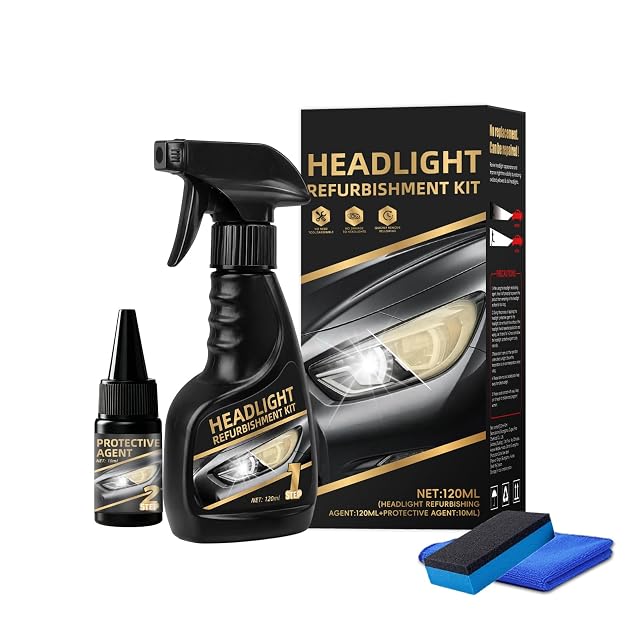
What you are getting
A 120 ml spray cleaner, a crystal coating liquid, a sponge applicator and a microfibre towel. No sanding, no drill. Stated for plastic and glass lenses. The method is published in three steps: spray and dwell 30 seconds, rinse with clean water and dry, then wipe the coating on in one direction only. $12.99.
It is the only kit on this shelf that publishes its instructions
“Step 1 — Cleaning: Evenly spray the cleaner onto the headlight surface. Let it sit for 30 seconds, then wipe with a clean towel. Step 2 — Rinsing: Thoroughly rinse the headlight surface with clean water to remove all cleaner, then use a dry cloth to wipe away any water spots. Step 3 — Restoration: Squeeze an appropriate amount of crystal coating liquid onto the sponge applicator, wipe the headlight surface carefully in one direction to complete restoration. (Tip: do not scrub back and forth. Complete the wiping in a single pass in the same direction to protect the coating layer.)”
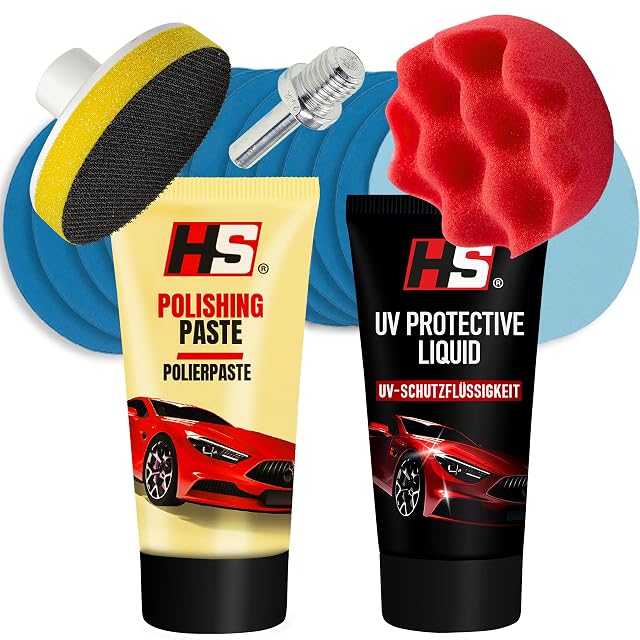
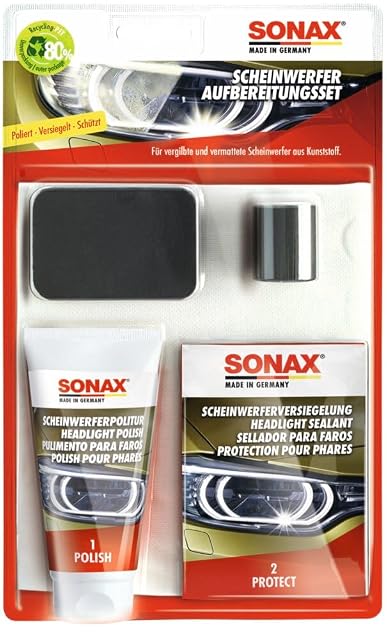
Three numbered steps, a dwell time and a technique note, in the listing. Nothing else on this shelf of ten does that — the published HS, ATG and Sonax kits state a number of stages without describing them, and the sanding kits list their contents.
Two parts of it are more useful than they look.
The rinse. A chemical restorer that is wiped off rather than rinsed leaves its own residue under the coating, and a coating applied over residue lifts. Step 2 exists to prevent that, and it is the step most listings skip — the published ATG kit is the only other one on this shelf with a distinct cleaning stage, which its page praises as “what stops grit being dragged across the lens”.
The one-direction wipe. A coating liquid applied back and forth is dragged partly off as it starts to set, which leaves streaks and thin spots that fail first. Single-direction application is the correct technique for any wipe-on sealant and almost nobody states it. The ZMHUM kit on this shelf states the equivalent for its own product — keep it dry for 24 hours — and together those two listings are where the technique on this shelf is written down.
And it claims glass lenses, which is worth reading carefully
“suitable for both plastic and glass lenses on a variety of vehicle models.”
The introduction opens with what a yellowed headlight is: “a degraded factory UV coating, not dirty plastic.”
Glass does not degrade that way. Glass headlight lenses do not yellow — they were standard until the late 1980s, they are now rare, and what goes wrong with them is stone chips and a dulled surface, not a failed coating. The whole of this shelf exists because polycarbonate lenses have a sprayed-on UV layer that fails.
So the glass claim is not false in itself — a cleaner and a coating can be used on glass — it simply does not describe the problem this shelf is about. What it does suggest is the nature of the product: a cleaner and a sealant, which work on any smooth surface, rather than a system aimed at polycarbonate specifically.
Nothing else on this shelf mentions glass. The two 3M kits state “plastic lenses” explicitly and list tail lights, fog lights and indicators alongside headlights.
One hundred and twenty milliliters, and the coverage that is not published
| Kit | Volume or coverage |
|---|
| ZMHUM | 180 ml, 8+ sets stated |
| This kit | 120 ml, no treatment count |
| Sonax, published | 85 ml |
| HS, published | at least 2 headlights |
A hundred and twenty milliliters is a useful quantity — more than the published Sonax kit’s 85 ml — and the listing never says how many lenses it does, or how the 120 ml divides between the spray cleaner and the coating liquid.
The ZMHUM kit on this shelf publishes 8+ sets for 180 ml, which at $16.99 is about $2.12 a car. Without a count here, $12.99 cannot be put on the same scale.
No abrasive, which is the same trade as the ZMHUM kit
Two of the ten kits on this shelf have no abrasive: this and the ZMHUM.
The advantage is complete: the buying advice for this shelf is about the risk an abrasive brings — “an abrasive that cuts polycarbonate removes clear coat from a wing in one careless pass” — and a spray has none of it. No masking, no drill, no pad, no grit sequence to get wrong.
The limit is the same too. A chemical removes the oxidized surface of a failed coating; it does not remove the coating. On a lens that is lightly hazed, this is a thirty-minute job with no risk. On one that has gone chalky and rough to the touch, the failed layer stays and the new coating goes over it.
For that case the kits on this shelf are the 3M 39195 at 500 grit and the Griot’s, which breaks the oxidation down chemically and then sands it off.
The coating is named, and not described
“crystal coating liquid” and “protective coating” are the terms used. There is no statement that it is ceramic, no statement that it blocks UV, and no durability period.
The introduction’s sorting test: “The second replaces the coating — a wipe-on or spray UV-resistant clear — and that is the only version with a claim to durability.”
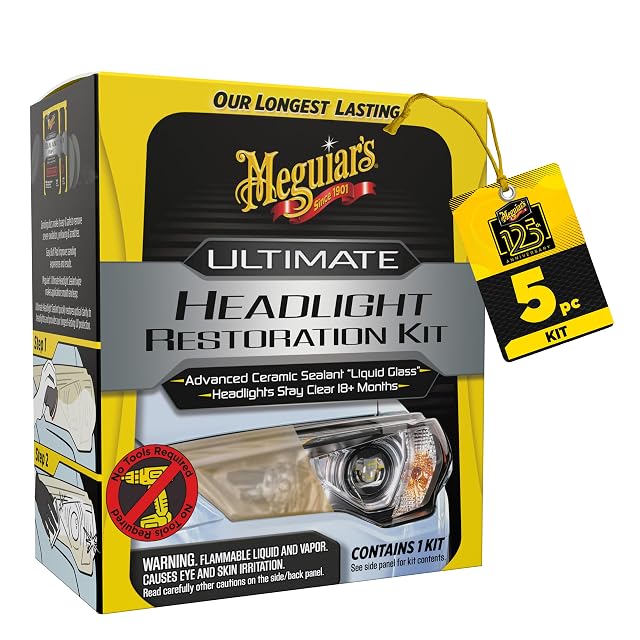
Without a UV statement, this kit cannot be placed confidently in that group. Compare, on this shelf: ZMHUM states a ceramic sealant that blocks UV; Meguiar’s states ceramic with UV protection and 18+ months; Griot’s states ceramic; the published Cerakote and ATG kits state ceramic and a UV coating.
A clear coating that does not block UV will keep water off and will not stop the next failure.
“Shine your car headlamp in just minutes”
“effectively clears up yellowing and cloudiness, shine your car headlamp in just minutes, instantly improving brightness and visibility” and “This instant headlight oxidation removal spray works in minutes.”
Minutes is credible for what it is — spray, dwell thirty seconds, rinse, wipe. Against the Griot’s kit’s four stages by hand, or the 3M 39195’s three grades plus masking, it is a different order of job.
What “instantly improving brightness” means is transmission through a clearer lens, which is real on a hazed lens and is not a change to the beam pattern.
What is not published
No treatment count for the 120 ml, and no split between cleaner and coating. No UV claim for the coating. No durability period. No cure time, where ZMHUM publishes 24 hours. No abrasive. No chemical identity. No gloves. No statement of what to do with a chalky lens.
At $12.99 it is the only kit on this shelf that tells you how to use it, and the only one that mentions a surface this shelf is not about.
Availability
On sale at around $13 on the American Amazon store at the time of checking.
Prices and availability are what Keepa reported on the date this page was updated; both move.
Prices quoted in this text were read on 6 October 2026. The live price is at the top of the page.