What you are getting
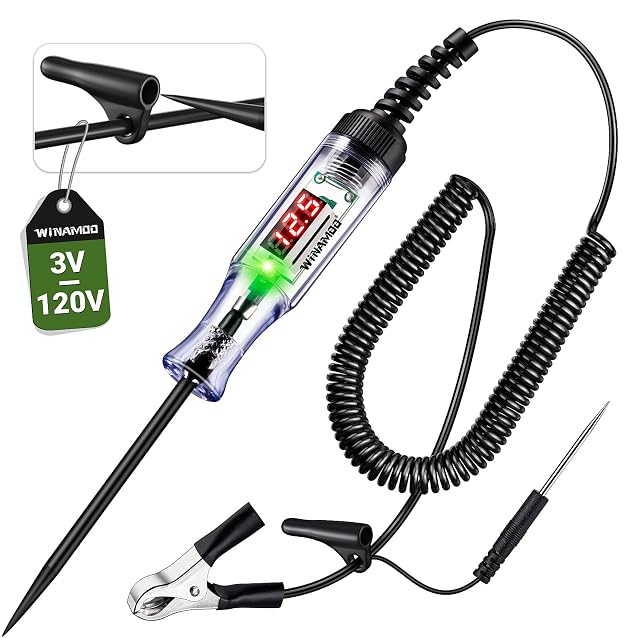
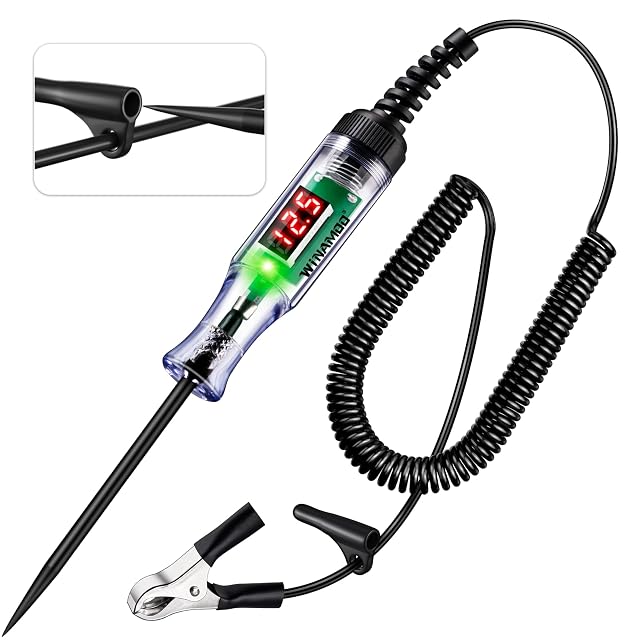
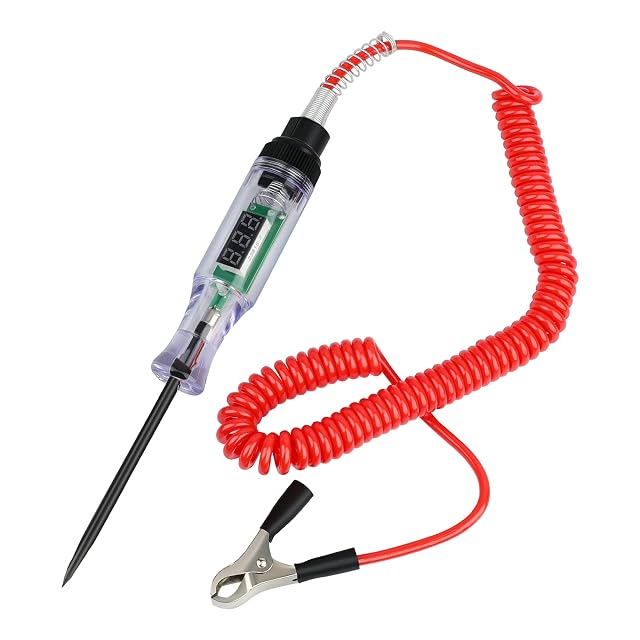
A test light reading 3 to 120 V DC on a bright LED display with 0.1 V resolution, a dual-color polarity indicator — red for positive, green for negative — a sharp stainless steel probe with an anti-lost protective sleeve, a large alligator clip, an extra probe on the wire, and an ABS body. Stated not for household AC outlets or mains voltage. $13.99.
It is the only listing on this shelf that rules out mains voltage
“WINAMOO auto circuit tester helps quickly diagnose issues in 3V-120V DC automotive systems. Not intended for testing household AC outlets or mains voltage.”
That sentence is in the first bullet, and it is there because the number above it invites the mistake.
One hundred and twenty volts is the nominal household supply in this market. A pen-shaped tester with a digital display and a 120 V ceiling looks exactly like a mains tester, and it is not one: the range is DC, the insulation is rated for automotive work, and a mains socket is alternating current at a fault energy an automotive tester is not built to survive.
Of the eleven tools on this shelf, this is the only one that says so. It is also the only one that needs to — the next widest range is 3–48 V.
And 120 volts is the widest range here by a factor of two and a half
| Tool | Stated range |
|---|
| This tester | 3–120 V DC |
| WINAMOO WITL111A · BGS, published | 3–48 V |
| XENIVO · VIREVO | 48 V |
| CrysGuard | 6–42 V |
| Ansbell | 6–36 V |
| FEAOXYO · Kaisal, published | 6–24 V |
| Xastro, published | 3–24 V |
| Qwork, published | 6, 12, 24 V |
What sits between 48 V and 120 V is worth knowing, because it is why the range exists. 48 V mild-hybrid systems are the top of ordinary automotive work; above that are the auxiliary and traction-adjacent circuits of hybrids and electric vehicles, which run at far higher voltages still.
A 120 V ceiling covers the 48 V systems with margin and reaches the low end of nothing else useful. So on a conventional car the extra range is headroom rather than capability — and the 3 V bottom end, which it shares with its own sibling and the published Xastro, is the more useful half: sensor and signal circuits live at 5 V and below.
| WITL111B | WITL111A |
|---|
| Price | $13.99 | $8.95 |
| Range | 3–120 V | 3–48 V |
| Display | LED, 0.1 V | the same |
| Polarity | red / green | the same |
| Probe sleeve | anti-lost | the same |
| Lead | length not published | 96 in (2.44 m) spring wire |
| Extra probe on the wire | yes | no |
Five dollars buys the wider range and the second probe; it loses the published lead length, which the cheaper sibling states and this does not.
“When space is tight and the alligator clamp is not accessible, the extra probe on the wire is a great addition, which increases… the flexibility of the accessible inspection area.”
That is a real gain. A crocodile clip needs something to bite — a battery post, a bolt, a bracket. In a door, behind a dash or at a tail light cluster, there is often nothing within reach, and a second probe lets the reference end be held against a known earth instead.
Dual-color polarity, which does the job the published Kaisal page praises
“Bidirectional light emitting diode on the circuit board for easy battery load testing, red light indicates positive polarity, green light indicates negative polarity.”
The published Kaisal page: polarity indication “removes the most common confusion when probing an unfamiliar loom.”
Two colors on one diode is the cheap, correct way to do it. On a loom where someone has already been — and the wire colors no longer mean what the diagram says — knowing which side of the circuit you are on is the first thing to establish.
Both WINAMOO testers here have it; so does the published Kaisal; the two inline draw testers solve the equivalent problem with a DC / −DC sign.
But the probe pierces insulation, which this shelf argues against
“Sharp stainless steel probe for piercing insulation with ease, also for hard to reach tight areas.”
The introduction asks for the opposite: a tip “sharp enough to back-probe a connector without piercing insulation.”
And the published BGS page states the cost of piercing: it “leaves a hole in the insulation, which must be sealed afterwards”. Water finds that hole. A pierced wire in a door or a wheel arch is next winter’s corroded break.
The anti-lost protective sleeve is a genuinely good detail on the same probe — “secure the probe during storage… making sure no stab and wound and won’t be lost” — and it is published on both WINAMOO testers and nothing else here.
For non-invasive work, the CrysGuard tracer on this shelf is the only tool that never touches a conductor.
Nought point one volts of resolution, and no accuracy
“0.1V resolution gives you reliable indication and shows you the voltage number easily and quickly.”
Resolution, not accuracy. The Ansbell tester here is the only tool on this shelf that publishes an accuracy — ±0.2 V — and on a 120 V range the question matters more than usual: a meter’s error is often a percentage of range, and 1% of 120 V is 1.2 V, which would swamp any volt-drop measurement on a 12 V circuit.
Nothing in the listing says whether the accuracy is a percentage of reading or of range, so a voltage drop measured on this tool is an indication rather than a figure.
What is not published
No lead length, which its own cheaper sibling publishes at 96 inches and which the introduction names as a thing that matters. No accuracy. No continuity function, which the CrysGuard and Ansbell tools here provide. No internal battery or power source. No insulation rating, on a tool whose range reaches 120 V. No AC capability at all — correctly, and stated. No case.
At $13.99 it is the widest-ranging tester on this shelf, and the only one that tells you where not to put it.
Availability
On sale at around $14 on the American Amazon store at the time of checking.
Prices and availability are what Keepa reported on the date this page was updated; both move.
Prices quoted in this text were read on 6 October 2026. The live price is at the top of the page.