What you are getting
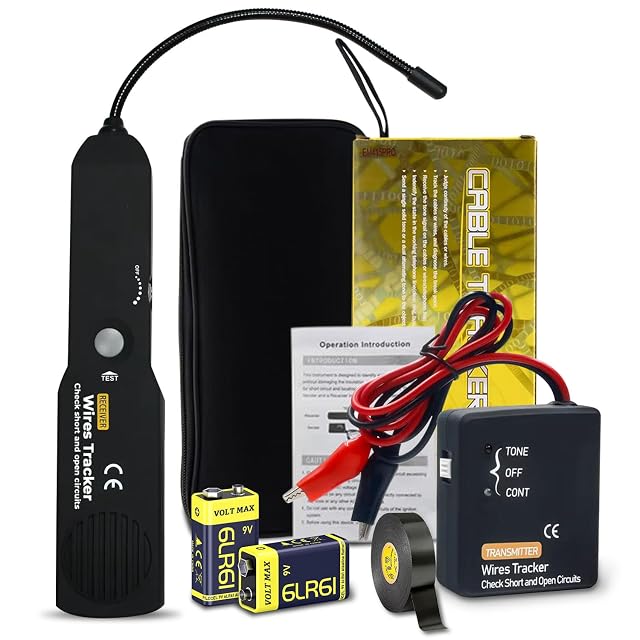
A signal transmitter and a receiver probe for tracing wires in 6 to 42 V DC systems, with a continuity mode marked CONT, a 7-inch flexible probe, test leads, alligator clips, 9 V batteries, insulation tape and a protective carrying case. $23.99.
The introduction asks for a probe tip “sharp enough to back-probe a connector without piercing insulation.”
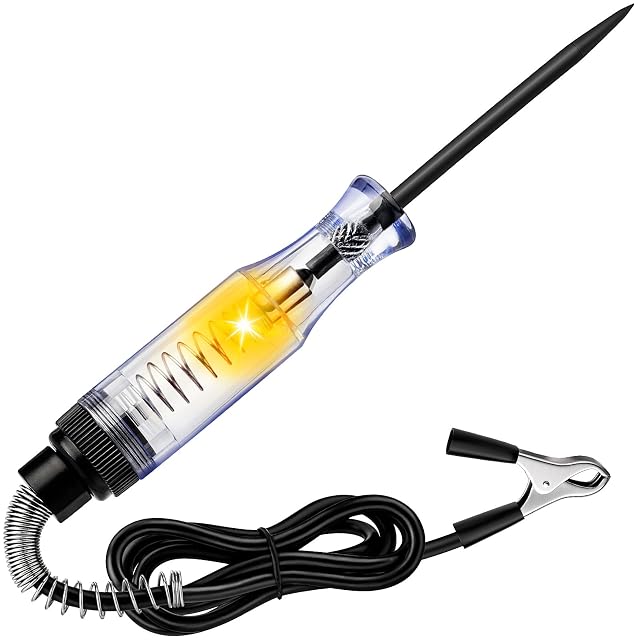
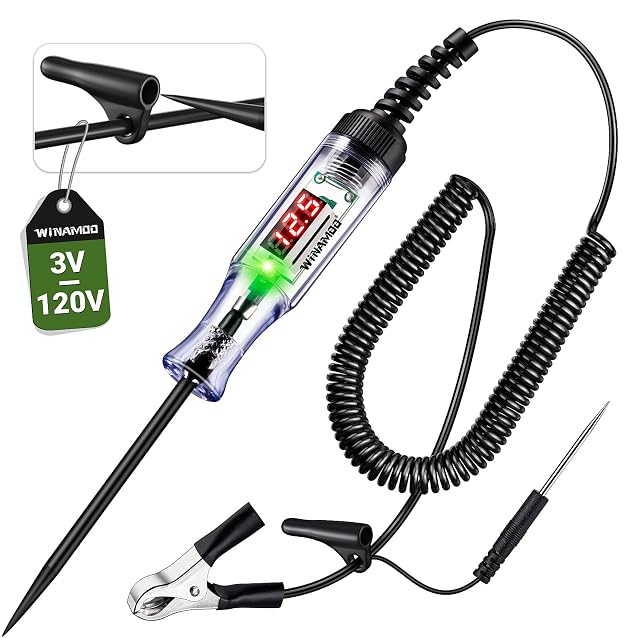
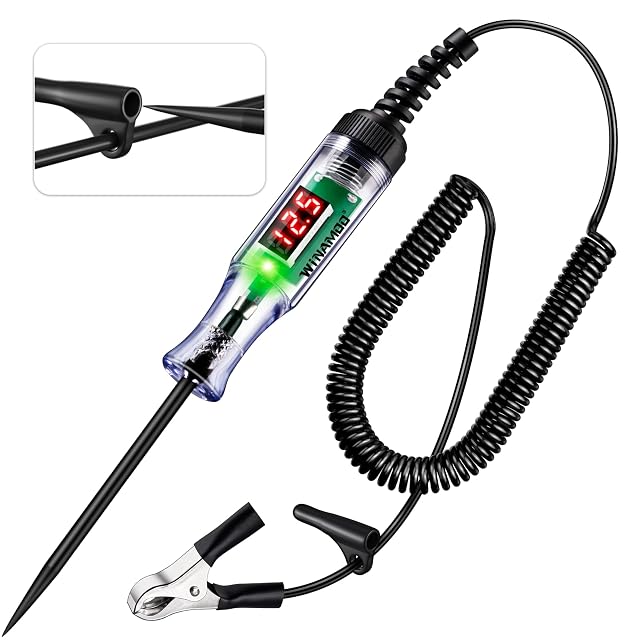
Nearly everything on this shelf does the opposite. The two WINAMOO testers and the FEAOXYO here all describe a “sharp stainless steel probe for piercing insulation with ease”, and the published BGS tester states a “piercing function for insulated cables” — whose own page records the cost: “a piercing probe leaves a hole in the insulation, which must be sealed afterwards.”
This one works the other way: “Non-Invasive Wire Tracing — Trace wires hidden behind dashboards, panels, carpets, or inside engine compartments without removing insulation. The transmitter sends a signal, and the probe follows the path precisely.”
The transmitter injects a tone onto one end of a wire; the probe picks up the field through the insulation and through trim. Nothing is cut, pierced or unplugged, which on a modern car — where a loom runs under a carpet, through a door grommet and behind a dash — is the difference between a two-hour job and a two-day one.
And it answers a different question from every test lamp here
A test lamp tells you whether there is power at a point you can reach. This tells you where the wire goes.
| Tool | Question answered |
|---|
| This tracer | where does this wire run, and where does it break |
| WINAMOO ×2 · FEAOXYO · Ansbell · the four published testers | is there voltage at this point |
| XENIVO · VIREVO | what current is this fuse circuit drawing |
Three different tools on one shelf, and this is the only one of the eleven that will find an open circuit in the middle of a loom — a chafed wire behind a kick panel, a break inside a door hinge conduit, a crimp that has corroded under heat-shrink.
“Easily locate broken or damaged wires, short circuits, and open connections in any DC 6–42 V automotive system.”
The continuity mode is the function the shelf asks for by name
The introduction’s third requirement: “whether the tool also reads continuity on a dead circuit.”
“Quick and Reliable Continuity Testing — Check the continuity of wires and cables in seconds using the CONT mode.”
Of the eleven tools on this shelf, two publish continuity: this with a named mode, and the Ansbell tester, which describes touching a probe to a point to “check continuity, voltage status, and polarity”. The published Qwork page records the absence as a reserve: “no continuity function.”
Continuity matters because half of all wiring faults are open circuits, and a test lamp cannot see one: no power at a point tells you the circuit is dead, not where it died. Continuity across a length of wire tells you whether that length is intact.
Six to forty-two volts, which covers the right things
6 to 42 V DC takes in 6 V classics, 12 V cars, 24 V trucks and the 42 V end of some auxiliary systems.
| Tool | Range |
|---|
| WINAMOO WITL111B | 3–120 V DC |
| WINAMOO WITL111A · BGS, published | 3–48 V |
| XENIVO · VIREVO | 48 V |
| This tracer | 6–42 V DC |
| Ansbell | 6–36 V stated |
| FEAOXYO · Kaisal, published | 6–24 V |
| Xastro, published | 3–24 V |
Where it stops short is the bottom: 6 V rather than 3 V, so the sensor and signal circuits that the published Xastro tester reads from 3 V are below its range. On a tracer that matters less than on a voltmeter — the transmitter supplies its own signal — but it is the figure to note if the same tool is wanted for both jobs.
Nine-volt batteries, insulation tape and a case, all listed
“Comes fully equipped with a signal transmitter, receiver probe, test leads, alligator clips, 9V batteries, insulation tape, and a protective carrying case.”
Three of those are unusual.
9 V batteries included means it works on arrival — a transmitter needs its own power, which is the one way this kind of tool fails to be used.
Insulation tape is the honest inclusion: tracing ends with a repair, and a repair needs tape. It is also the acknowledgement that even a non-invasive tool leads to a cut wire eventually.
A case matters on a two-piece tool. A transmitter and a probe that live in different drawers are a tool that is never complete.
A seven-inch flexible probe
“a flexible 7-inch probe for tight spaces.”
Seven inches is 178 mm (7.01 in), and flexible is the point: a tracer probe is run along a loom behind a dash, where a rigid pen cannot follow the bend.
What this is not is a lead length. The introduction asks for “the lead length to reach a battery from a rear light”, and the figure is not published here. Three tools on this shelf publish one — the Ansbell at 14.7 ft, the WINAMOO WITL111A at 96 in and the FEAOXYO at 39 in — and none of the four published testers does.
What is not published
No voltage reading — this is not a voltmeter, and it indicates rather than measures. No lead length between transmitter and clip. No signal frequency, which is what decides how well a tone carries through trim and alongside parallel wires. No depth or range for the probe through panels. No battery life for the 9 V cells. No statement about airbag or CAN circuits, and the buying advice for this shelf is unambiguous: “keep the probe out of airbag and CAN wiring entirely.”
At $23.99 it is the most expensive tool on this shelf, the only one that finds a wire rather than a voltage, and the only one that does it without making a hole.
Availability
On sale at around $24 on the American Amazon store at the time of checking.
Prices and availability are what Keepa reported on the date this page was updated; both move.
Prices quoted in this text were read on 6 October 2026. The live price is at the top of the page.