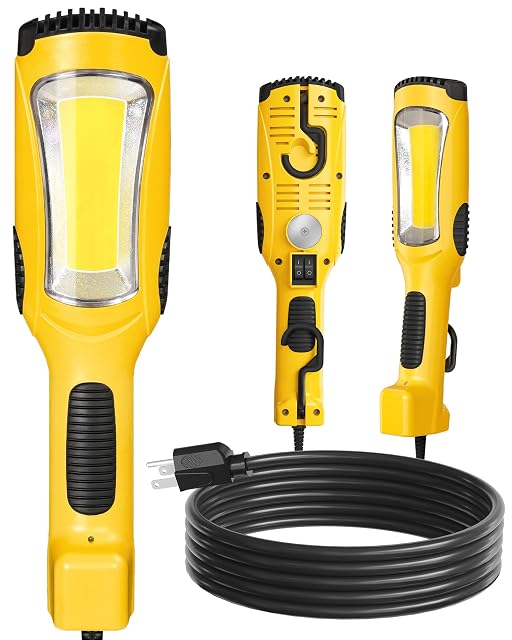
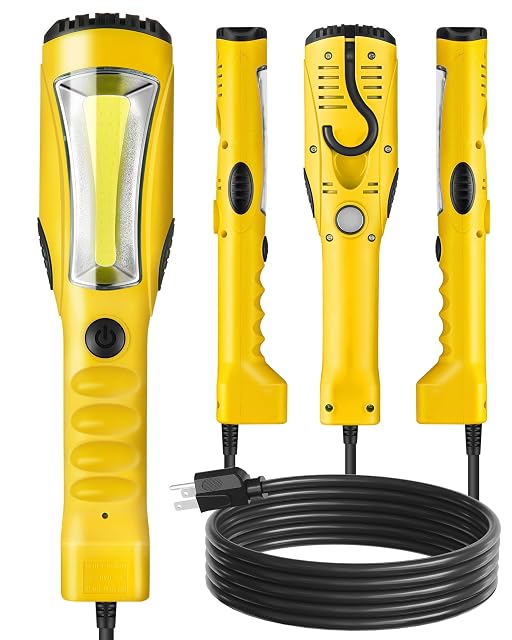
What you are getting
A corded 24 W COB work light at 3000 lumens, with dual switches giving 1500 lm or 3000 lm; a 15-foot 16AWG/3C SJTW cord rated −40 °F to 140 °F; three ways to use it — handheld, attached to metal surfaces, or hung from a 360° rotating hook, with a top folding hook for storage; a grounded outlet at the base so it doubles as an extension lead; a rubber-textured handle and rubber pads on the sides. ETL Listed. $39.99.
It is the brightest lamp here that publishes two usable levels
“Our 24W LED work light delivers a powerful 3000LM output. Its dual switches allow you to switch between 1500LM and 3000LM for various tasks.”
| Lamp | Published outputs |
|---|
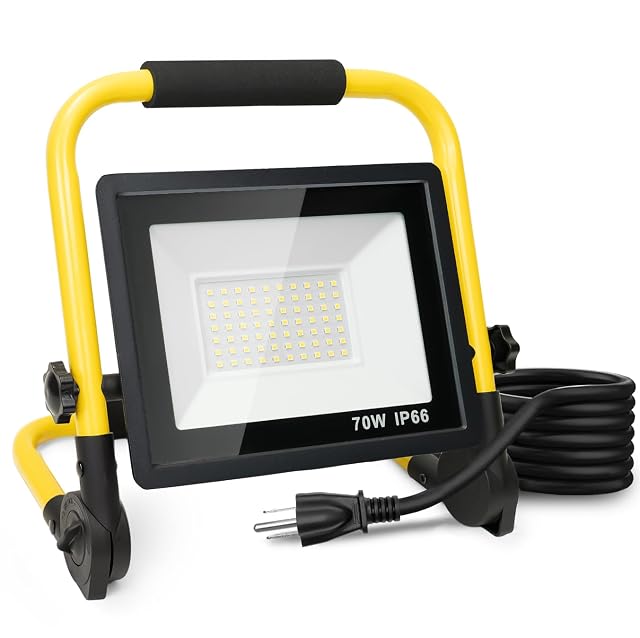
| PacoLit | 10,000 lm, one level |
| This lamp | 3000 / 1500 lm |
| VEVOR | 2300 lm, three levels, lumens per level not stated |
| WILAWELS Y03WL06 | 2000 lm, one level |
| LINKAX, published | 240 lm flood + 80 lm torch |
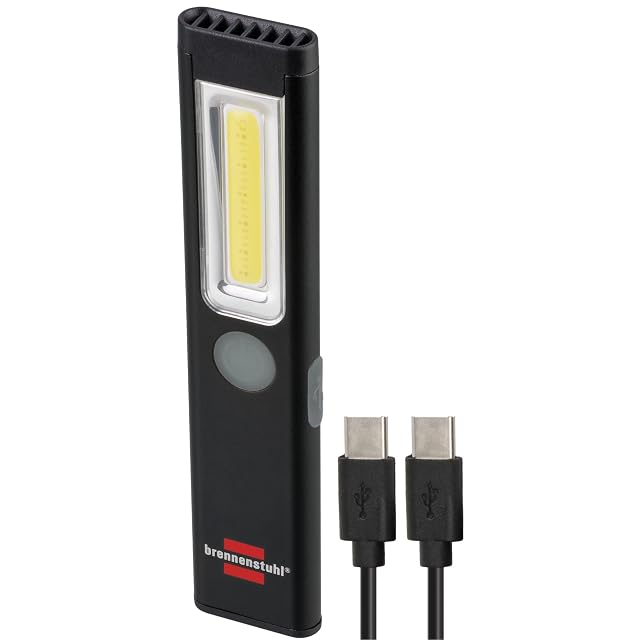
| Brennenstuhl, published | 200 lm |
| OSRAM, published | 200 / 80 / 40 lm |
| Coquimbo · Tolesum, published | none |
The published OSRAM page makes the case for this kind of listing: three output levels published individually “rather than as 5 modes”. Two levels with a lumen figure on each is the same virtue — you know what the low setting is, which on the VEVOR lamp here, with three levels and one lumen figure, you do not.
Fifteen hundred lumens is the setting that will mostly get used. Three thousand in a confined engine bay off white paint is enough to be unpleasant.
And it has a mains socket in its base, which nothing else here does
“Equipped with a 15-foot power cord and a grounded outlet at the base, this work light transforms into an extension cord.”
That is the most practical idea on this shelf and it is easy to skip over. A lamp on a 15-foot lead reaches under a bonnet; a lamp with a socket in it means the inspection lamp and the drill or the polisher share one run of cable, and nobody unplugs the light to plug in the tool.
Both WILAWELS lamps here do it. Nothing else on this shelf does — the other seven are either battery lamps or, in PacoLit’s case, a corded floodlight with a 5-foot lead and no outlet.
Three ways to mount it, including a magnet-free attachment
“Handheld for easy portability, securely attached to metal surfaces for stable lighting that frees your hands, and hangable with a 360° rotating hook for multi-angle illumination. The top folding hook allows for space-efficient storage.”
The introduction lists “magnets, hooks and a body that survives being dropped” among the parts that keep a lamp where you put it.
“Attached to metal surfaces” is how this listing describes what three published lamps on this shelf call a magnetic base. The word magnet does not appear, so whether the attachment is magnetic or mechanical is not stated — the Coquimbo, Tolesum and LINKAX lamps published here all say magnet plainly.
The 360° rotating hook is the part that matters on a corded lamp hung from a bonnet catch: the hook stays and the beam turns, which is the virtue the published Coquimbo page describes as aiming “the beam without moving the magnet”.
The cord is specified, which is unusual on a work light
“a heavy-duty, waterproof 16AWG/3C SJTW cord, ensuring reliable operation in temperatures ranging from −40°F to 140°F.”
Three pieces of information in one phrase. 16AWG is the conductor size — adequate for a 24 W lamp with headroom for a tool plugged into the base. 3C is three cores, so the socket’s earth is real. SJTW is a US cord designation: S service, J junior (300 V), T thermoplastic, W weather and water resistant.
And −40 °F to 140 °F (−40 to 60 °C) is a wider band than the VEVOR lamp’s −20 to 50 °C (-4 to 122 °F). On a cord that lies on a cold concrete floor in January, a stated cold rating is the difference between flexible and cracking.
Two lamps on this shelf publish a temperature range: these two WILAWELS and the VEVOR.
“The work light is ETL Listed for safety.”
ETL listing means a recognized laboratory has tested the lamp against the applicable US safety standard. It is the only third-party safety mark on this shelf — PacoLit publishes IP66, which is an ingress rating and a different thing, and the published OSRAM lamp publishes a 2-year warranty, which is a commercial term.
On a mains lamp held in a wet hand under a car, a safety listing is the right thing to publish.
But it publishes no IP rating, and it is not rechargeable
No IP rating. The cord is called waterproof; the lamp body is not rated. The introduction asks for one explicitly: “plus an IP rating, because a garage lamp meets brake cleaner and oil.” Only PacoLit answers, at IP66.
No battery. This is a corded lamp, which has no runtime to publish and no charge to forget — a real advantage over the six rechargeable lamps on this shelf, and a 15-foot tether.
No CRI and no color temperature, which the introduction puts first and which only the VEVOR lamp here answers.
And it is one of two nearly identical WILAWELS lamps
| Y03WL06 | Y05WL06 |
|---|
| Power | 18 W | 24 W |
| Output | 2000 lm | 3000 lm |
| Levels | one | two — 1500 / 3000 |
| Cord | 15 ft, 16AWG/3C SJTW | same |
| Temperature | −40 to 140 °F | same |
| Outlet at base | yes | yes |
| Mounting | handheld, attached, hook | same |
| ETL Listed | yes | yes |
| Price | $32.99 | $39.99 |
Seven dollars buys 1000 more lumens and a second level. On a shelf where the differences between products are usually a brand and a price, that is a clean comparison — and the second level is worth more than the lumens, because it is the one that makes a 3000-lumen lamp usable up close.
What is not published
No CRI, no color temperature, no IP rating, no beam angle, no weight, no bulb life, no magnet, and no warranty term.
At $39.99 it is the brightest lamp here with a low setting you can read off the box, and the only kind of lamp on this shelf that never needs charging.
Availability
On sale at around $40 on the American Amazon store at the time of checking.
Prices and availability are what Keepa reported on the date this page was updated; both move.
Prices quoted in this text were read on 6 October 2026. The live price is at the top of the page.