A parasitic draw tester that names its fuse standards, four dollars cheaper
VIREVO Inline fuse current monitor, 20 A
The cheaper of two near-identical draw testers, and the one that names the fuse standards it fits.
What you are getting
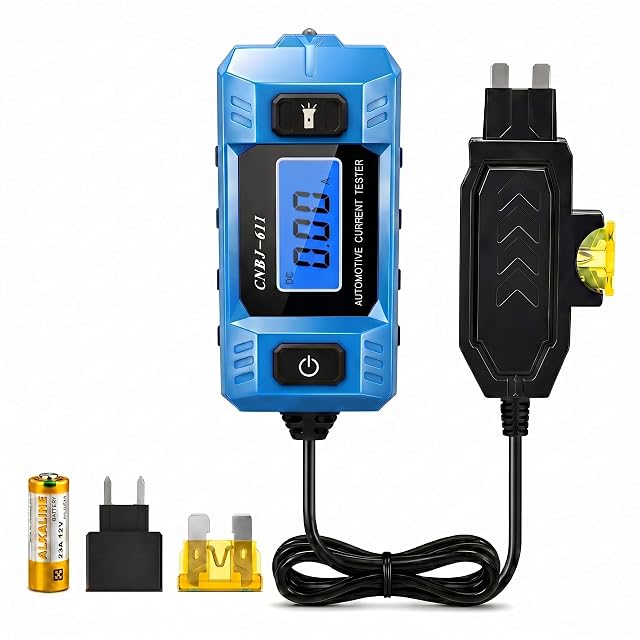
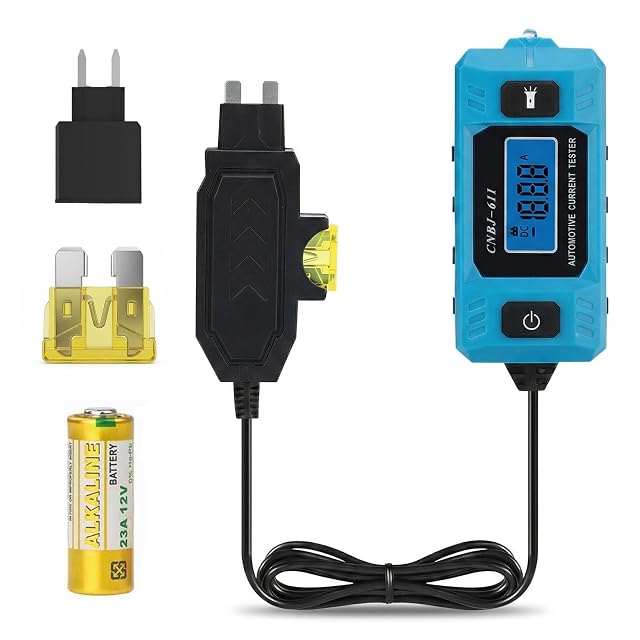
An inline fuse current monitor for 20 A, 48 V DC circuits, reading from 0.01 A on a backlit LCD, with a DC / −DC direction display, a built-in LED work light, and compatibility with Mini (ATM) and Standard (ATO/ATC) blade fuses. The vehicle’s own fuse goes into the tester, and the tester into the fuse slot. $12.99.
It measures a current, which nothing else on this shelf except its twin does
The introduction describes a voltage tool: “A test lamp answers the question a scan tool cannot: is there power at this wire, right now.”
This answers a different question entirely: how much current is this circuit drawing, with the car asleep.
| Tool | What it measures |
|---|
| This tester · XENIVO | current, 0.01–20 A, through a fuse |
| WINAMOO ×2 · Ansbell · Kaisal · Xastro, published | voltage at a point |
| FEAOXYO · Qwork · BGS, published | presence of voltage, by lamp |
| CrysGuard | the path of a wire |
Three jobs on one shelf, and this is the pair for the fault a test lamp is blind to: “Ready to pull your hair out because your car battery keeps dying overnight? This parasitic draw tester helps check fuse-circuit current to narrow down abnormal power draw.”
A parasitic drain is a circuit that stays awake after the car locks. A healthy modern car settles to 20 to 50 milliamps after its modules sleep; a drain of 200 mA flattens a battery in a few days. No test lamp will see that, because the voltage is there on every circuit — what is wrong is the current.
| VIREVO | XENIVO CNBJ-611 |
|---|
| Price | $12.99 | $16.99 |
| Range | 20 A, 48 V | 20 A, 48 V |
| Resolution | 0.01 A | 0.01 A |
| Display | backlit LCD | “clear real-time display” |
| Direction | DC / −DC shown | not stated |
| Work light | LED | not stated |
| Fuse standards | Mini ATM, Standard ATO/ATC named | “mini & standard blade fuse” |
| Fuse-inline design | implied | stated to keep factory protection active |
Same range, same resolution, same method. This one publishes four things the other does not and costs $4.00 less; the XENIVO publishes one thing this does not, which is that the vehicle’s own fuse stays in circuit.
That one point is worth keeping: on both tools the original fuse is inserted into the tester, so the circuit keeps its factory protection — which is what separates this method from putting a multimeter across a fuse holder on its own.
The direction display is the feature that saves a mistake
“CLEAR DIRECTION DISPLAY — No more guessing which side has power. The LCD instantly displays DC or −DC to help you identify power-side and load-side orientation.”
A fuse has a supply side and a load side, and an inline tester inserted the wrong way round reads a negative current. Showing the sign rather than making you work it out is a small thing that prevents the wrong conclusion — particularly at two in the morning under a dashboard, which is when this tool gets used.
The two WINAMOO testers on this shelf solve the equivalent problem with dual-color polarity, red for positive and green for negative, and the published Kaisal page calls polarity indication the thing that “removes the most common confusion when probing an unfamiliar loom”.
“Paired with a built-in LED work light, this tool makes it easy to read circuitry and navigate dark, cramped fuse boxes under the dashboard, inside the engine bay, or in the trunk.”
An under-dash fuse box is the worst-lit place in a car, and a tool that lights its own slot is a tool that does not need a third hand. The Ansbell tester here is the only other item on this shelf with a built-in light; this site’s work lights shelf is the alternative.
Naming the fuse standards is what makes the compatibility checkable
“Designed for supported Mini (ATM) and Standard (ATO/ATC) blade fuse circuits… Please verify your fuse type and slot clearance before purchase.”
ATO/ATC is the standard blade fuse — 19 mm wide — and ATM is the mini, 11 mm. Low-profile mini and Micro2 fuses are neither, and a modern car’s under-dash box is often full of them.
Naming the two standards it fits, and telling you to check, is more useful than the XENIVO’s “mini & standard blade fuse compatible”. The slot clearance warning is the other half: an inline tester is thicker than a fuse, and a densely packed fuse box may not have room for it beside its neighbors.
Point zero one amps of resolution, which is resolution and not accuracy
“crisp 0.01A (10mA) resolution allows you to instantly track and compare tiny power draws across fuses.”
Ten milliamps is the right order for the job: a sleeping car draws 20 to 50 mA in total, so a tool that reads in 10 mA steps can tell a sleeping circuit from a woken one.
What is not published is the accuracy. Resolution is the smallest step the display shows; accuracy is how close that number is to the truth. Of the eleven tools on this shelf, only the Ansbell publishes an accuracy, at ±0.2 V — and that is a voltmeter figure. Neither draw tester publishes one.
For this job it matters less than it would elsewhere: parasitic diagnosis is comparative — you are looking for the one fuse that reads far more than its neighbors — and a consistent error does not hide that.
What is not published
No accuracy figure. No measurement burden — an inline shunt adds resistance to the circuit, and how much is not stated. No battery or power source for the tester itself. No continuity function, which the CrysGuard tracer and the Ansbell tester publish. No voltage reading. No sleep-current guidance, which is the number a user actually needs to interpret the display. No case.
At $12.99 it is the cheaper of two identical draw testers, the one that names its fuse standards, and it will not tell you whether there is power at a wire.
Availability
On sale at around $13 on the American Amazon store at the time of checking.
Prices and availability are what Keepa reported on the date this page was updated; both move.
Prices quoted in this text were read on 6 October 2026. The live price is at the top of the page.