Calibrated in its own accredited laboratory, and the reading locks
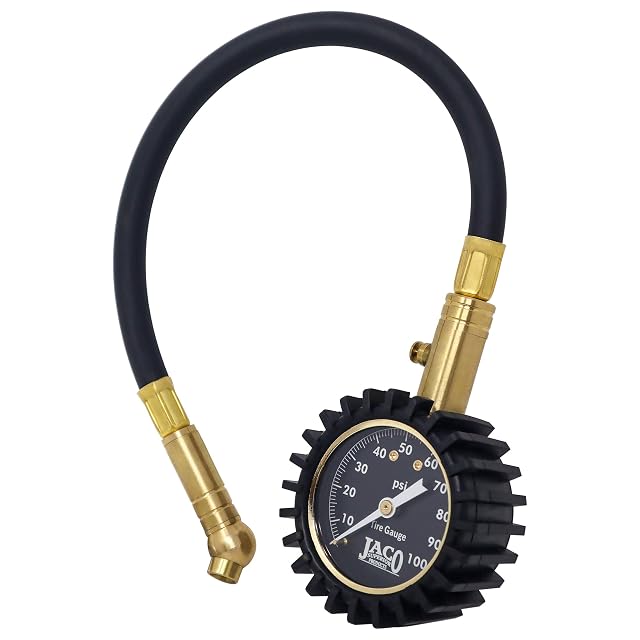
JACO Superior Products ElitePro 100 PSI
A brass dial gauge calibrated to ANSI 1.5% whose reading locks until reset, with a 360-degree chuck and a bleed valve.
What you are getting
A 100 PSI dial gauge in solid brass with a shock-resistant gear-style guard, a 2-inch glow dial reading in single PSI increments that locks until the reset button is pressed, a 360-degree swivel chuck, a built-in air bleeder valve and a HybridFlex hose. Calibrated within ANSI standards (±1.5%) at the maker’s own ANSI-accredited calibration facility. 100% lifetime warranty. 159 g (5.6 oz). $22.90.
It is the only gauge on this shelf that says where it was calibrated
“Performance tested, certified, & calibrated accurate within ANSI Standards (±1.5%) at our ANSI accredited calibration facility.”
The introduction to this shelf: “Stated accuracy is usually a percentage of reading or a class marking, and it is the only comparable figure on the packaging.”
Four of the seven American gauges here publish an accuracy. This is the only one — on the whole shelf — that names the place as well as the number, and says that place is accredited.
That matters because a calibration figure is a claim about a process. “Factory-calibrated to ±1 PSI”, which the AstroAI digital gauge here states, is a figure without a laboratory; an accredited facility is a figure with one.
±1.5% of reading at a car’s 35 PSI is ±0.5 PSI. Compare the AstroAI T3 in this survey, whose stated tolerance below 80 PSI is ±3 PSI — six times wider at the pressure a car actually uses.
And the reading locks, which is what makes a gauge usable alone
“Accurate readings that ‘lock’ in place until the pressure reset button on the brass neck is pressed.”
That is the feature the introduction is really describing when it says the useful gauge “gives the same reading twice on the same tire”. A gauge whose needle falls back the moment it leaves the valve has to be read while crouched at the wheel, in the dark, at an angle. One that holds the reading is read standing up.
Of the seven American gauges here, this and the Allstar are dial gauges that glow; this is the only one on the shelf that states a lock. The published QWORK gauge states a reset button without saying the reading holds until it is pressed. The pencil-type UNCO and the sliding-scale LUMITECO hold their reading by mechanism — a bar that stays out until pushed back — which is the same virtue arrived at differently.
A 360-degree chuck, which the introduction calls the daily decision
“The handy 360-degree swivel chuck allows for easy access to the tire valve from any angle.”
The introduction: “What decides daily use is the chuck: a straight chuck will not reach a valve behind an alloy spoke, and an angled or dual-foot one will.”
A swivel on a hose reaches any valve on a car. Five of the seven gauges in this survey pass that test; the AstroAI digital and the UNCO pencil are straight-on only.
And a bleeder on the body, which is how a pressure is set rather than read
“Equipped with a built-in air bleeder valve to reduce pressure in overinflated tires.”
Five of seven have one. It is what turns a measuring instrument into an adjusting one: over-inflate from a compressor, then bleed down to the number on the door jamb.
The TIRETEK in this survey describes the same thing most clearly — bleeding “while the gauge is still on the tire valve” — which is the detail that matters, because a bleeder that requires taking the gauge off is a guess.
Brass under a guard, and a lifetime warranty
“Built to last from solid brass shielded by our durable shock-resistant gear-style protective guard; features our signature HybridFlex leak-proof air hose.”
Brass is the right material for a chuck and a neck: it machines to a seal and it does not corrode. The guard is for the one failure a dial gauge has, which is being dropped on concrete.
“100% lifetime warranty” is the only lifetime term on this shelf. The published BGS gauge offers a stated calibrated version and European manufacture; nothing published here offers a warranty term.
One hundred PSI, in single increments
The range is the one thing to read against your own use.
| Gauge | Range | Finest scale |
|---|
| Allstar ALL44047 | 0–30 PSI | 4-inch dial |
| TIRETEK | 0–60 PSI | dial |
| UNCO | 10–75 PSI | pencil bar |
| This gauge | 0–100 PSI | 1 PSI |
| AstroAI T3 | 10–120 PSI | indicator bar |
| LUMITECO | 10–150 PSI | 2 PSI |
| AstroAI digital | 0–150 PSI | digital |
A car runs 30 to 40 PSI and a spare often 60. One hundred PSI covers cars, vans and light trucks with 1 PSI graduations — which is the resolution that makes a 0.5 PSI accuracy figure readable at all.
What is not published
No units but PSI — the AstroAI digital offers four and the UNCO three, which matters if you work to a bar figure. No operating temperature, where the AstroAI T3 publishes −10 to 50 °C. No hose length, where the Allstar publishes 14 inches. No recalibration interval, which is the thing an accredited calibration implies and nobody on this shelf states.
At $22.90 it is the second-most expensive gauge here and the only one that tells you who calibrated it.
Availability
On sale at around $23 on the American Amazon store at the time of checking.
Prices and availability are what Keepa reported on the date this page was updated; both move.
Prices quoted in this text were read on 6 October 2026. The live price is at the top of the page.