Twelve inches of reach, two gauges, and no accuracy figure
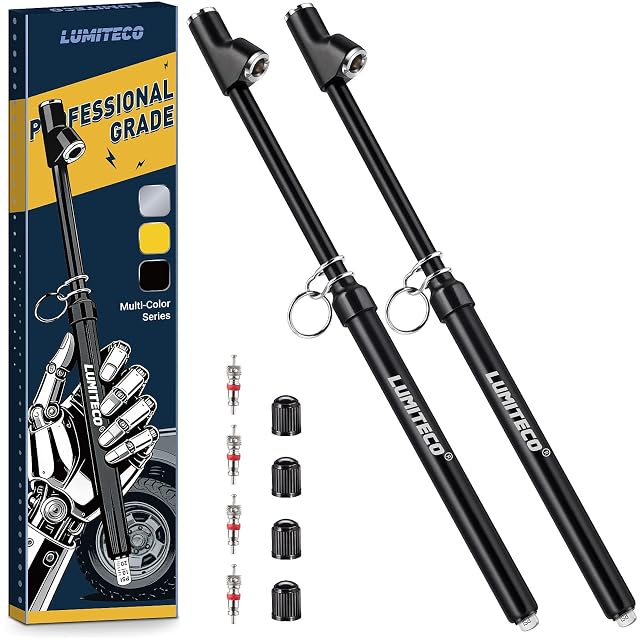
LUMITECO Dual Head Gauge, 2-pack
A two-pack of dual-head gauges with 12.3 inches of reach reading 10 to 150 PSI, with no stated accuracy.
What you are getting
Two sliding-scale gauges reading 10–150 PSI / 1–10 bar in 2 PSI increments on a dual-sided ABS scale, with a dual-head zinc alloy chuck — straight plus 30° angled — 12.3 inches of extended reach, a solid brass core, a stainless steel body, a hanging ring, and 4 valve cores and 4 valve caps. No batteries. 290 g. $15.91 for the pair.
“The 12.3 inch extended reach eliminates the need for awkward manoeuvring in tight wheel wells.”
The introduction to this shelf: “What decides daily use is the chuck: a straight chuck will not reach a valve behind an alloy spoke, and an angled or dual-foot one will.”
Reach is the half of that question nobody else answers. The AstroAI T3 in this survey has the same dual-head straight-plus-30° arrangement and publishes no length; the Allstar publishes a 14-inch hose and the published HAZET inflator gun a 400 mm (15.7 in) one, which is a different thing — a flexible hose finds an angle, a rigid 12.3-inch barrel reaches past a spoke.
What 12.3 inches is for is stated: “effortlessly access inner and outer tire valves on dual-wheel of semi trucks or RVs”. On a twin-wheel axle the inner valve is a hand’s depth inside the outer rim, and a short gauge cannot get to it at all.
And it reads in two units with a 2 PSI scale
“Dual-sided ABS scale (10-150 PSI / 1-10 Bar, 2 PSI increments).”
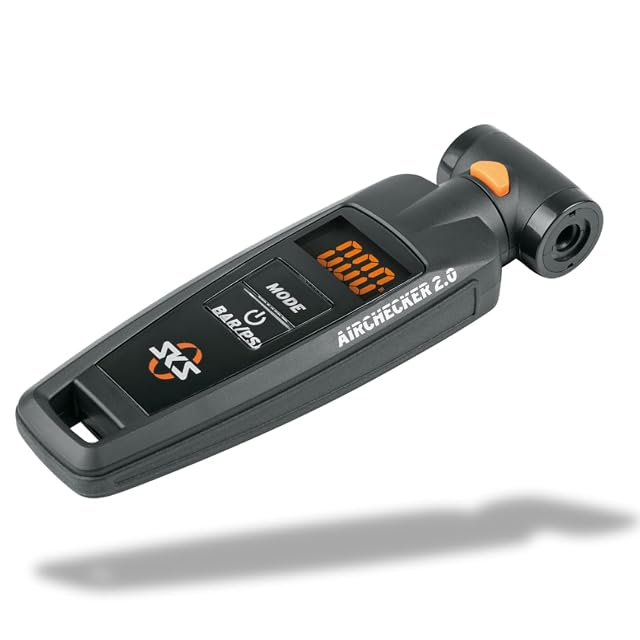
Two units puts it third on this shelf behind the AstroAI digital’s four and the UNCO pencil’s three.
2 PSI increments is the resolution, and it is the figure to read beside the missing accuracy. A scale marked every 2 PSI can be read to about 1 PSI by eye — so at a car’s 35 PSI the reading resolution alone is roughly ±3%, before any question of whether the gauge is right.
Five bullets, and no percentage, no standard, no grade, no tolerance.
The introduction: “Stated accuracy is usually a percentage of reading or a class marking, and it is the only comparable figure on the packaging.”
| Gauge | Stated accuracy |
|---|
| JACO ElitePro | ANSI ±1.5%, accredited facility |
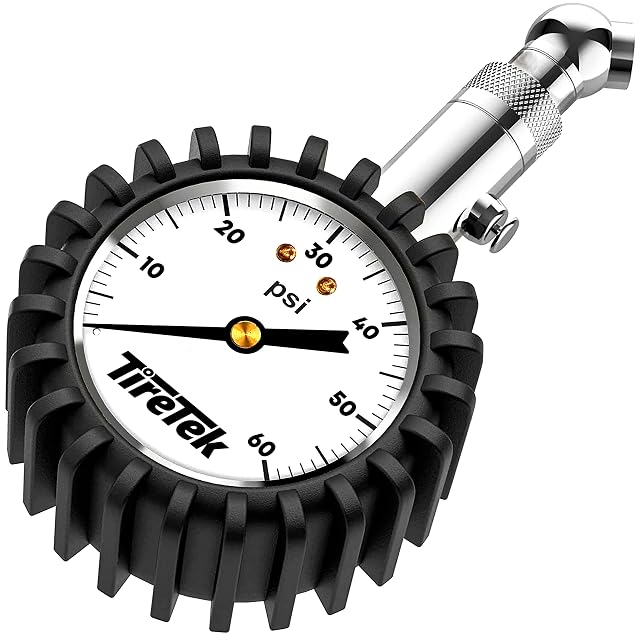
| TIRETEK | ANSI B40.1 Grade B, 2% |
| AstroAI digital | ±1 PSI |
| AstroAI T3 | ANSI B40.1, ±2 / ±3 PSI |
| This gauge | none |
| Allstar, UNCO | none |
What the listing offers instead is the word: “Safety starts with accurate… this air gauge for tire pressure delivers the accuracy you need to prevent tire blowouts.”
That is a sentence about the consequence of accuracy rather than a statement of it. On a sliding-bar gauge the mechanism is simple and often good; without a figure there is nothing to compare, and the buying advice on this shelf is the only recourse: “check your gauge against a second one once. Two gauges that agree are almost certainly both right.”
Which this purchase makes easy, because there are two of them in the box — and two gauges from the same production run agreeing with each other proves rather less than two from different makers.
Two gauges, which is the value argument
$15.91 for the pair is $7.96 each.
“Keep one tire pressure gauge in your car and one in your garage or workshop… no need to buy multiple tools for different vehicles.”
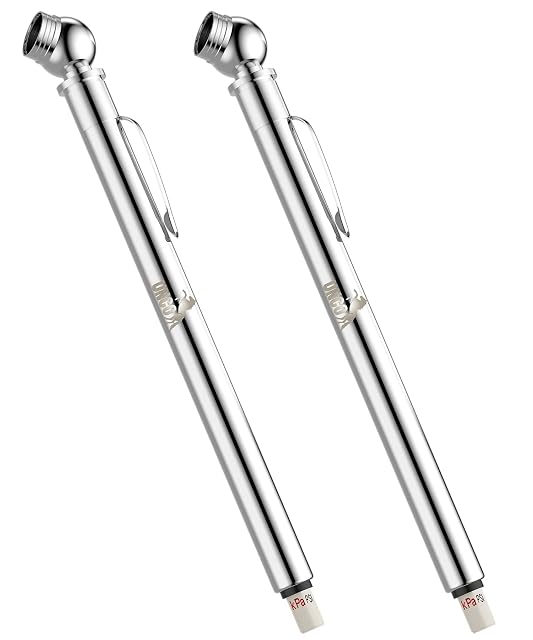
That is the right use. A gauge left in a car is a gauge that gets used; a gauge in the workshop is one that is still there when the first is lost. The UNCO pencil pair in this survey takes the same approach at $1.98 each.
Zinc alloy chucks, brass core, stainless body
“A solid brass core, zinc alloy chucks for airtight seals. The stainless steel body resists rust and drops.”
Three materials, each named for its job. Brass at the core is the sealing and pressure-bearing part; zinc alloy is a cast material, cheaper than machined brass and adequate for a chuck face; stainless for the barrel.
Zinc alloy is the weakest of the three and it is on the part that is pushed against a valve a few hundred times a year. The TIRETEK uses steel and brass and the JACO solid brass.
No bleed valve
Five of the seven American gauges here have one, as do the published BGS and HAZET inflator guns; this does not.
So it measures, and the four valve cores and caps in the box are for a different job — replacing the insert that leaks, rather than letting air out deliberately. The AstroAI T3 supplies a core tool to go with them and this does not.
What is not published
No accuracy, grade or standard. No bleed valve. No core tool for the cores supplied. No operating temperature, despite claiming to perform “in rain, dust, freezing cold, or scorching heat”. No scale length. No warranty.
At $7.96 a gauge it reaches further than anything else here, it reads in two units, and it will not tell you how close to right it is.
Availability
On sale at around $16 on the American Amazon store at the time of checking.
Prices and availability are what Keepa reported on the date this page was updated; both move.
Prices quoted in this text were read on 6 October 2026. The live price is at the top of the page.