What you are getting
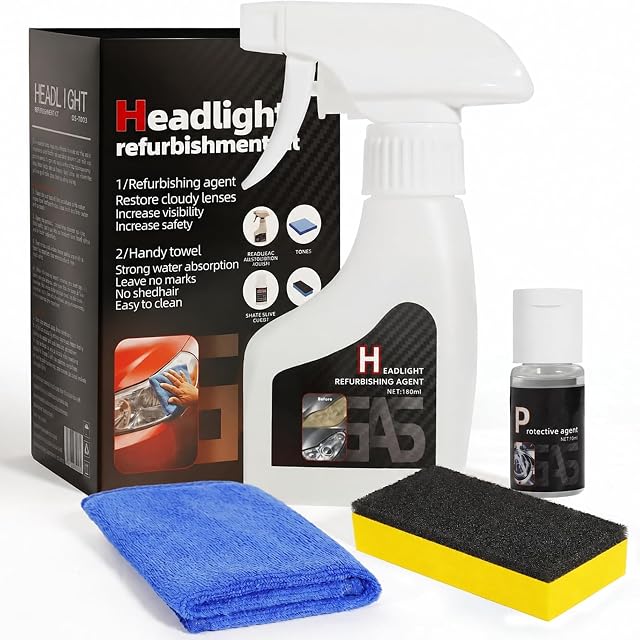
A wipe-on chemical restorer stated to dissolve surface oxidation and yellowing on contact, with a ceramic coating sealant forming a UV barrier; 180 ml, stated to treat 8 or more sets; a sponge applicator, a UV protective agent and a microfibre towel. No sanding and no drill. Stated to cure fully if kept dry for the first 24 hours. $16.99.
It is the only kit on this shelf that publishes a cure condition
The introduction lists “cure requirements” among the four things it compares, and nine of the ten kits here say nothing about them.
“Pro Tip: For the best results, ensure the lens surface is completely dry and clean before applying the protective sealant. Allowing the coating to fully cure without exposure to moisture for the first 24 hours will help lock in the transparency and maximize durability.”
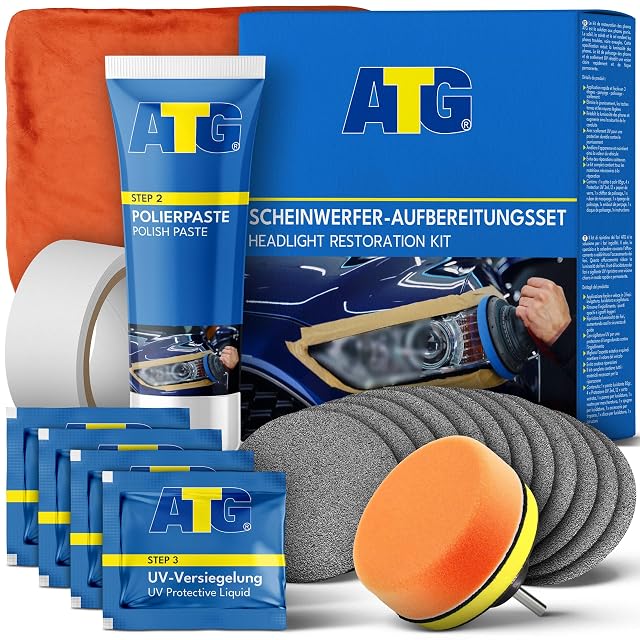
Twenty-four hours dry. That is the figure that decides whether a restoration survives its first week, and it is the reason the published ATG page carries “UV coatings have a cure time that has to be respected” as a reserve — without a number.
It also tells you when to do the job: not the afternoon before rain, and not outdoors in a British autumn. A car that lives on a driveway needs a dry forecast, which nothing else on this shelf mentions.
And it has no abrasive, which is the thing to understand before buying
“No Sanding or Drill Required… this kit eliminates the risk of permanent scratches caused by improper sanding techniques. Our wipe-on technology delivers a professional-level finish in minutes.”
Two kits on this shelf work this way: this and the Carrie Rowe kit. The other eight sand.
The case for it is real. The buying advice on this shelf describes the risk a kit without abrasives removes entirely: “an abrasive that cuts polycarbonate removes clear coat from a wing in one careless pass.” And the published Cerakote page calls no-machine working the thing that “removes the main risk for a first attempt”.
The case against is in the introduction’s first sentence: “A yellowed headlight is a degraded factory UV coating, not dirty plastic.”
A degraded coating is a physical layer, crazed and chalked, bonded to the polycarbonate. A chemical that “dissolves stubborn surface oxidation on contact” is working on the surface of that layer. What it does not do is remove the layer — which is what 500, 800 or 1000-grit abrasive is for.
So the outcome depends entirely on how far gone the lens is. On a lightly hazed lens the oxidized film is thin and a chemical clean plus a new coating is a sensible, low-risk job. On a chalky lens the failed coating stays, and the new ceramic goes on top of it.
“180ml = 8+ Full Treatments. Concentrated headlight restoration spray treats 8+ sets.”
| Kit | Coverage published |
|---|
| This kit | 180 ml, 8+ sets |
| Carrie Rowe | 120 ml |
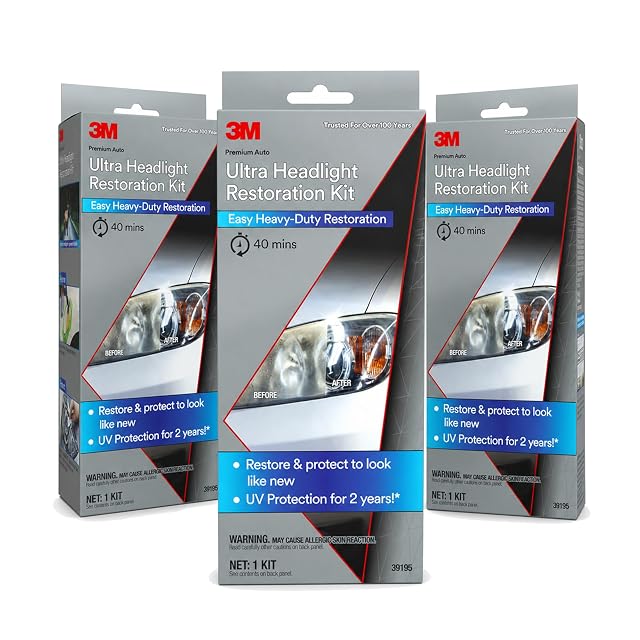
| 3M 39195 | three complete kits |
| HS, published | “at least 2 headlights” |
| Sonax, published | 85 ml |
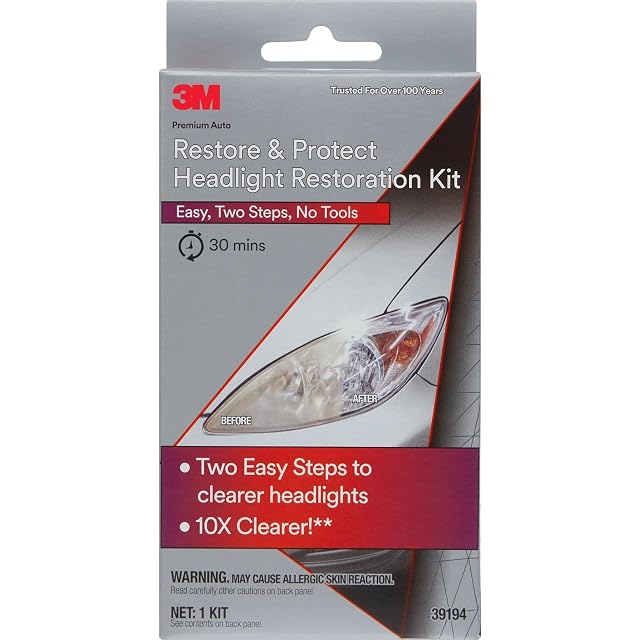
| Griot’s · 3M 39194 · Meguiar’s | two wipes each |
Eight sets at $16.99 is about $2.12 a car, which is the cheapest per-lens figure on the shelf by a wide margin — and it is the argument for a chemical kit over a sachet of two wipes.
What is not published is the split: how much of the 180 ml is restorer and how much is sealant. On a kit whose two stages do different jobs, that is the figure that decides whether both last eight treatments.
Nine bullets, and most of them are not about the product
The listing runs to nine bullets. Four carry information — the formula, the ceramic coating, the coverage and the cure tip. The rest are about driving safety at night, outdoor parking, paint safety and the fact that it works on trucks and motorcycles.
Two are worth reading for what they claim rather than what they specify:
“ENHANCED DRIVING SAFETY — Cloudy, foggy headlights can significantly reduce light output… This lens restoration liquid helps restore the original beam pattern and brightness.”
Reduced output from a hazed lens is true and well established. “Restore the original beam pattern” is a stronger claim: a beam pattern is set by the reflector and the lens optics, and haze scatters light rather than redirecting it. Clearing the lens restores transmission; the pattern was never moved.
“PAINT-SAFE & RESIDUE-FREE — tough on oxidation but gentle on surrounding paint and trim.”
That is a genuine advantage of a chemical kit and the counterpart to this shelf’s masking advice. It is also unverified: no statement of what the chemical is, no pH, no solvent named.
What the ceramic sealant is stated to do
“a professional-grade Ceramic Coating sealant that forms a durable, high-gloss hydrophobic barrier. It effectively seals the plastic pores to block harmful UV rays, helping to prevent your headlights from turning cloudy or foggy again for an extended period.”
This puts the kit in the group the introduction prefers — the one that replaces the coating. What it lacks is the number: “an extended period” against the Meguiar’s kit’s 18+ months, which is the only durability figure on this shelf.
“Seals the plastic pores” is marketing language — polycarbonate is not porous — and the mechanism it describes, a clear UV-blocking film over the lens, is the right one regardless.
What is not published
No abrasive of any kind, which on a chalky lens is the limitation. No durability period. No split of the 180 ml between restorer and sealant. No chemical identity, pH or solvent. No application temperature. No statement of what to do if the lens is deeply oxidized, beyond the claim that it works. No gloves, where three kits here supply one.
At $16.99 it is the cheapest per car on this shelf, the only one that tells you to keep it dry for a day, and it removes nothing.
Availability
On sale at around $17 on the American Amazon store at the time of checking.
Prices and availability are what Keepa reported on the date this page was updated; both move.
Prices quoted in this text were read on 6 October 2026. The live price is at the top of the page.