The only listing that explains why the factory fuse stays in the circuit
XENIVO Inline fuse current tester, 20 A
A parasitic draw tester whose listing explains the one safety point the method depends on.
What you are getting
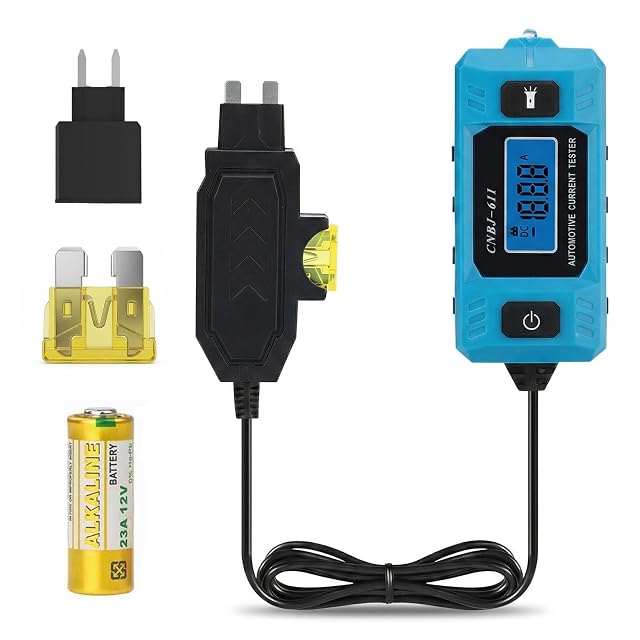
An inline fuse current tester for 20 A, 48 V circuits, measuring 0.01 A to 20 A in real time, compatible with Mini and Standard blade fuses, and designed so the vehicle’s original fuse stays in the circuit while it measures. $16.99.
It is the only listing here that explains why the original fuse matters
“Maintains Factory Circuit Protection: The fuse-inline design measures current through the vehicle’s original fuse, keeping factory circuit protection active while monitoring current during diagnostics.”
That sentence is the whole justification for this kind of tool, and its near-twin on this shelf — the VIREVO tester at $12.99 — does not include it.
Here is why it is the point. The classic way to measure a parasitic drain is to put a multimeter in series with the battery or across a pulled fuse. Both leave the circuit unfused for the duration: the meter’s own fuse, if it has one, is rated for the meter and not for the car. A short while you are probing then runs through the meter, and a 10 A meter fuse in a 30 A circuit is a destroyed meter at best.
An inline fuse tester puts the car’s own fuse back into the path. The protection is the one the manufacturer specified, and it stays there while you read the current.
The published Qwork page on this shelf makes the equivalent point about load: a tool that changes the circuit it is measuring is a tool that can mislead or damage.
And it measures what a test lamp on this shelf cannot see
The introduction describes a voltage tool: “is there power at this wire, right now.”
This measures current:
“Locate the Exact Fuse Causing Battery Drain: Stop guessing which circuit is draining your battery. This tester allows you to pinpoint the specific fuse responsible for abnormal parasitic current draw — fast, accurate, and without disconnecting the battery.”
A parasitic drain is invisible to a test lamp, because the voltage is present on every live circuit whether it is drawing anything or not. What is wrong is the amps.
Without disconnecting the battery is the other half of the method. A modern car’s modules take anything from twenty minutes to several hours to go to sleep, and disconnecting the battery restarts that clock — which is why the classic series-multimeter method so often reads a car that never settles. A fuse-slot tester leaves the battery connected and the car asleep.
Nought point nought one amps to twenty, which is the right window
“Measures 0.01A–20A current with clear real-time display.”
Two ends matter.
0.01 A (10 mA) at the bottom is the resolution the job needs: a sleeping car draws 20 to 50 mA in total, so ten-milliamp steps separate a sleeping circuit from a woken one.
20 A at the top is what lets you leave it in a circuit that is actually working. Most car fuses are 7.5 to 20 A, so the tester can stay in place while the circuit is switched on — “observe actual load conditions while running”, in the listing’s terms — which is how you confirm a suspect circuit rather than only finding it.
What is not published is the accuracy, only the resolution. Of the eleven tools on this shelf, only the Ansbell publishes an accuracy figure, and that is a voltmeter’s ±0.2 V.
Easier than a multimeter, which is the comparison worth making
“Easier Than Using a Multimeter: No loose probes or unstable contacts. Simply plug into the fuse slot to get steady real-time current readings.”
That is accurate, and the reason is mechanical rather than electrical. A multimeter in series with a fuse holder depends on two hand-held probes staying in contact for however long the car takes to sleep. One twitch and the circuit opens, the module wakes, and the clock restarts.
A tester that plugs in cannot lose contact. It is the difference between a measurement and an attempt at one.
But four things the twin publishes are missing here
| XENIVO | VIREVO |
|---|
| Price | $16.99 | $12.99 |
| Range and resolution | 20 A, 48 V, 0.01 A | the same |
| Display | “clear real-time display” | backlit LCD |
| Direction | not stated | DC / −DC shown |
| Work light | not stated | LED |
| Fuse standards | “mini & standard blade” | Mini ATM, Standard ATO/ATC named |
| Factory protection explained | yes | no |
Four dollars more for one published idea and four fewer published features. The missing backlight is the one that will be noticed: this tool’s working environment is an under-dash fuse box, which the VIREVO listing describes as “dark, cramped” and lights with an LED.
The missing fuse standard names are the one that could cost a return: ATO/ATC standard and ATM mini are the two this fits, and a car full of low-profile mini or Micro2 fuses is a car it does not.
What is not published
No accuracy figure. No measurement burden — an inline shunt adds resistance, and a sensitive circuit can behave differently with it in place. No display type or backlight. No fuse standard names. No power source for the tester itself. No voltage or continuity function. No guidance on what current is normal, which is the figure that makes the reading mean anything.
At $16.99 it is the dearer of two identical testers, and the only one that tells you why the method is safe.
Availability
On sale at around $17 on the American Amazon store at the time of checking.
Prices and availability are what Keepa reported on the date this page was updated; both move.
Prices quoted in this text were read on 6 October 2026. The live price is at the top of the page.