What you are getting
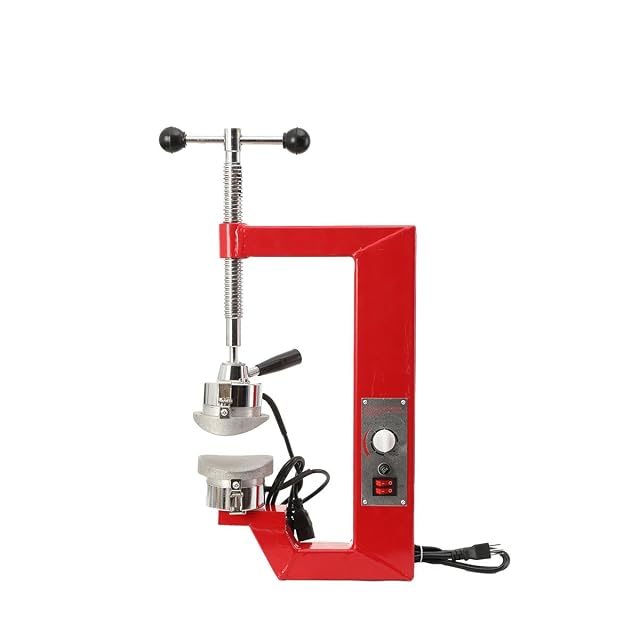
A tire vulcanizing press on a fully rotating C-frame, 110 V, with two curing heads that work “individually or simultaneously”, six molds for tread, shoulder and sidewall positions, and a controlled curing range of 140–165 °C (284 to 329 °F). 9 kg (19.8 lb). $83.66.
This is not a kit for the boot, and it should not be bought as one
Everything else in this survey is a bag of plugs and a T-handle that weighs between 630 g (22.2 oz) and 1.2 kg (2.6 lb). This weighs nine kilograms, plugs into the wall and clamps a wheel in a frame.
It is here because of what the rest of this shelf is honest about. This site’s own guidance says it twice:
“The plug gets you going from the outside; a professional repair is done with the tire off the rim, with an inspection of the inside. Only the second is durable.”
“Is a plug a permanent repair? No: it gets you home.”
A vulcanizing press is the machine that does the second kind. “The vulcanizing repair process cures the patch and inner tire lining to form a dense, sealed repair job” — which is a chemical bond between patch and casing, not a rubber bung wedged in a hole.
So the shelf has six get-you-home kits and one piece of equipment for the place they get you home to.
The six molds are the whole specification
“6 molds which fully meet the needs of tire repair at any position (such as shoulder, crown and sidewall), just need to select the corresponding mold.”
A cured patch has to be pressed against the inside of the casing at the casing’s own curvature. A crown is nearly flat, a shoulder is a tight radius and a sidewall is flat again at a different angle — so the mold is the part that decides which positions the machine can do at all.
Six molds and a fully rotating C-frame that “accommodates different wheel sizes and allows for vertical or horizontal repairs” is what a one-bay workshop needs.
And on the sidewall, the machine and this site do not agree
The listing: the press “can repair tread, shoulder and sidewall”, and one of the six molds is a sidewall mold.
This site’s guidance for the shelf, twice: “A sidewall puncture cannot be repaired, neither with a plug nor in a workshop. The tire has to be replaced.” And: “Can a sidewall be repaired? Never. A sidewall puncture writes off the tire, in a workshop too.”
Both statements are published and they are about different things. HOTSTORE is describing what the press can physically cure — it supplies the mold for that curvature. Whether a given tire may be repaired at the sidewall is not set by the press: it is set by the tire manufacturer’s own repair limits, which generally place the sidewall and the shoulder of a car tire outside the repairable area because that is where the casing flexes.
The press can cure a sidewall patch. The tire’s maker decides whether that tire is still a tire afterwards. Neither sentence answers the other, and this survey is not in a position to settle it — nobody here has cut a casing open.
Stated: 110 V. The four European listings published on this shelf carry no mains equipment at all, so this is the first item here that has a voltage, and it is the American one.
Worth saying plainly because a vulcanizing press is a heater: a 230 V machine on a 110 V supply undercures, and a cure that does not reach 140 °C (284 °F) is a patch that has been pressed on rather than bonded.
The temperature range is the only process window on this shelf
“Vulcanizing temperature between 140℃-165℃. Constant controlled heating elements maintain optimum temperature.”
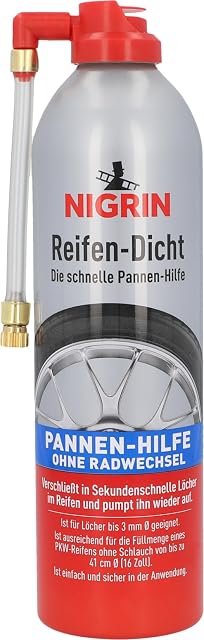
Twenty-five degrees of window around a cure. That is the kind of figure the plug kits have nothing equivalent to — not one of them publishes a cure temperature, a cure time or an expiry date, and only CKAuto publishes a plug length. The published NIGRIN sealant states a limit rather than a window: holes up to 3 mm (0.12 in), one tubeless tire up to 41 cm (16.1 in).
It is also the figure to ask a question about that the listing does not answer: how long at that temperature. A vulcanizing cure is a time-and-temperature pair, and only the temperature is published.
Two heads, used together or apart
“Curing heads can be operated individually or simultaneously for maximum repair efficiency.”
Two repairs at once, or one head on a crown while the other is cold. In a single-bay workshop that is the difference between a cure cycle blocking the bay and not.
What is not published
No cure time, which is half of a vulcanizing specification. No clamping pressure. No power rating in watts, so the circuit it needs is unknown. No maximum wheel diameter, despite the frame being sold on accommodating different sizes. No mold sizes for the six molds. No patch supply — the machine cures patches and the listing does not say whether any are included. No thermostat tolerance on “constant controlled”. No warranty.
At $83.66 it is the only item on this shelf that does the repair the shelf calls durable, and it is a piece of garage equipment, not something to carry.
Availability
On sale at around $84 on the American Amazon store at the time of checking.
Prices and availability are what Keepa reported on the date this page was updated; both move.
Prices quoted in this text were read on 6 October 2026. The live price is at the top of the page.