What you are getting
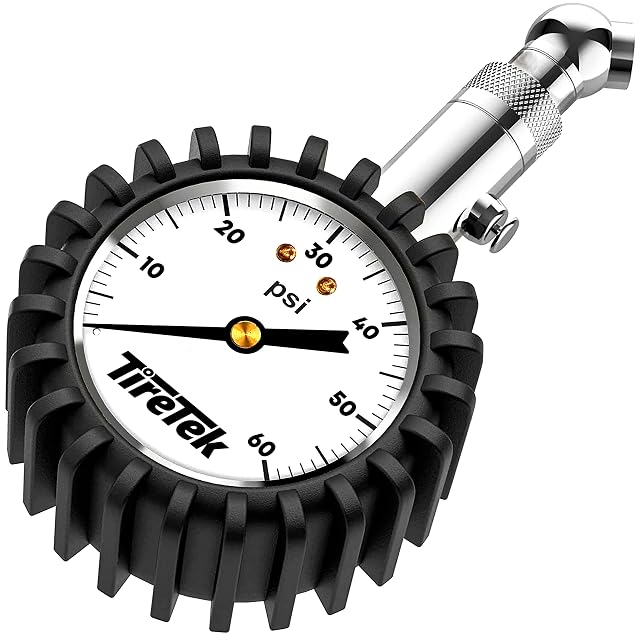
A 0–60 PSI dial gauge in steel and brass with an extended 5 mm (0.20 in) chuck tip, a 45-degree fully swivelling chuck, a built-in relief valve, an easy-read dial and a rubber cover. Calibrated to ANSI B40.1 Grade B (2%). No batteries. 159 g (5.6 oz). $9.77.
It names a grade inside a standard, which is more than a percentage
“Calibrated to ANSI B40.1 Grade B (2%) international accuracy standard.”
The introduction to this shelf: “Stated accuracy is usually a percentage of reading or a class marking, and it is the only comparable figure on the packaging.”
A class marking is the stronger of the two, because it is a grade defined in a document rather than a number chosen by a seller. Grade B carries 2% of full scale — and on a 60 PSI gauge that is ±1.2 PSI across the dial.
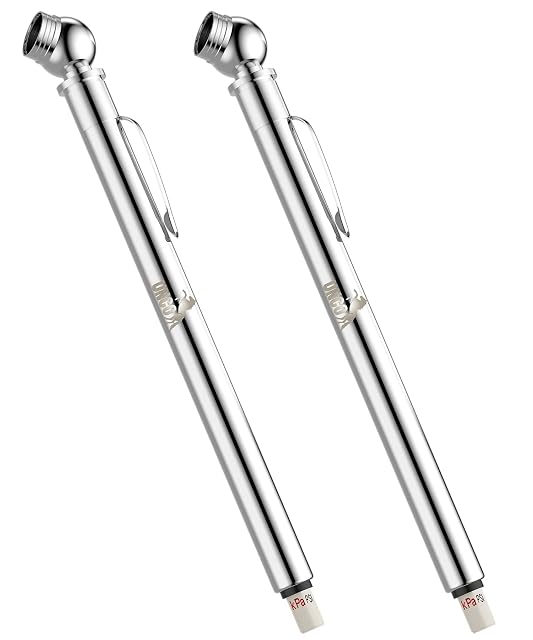
Three of the seven American gauges here cite ANSI B40.1: this, the AstroAI T3 and, by percentage rather than grade, the JACO. The published Etenwolf gauge on this shelf cites ANSI B40.7 grade 2A with ±0.06 bar, which is a different document and a tighter grade.
So the shelf now has gauges quoting two different ANSI documents and three grades. The useful comparison is the resulting figure in PSI at the pressure you use.
And the bleeder works while the gauge is still on the valve
“Our built-in relief valve allows you to press the bleed button while the gauge is still on the tire valve, releasing air until you reach the exact target required.”
That is the clearest description of a bleeder on this shelf, and the clause that matters is “while the gauge is still on”.
A bleeder that requires lifting the chuck off makes setting a pressure a loop of guesses: bleed, refit, read, bleed again. One used in place is a single operation — watch the needle fall to the number and stop.
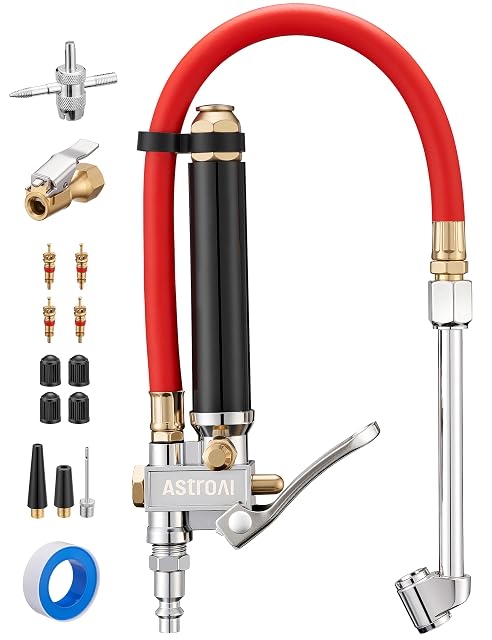
Five of the seven American gauges here have a bleeder, as do the published BGS and HAZET inflator guns. Only this one says it can be used without breaking the seal.
A 45-degree chuck that also swivels
“Easy to read dial with a 45 degree angled and fully swivelling chuck.” And: “an extended 5 mm (0.20 in) chuck tip, so you get a great seal with no air leakage.”
The introduction: “What decides daily use is the chuck: a straight chuck will not reach a valve behind an alloy spoke, and an angled or dual-foot one will.”
Forty-five degrees is the angle that clears a spoke, and a swivel on top of that means the hand does not have to be at the angle too. The 5 mm (0.20 in) extended tip is the other half: a short tip bottoms out on a recessed valve before it seals, and the hiss is the gauge leaking rather than the tire.
Sixty PSI, which is the right range and not a wide one
A car runs 30 to 40 PSI and a full-size spare is often 60.
| Gauge | Range |
|---|
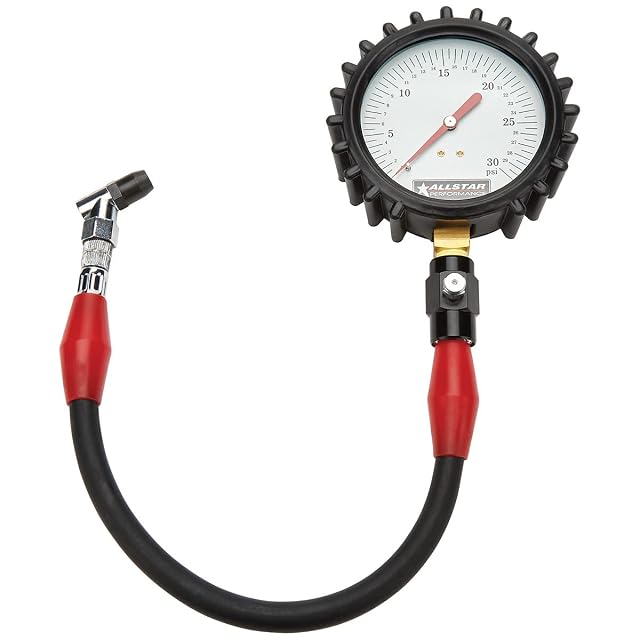
| Allstar | 0–30 PSI |
| This gauge | 0–60 PSI |
| UNCO | 10–75 PSI |
| JACO ElitePro | 0–100 PSI |
| AstroAI T3 | 10–120 PSI |
| LUMITECO | 10–150 PSI |
| AstroAI digital | 0–150 PSI |
Sixty PSI puts a car’s 35 at the middle of the dial, which is where a dial is most readable and where a 2% full-scale tolerance costs least in absolute terms. It also stops at the spare’s limit, so a van or a light truck at 65 PSI is outside it.
A narrow range on a dial gauge is a feature, not a limitation — the Allstar in this survey takes it further with 0–30 PSI on a four-inch face.
And two of its five bullets are keyword lists
Bullet one ends: “Makes great car accessories, car stuff, tire deflator, car stuff for men, cool car gadgets, car gifts for men, him, dad.”
Bullet five is nothing else: “Car accessories for men and women — give as the perfect gifts for men, car accessories gifts for men, gifts for dad, car gifts, car gifts for men, car stuff for men, gifts for car guys, car guy gifts for men, gifts for car lovers, cool car gifts, car lovers gifts for men.”
Eleven phrases for the same idea, in a bullet of its own, on a gauge whose first clause cites an ANSI grade.
It changes nothing about the instrument and it is worth seeing, because the same listing contains the best bleeder description on the shelf and the only published chuck tip length.
No batteries, in all weather
“No batteries required. This top-rated, professional tire monitoring system is easy to use and is reliable in all weather conditions.”
Six of the seven gauges in this survey are mechanical and four of them make a point of it. The AstroAI digital gauge is the only one that needs a cell, and its own listing names the reason this matters: it auto-powers-down after 30 seconds “so the included 2×AAA batteries last longer”.
“Reliable in all weather” is a claim without a temperature. The AstroAI T3 publishes −10 to 50 °C (14 to 122 °F) and is the only gauge on this shelf that does.
What is not published
No units but PSI. No operating temperature. No dial diameter, where the JACO publishes 2 inches and the Allstar 4. No hose length — the chuck appears to be on the body rather than a hose. No recalibration interval.
At $9.77 it is the cheapest dial gauge here with a published accuracy, and the only one that tells you how to use its bleeder properly.
Availability
On sale at around $10 on the American Amazon store at the time of checking.
Prices and availability are what Keepa reported on the date this page was updated; both move.
Prices quoted in this text were read on 6 October 2026. The live price is at the top of the page.