Two dollars a gauge, three units, and a bar that stays out
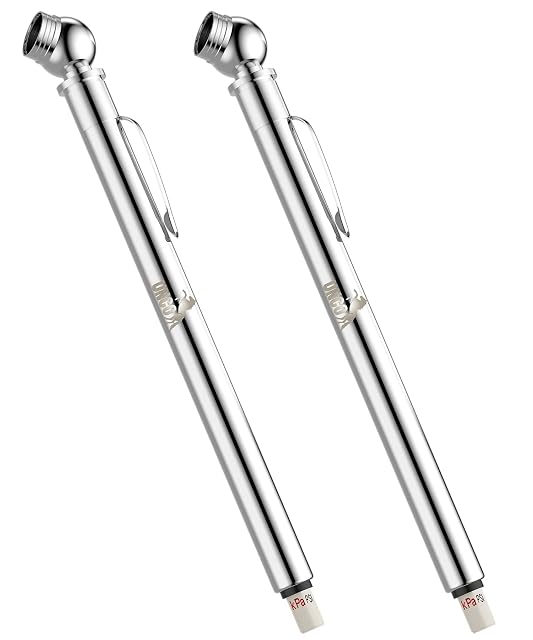
UNCO Pencil Gauge, 2-pack
Two stainless pencil gauges reading in three units with an integrated deflator, at under two dollars each.
What you are getting
Two pencil gauges in stainless steel reading 10–75 PSI / 70–550 kPa / 0.7–5.5 bar on an ABS indicator bar, with an integrated deflator valve, a chuck and a pocket clip. No batteries. 50 g the pair. $3.95 — $1.98 a gauge, the cheapest thing on this shelf.
Three units, which puts it second on this shelf
“This device accurately measures PSI, kPa, BAR in a range of 10-75 PSI, 70-550 kPa, and 0.7-5.5 BAR.”
| Gauge | Units |
|---|
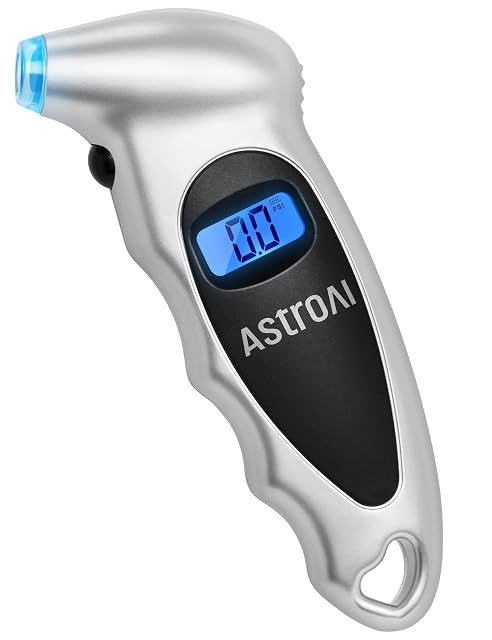
| AstroAI digital | 4 |
| This gauge | 3 — PSI, kPa, bar |
| LUMITECO | 2 |
| JACO, TIRETEK, AstroAI T3, Allstar | 1 |
Three scales printed on a sliding bar on a $1.98 gauge is more than four of the dearer gauges here manage, and it matters on a shelf that is American by market and international by equipment: a European car’s door jamb is in bar, a motorcycle manual often in kPa.
And the indicator bar holds the reading by mechanism
A pencil gauge works by pushing a graduated bar out of a barrel against a spring. The bar stays where the pressure put it until it is pushed back in by hand.
That is the same virtue the JACO in this survey engineers with a locking dial and a reset button, arrived at for nothing. The introduction to this shelf frames the whole category on it: the useful gauge “gives the same reading twice on the same tire, so you can correct from it” — and a reading you can carry away from the wheel and read in the light is the first condition of that.
An integrated deflator, on the cheapest gauge here
“UNCO tire pressure gauge features an integrated deflator valve, chuck, and ABS indicator bar.”
Five of the seven gauges in this survey have a bleeder and this is the cheapest of them. The AstroAI digital at $6.58 and the LUMITECO pair at $15.91 do not.
So at $1.98 this gauge both reads and adjusts, which is the whole job.
Five bullets, and no percentage, no grade, no standard.
The introduction: “Stated accuracy is usually a percentage of reading or a class marking, and it is the only comparable figure on the packaging.”
What the listing says instead is “this device accurately measures” — the adverb standing in for the number. Three of the seven gauges here cite ANSI; this, the LUMITECO and the $52.99 Allstar cite nothing.
A pencil gauge is a spring and a bar, which is a mechanism with few ways to be subtly wrong and several ways to be plainly wrong — a tired spring reads low across the whole scale. The buying advice is the only check available: “check your gauge against a second one once. Two gauges that agree are almost certainly both right; a single gauge that has drifted is invisible.”
Two in the box makes that easy and weak: two gauges from one production run agreeing proves less than two from different makers.
And the chuck is straight, which the introduction calls the daily decision
“Simply press the chuck onto the valve.”
The introduction: “a straight chuck will not reach a valve behind an alloy spoke, and an angled or dual-foot one will.”
A pencil gauge is a straight barrel with the chuck on the end. On an exposed valve it is the fastest thing on this shelf; behind a deep-dish spoke it will not go on square, and a chuck that is not square on the valve reads low and hisses.
This and the AstroAI digital are the two straight-on gauges in this survey. Five others are angled, swivelling or dual-footed.
Ten to seventy-five PSI, and the warning about the top of it
“Keep in mind that it should not exceed the maximum pressure of the gauge, as it will damage it.”
That is an unusually direct sentence and it is true of every mechanical gauge: over-pressuring a spring-and-bar mechanism bends the spring and the gauge reads wrong afterwards, with nothing to show it.
10 to 75 PSI covers a car at 35 and a spare at 60 with margin. A light truck at 80 is outside it, and the sentence above says what happens then.
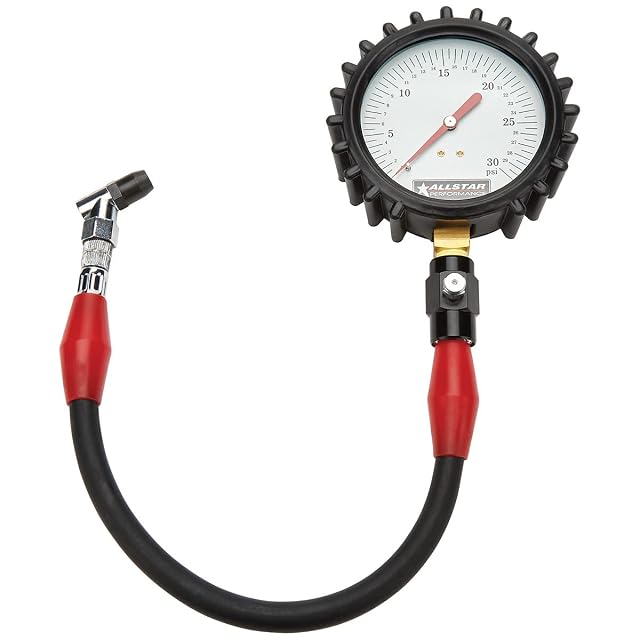
The Allstar in this survey, at 0–30 PSI, is the gauge on this shelf most easily over-pressured by a road car — and it does not carry the warning.
Fifty grams for two, and a pocket clip
The lightest thing on this shelf, and the clip is the reason it gets used: a pencil gauge in a shirt pocket or a door bin is to hand, and a gauge in a toolbox in the garage is not.
Stainless steel on both the barrel and the components, “rust and corrosion-resistant for a secure seal around the valve stem” — which on a part that lives in a door bin through winter is the right material.
What is not published
No accuracy, grade or standard. No resolution — how the bar is graduated is not stated, where the LUMITECO publishes 2 PSI increments. No operating temperature. No warranty. No chuck tip length, where the TIRETEK publishes 5 mm.
At $1.98 a gauge it reads three units, holds its reading, lets air out and fits in a pocket, and it will not tell you how close to right it is.
Availability
On sale at around $4 on the American Amazon store at the time of checking.
Prices and availability are what Keepa reported on the date this page was updated; both move.
Prices quoted in this text were read on 6 October 2026. The live price is at the top of the page.