Four units, a lit nozzle, and a straight chuck
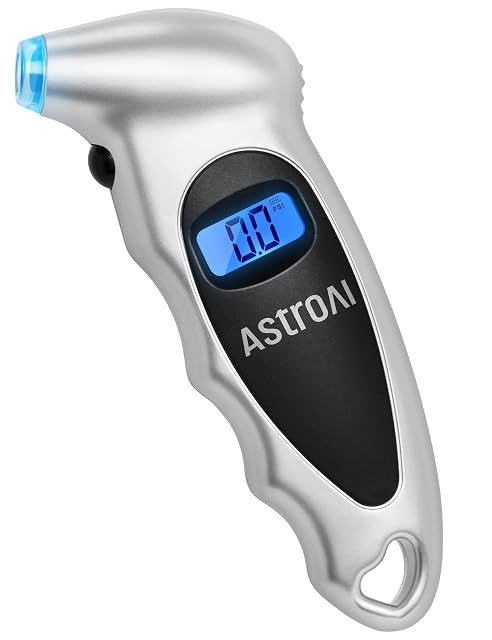
AstroAI Digital Tire Pressure Gauge 150 PSI
A digital gauge stated to ±1 PSI with four units, a backlit screen and a light on the nozzle, at 68 grams.
What you are getting
A digital gauge reading 0–150 PSI, stated factory-calibrated to ±1 PSI, with a backlit LCD, an illuminated nozzle, four units — PSI, bar, kgf/cm² and kPa — on one button, 30-second auto-off and 2 × AAA batteries included. 68 g (2.4 oz). $6.58.
“Quickly switch among PSI, Bar, Kgf/cm², and KPA with a single press.”
The introduction to this shelf lists units among the five things it compares, and the spread on this shelf is wide:
| Gauge | Units |
|---|
| This gauge | 4 — PSI, bar, kgf/cm², kPa |
| UNCO | 3 — PSI, kPa, bar |
| LUMITECO | 2 — PSI, bar |
| JACO, TIRETEK, AstroAI T3, Allstar | 1 — PSI |
It matters more than it sounds on a shelf that is American by market and international by equipment. A European car’s door jamb is often in bar, a motorcycle manual in kPa, and a trailer plate in PSI. A gauge that converts removes the arithmetic from a crouch at the wheel.
And the lit nozzle is the practical idea on this gauge
“The illuminated nozzle helps you find the valve stem in the dark, while the backlit LCD makes readings crystal clear in dim garages.”
Two lights for two problems. The backlit screen is common; the light on the nozzle is not, and it is the one that saves time — a valve stem behind a dark alloy wheel is found by feel otherwise.
No other gauge on this shelf has either. The JACO and Allstar dial gauges glow in the dark instead, which needs charging in daylight and works for minutes rather than hours.
“Factory-calibrated to ±1 PSI.”
The introduction: “Stated accuracy is usually a percentage of reading or a class marking, and it is the only comparable figure on the packaging.”
±1 PSI is an absolute figure, which is the easier kind to read: at a car’s 35 PSI it is ±2.9%. That is tighter than the TIRETEK’s 2% of full scale on a 60 PSI dial (±1.2 PSI) and looser than the JACO’s ±1.5% of reading (about ±0.5 PSI at 35).
What it does not have is a standard or a place. “Factory-calibrated” is the maker’s own process; the JACO names an ANSI-accredited facility, and the TIRETEK and AstroAI T3 name ANSI B40.1. On a digital gauge the figure also depends on the battery and the temperature, and neither is bounded here.
And the chuck is straight, which is the one thing the introduction says decides
“Fits standard Schrader valves; just press on for a reading.”
The introduction: “What decides daily use is the chuck: a straight chuck will not reach a valve behind an alloy spoke, and an angled or dual-foot one will.”
This is a straight press-on chuck on the body of the gauge. On a steel wheel with an exposed valve it is the quickest thing here; on a deep-dish alloy with the valve set behind a spoke it is the wrong tool, and the gauge is 68 grams of plastic you cannot get an angle on.
Five of the seven gauges in this survey are angled, swivelling or dual-footed. This and the UNCO pencil are not.
No bleed valve either, which five of the seven American gauges have — so this gauge measures and does not adjust. Over-inflate and you go back for something else.
Thirty seconds of auto-off, and two AAA cells
“The gauge automatically powers down after 30 seconds of inactivity, so the included 2×AAA batteries last longer.”
That is the right trade and it is also the gauge’s single point of failure. Six of the seven American gauges here are mechanical and four make “no batteries required” an explicit selling point — the TIRETEK calls itself “reliable in all weather conditions” on that basis.
A flat cell in a glove box in January is the scenario, and AstroAI’s answer is a short timeout rather than a low-battery warning, which is not published.
Sixty-eight grams, the lightest single gauge on this shelf
Against 159 g (5.6 oz) for the JACO and TIRETEK, 290 g (10.2 oz) for the LUMITECO pair, 440 g (15.5 oz) for the AstroAI T3 and 553 g (19.5 oz) for the Allstar. Only the UNCO pencil pair is lighter at 50 g (1.8 oz) for two.
“Slips into any glove compartment” is accurate, and it is what a monthly-check gauge should do.
What is not published
No standard or grade, where three gauges here cite ANSI. No operating temperature, where the AstroAI T3 from the same maker publishes −10 to 50 °C — and a digital sensor is more temperature-sensitive than a Bourdon tube. No resolution, so whether it reads to 0.5 PSI or 1 is unknown. No bleed valve. No low-battery warning. No warranty.
At $6.58 it is the cheapest gauge here with a published accuracy, it converts four ways and lights its own nozzle, and it cannot reach a valve behind a spoke.
Availability
On sale at around $7 on the American Amazon store at the time of checking.
Prices and availability are what Keepa reported on the date this page was updated; both move.
Prices quoted in this text were read on 6 October 2026. The live price is at the top of the page.