What you are getting
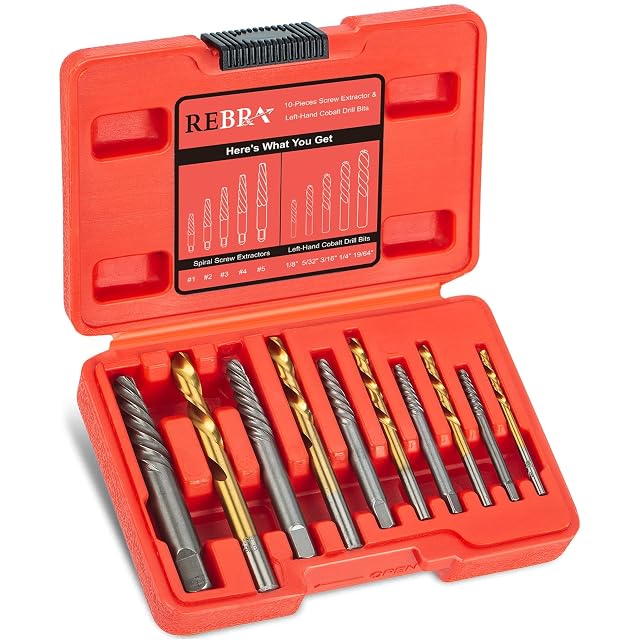
Five #6542 HSS cobalt left-hand drill bits at 1/8, 5/32, 3/16, 1/4 and 19/64 inch with a 135-degree point, and five #37 alloy steel spiral extractors sized #1 to #5, in a case measuring 136 × 100 × 33 mm. $12.99.
Its drill bits run in the undoing direction, with cobalt in the steel
The shelf’s introduction singles this out: “Several sets pair extractors with left-hand drill bits, which sometimes remove the bolt before the extractor is needed.”
A left-hand bit turns counterclockwise. On a snapped bolt that is seized rather than welded in, the bit’s own cutting torque is unscrewing torque — and often the stub starts to back out while the hole is still being drilled. The extractor then never comes into it.
Of the twelve items on this shelf, five ship drill bits:
| Set | Drill bits |
|---|
| This set | 5, left-hand, cobalt HSS, 135° |
| YURINWOO 9 pcs, published | 3 spiral drills, left-hand |
| CAINCAY 6 pcs, published | double-ended — the left-hand drill point is on the extractor itself |
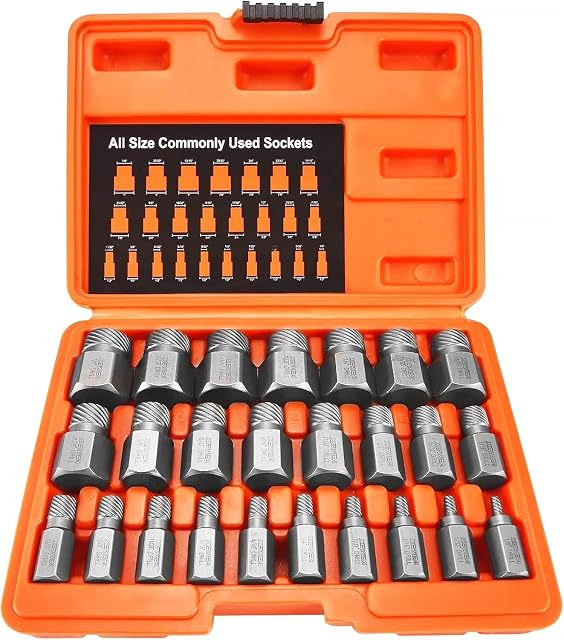
| CRENGYBL 26 pcs | 6, right-hand, titanium-coated HSS, 135° |
| CCLIFE 25 pcs, published | 6 HSS drills, direction not stated |
| The other seven | none |
CRENGYBL’s bits drill the pilot hole and nothing else. These, and the three on the published YURINWOO set, can do the job on their own.
Cobalt is the other specification worth reading: cobalt-alloyed high-speed steel keeps its edge hotter than plain HSS, which matters because a snapped bolt is usually drilled dry in a tight space and the bit heats up fast. It is the only cobalt claim on this shelf.
And it is the only set that names a bit size against each extractor
“Left-hand bits / reversed drillbits — 1/8”, 5/32”, 3/16”, 1/4”, 19/64” and Matching Alloy Extractors (stud outs) — 1#, 2#, 3#, 4#, 5#.”
The shelf’s introduction is unusually direct about why that matters: “The most useful thing a set includes is not a tool at all: a drill size table, since the pilot hole decides everything.”
No listing on this shelf publishes a drill size table. This bullet is the closest thing to one: five bits listed in order against five extractors listed in order, so the pairing is readable even though the word “table” never appears. The published YURINWOO set calls its three spiral drills “matched” without giving a size for either, and the published CAINCAY set sidesteps the question by putting the drill point and the extractor on the same double-ended bit.
The contrast is CRENGYBL, which ships 6 drill bits and 6 spiral extractors and never says which bit belongs to which extractor. Both sets then depend on the buyer getting the pilot hole right, and only one of them helps.
#1 to #5 is not a diameter. A numbered spiral extractor covers a range of bolt diameters, and the number tells you which pilot hole it needs rather than what bolt it fits — which is exactly why the drill size question is the whole question.
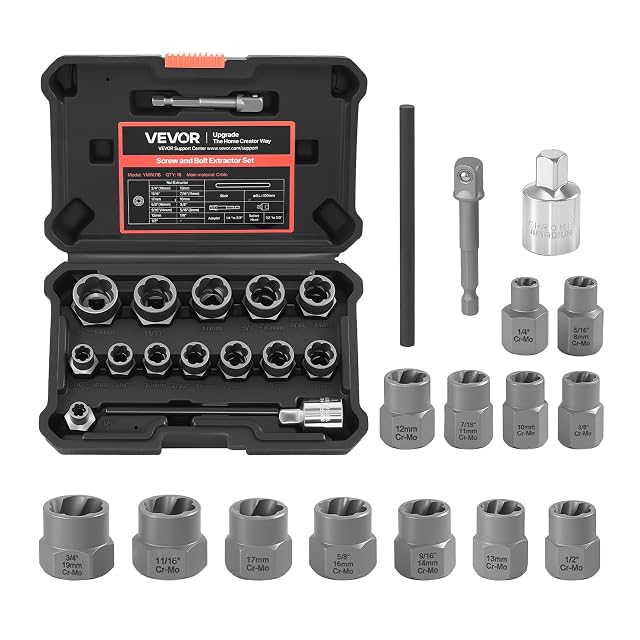
The published sets on this shelf use the same convention, and the American sets mostly do not: VEVOR, XEWEA and NEIKO all mark their extractors in inches or millimeters because they grip the outside of a fastener, where the size is the size.
That is the real division on this shelf, and it is worth understanding before buying:
| Approach | What it grips | Needs a pilot hole |
|---|
| Spiral extractor (#1–#5) — this set, CRENGYBL | the inside of a drilled hole | yes |
| Multi-spline — XEWEA, NEIKO | the outside of a rounded head or stud | no |
| Socket type — VEVOR, KTI | the outside of a rounded head | no |
A spiral extractor is for a bolt that has snapped off. An external one is for a head that is rounded but still there. They are not substitutes, and this set is built for the first problem.
“The 135° angle design of the head makes it easier to touch the fasteners and ensures precise countersinking and hole smooth clean.”
A 118-degree point is the general-purpose angle; 135 degrees is flatter, which makes it self-centering on a hard surface instead of wandering. On the convex, work-hardened face of a snapped bolt that is the difference between a centered hole and a thread repair.
The shelf’s buying advice: “drill straight and centered, and take the time to punch the center first. An off-center pilot hole turns a bolt extraction into a thread repair.”
Both sets that ship bits publish the 135-degree figure. Neither ships a center punch — only VEVOR does, a 6 mm (0.24 in) pin punch, and that set has no drill bits at all.
But the steel grade is a number without a scale
“5pcs #37 alloy steel bolt extractors.”
#37 is a Chinese steel designation, not a hardness and not an alloy family in the sense the shelf asks for. The introduction wants “stated hardness”, and the warning behind it is the reason: “a broken extractor is harder to remove than the bolt was — the steel is deliberately hard, which also makes it brittle.”
Several of the ten items on this shelf publish a hardness: the published YURINWOO set at 63–65 HRC, CRENGYBL at 58–62, the published GEDORE set at 54 and VEVOR at 50–55. This set publishes neither a hardness nor a chrome-molybdenum claim, and on a tool whose failure mode is snapping off inside the bolt that is the figure you would most want.
What is not published
No hardness. No drill size table, though the bit-to-extractor pairing is published. No bolt diameter ranges for #1 to #5, so which extractor suits an M8 stud is not stated. No center punch. No coating for the extractors — XEWEA publishes manganese phosphate. No weight. No torque limit, on a tool used with a tap wrench.
At $12.99 it is built for a bolt that has actually snapped, and its bits turn in the direction that undoes one.
Availability
On sale at around $13 on the American Amazon store at the time of checking.
Prices and availability are what Keepa reported on the date this page was updated; both move.
Prices quoted in this text were read on 6 October 2026. The live price is at the top of the page.