The same cable as the dearer pair here, three dollars less
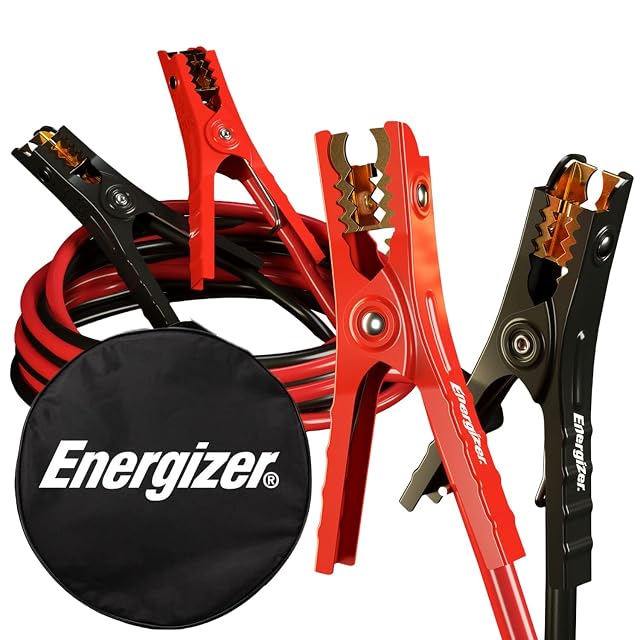
Energizer 6 AWG, 16 ft, with bag
A 6-gauge pair at the lowest price for its length here, sharing its bullets with another brand.
What you are getting
Sixteen feet (4.9 m) of 6-gauge cable in a thick vinyl coating, copper-clad aluminum, with clamps carrying a strong spring and a comfortable handle, stated tangle free and flexible at −40 °C, in a travel bag. Stated for “trucks, SUVs, full-size cars, mid-size cars and small/compact cars”. 280 × 276 × 79 mm packed. $19.96.
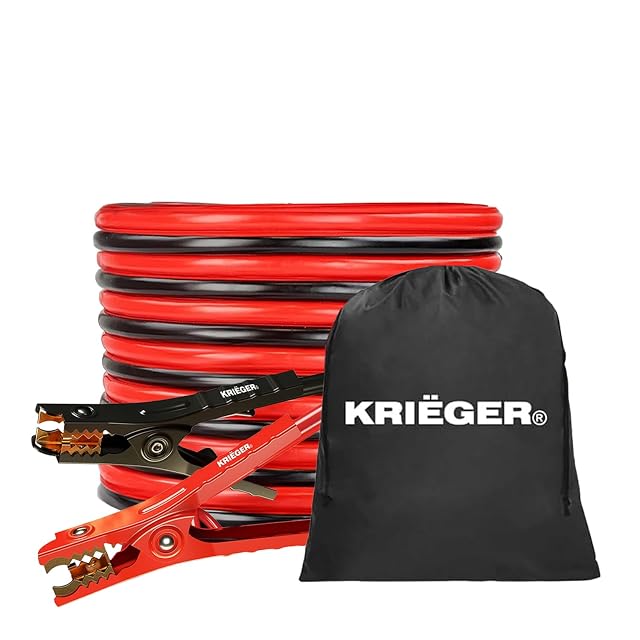
Its five bullets are the K KRIËGER pair’s five bullets
This is the fact that decides how to read the listing, so it is worth setting out plainly.
| Bullet | This lead | K KRIËGER KJC616 |
|---|
| 1 | “16 FEET JUMPER CABLES — 6 Gauge, 16 FT… Ideal for trucks, SUVs, full-size cars, mid-size cars and small/compact cars” | identical, brand swapped |
| 2 | “THICK VINYL COATING — Includes a strong spring and a comfortable handle…” | identical opening, different second clause |
| 3 | “CARRYING CASE INCLUDED — Our Energizer jumper cables come with a high-grade travel bag” | identical, “Our Krieger jumper cables” |
| 4 | “TANGLE FREE CCA BOOSTER CABLES”, then 16 feet of reach and a copper-clad aluminum cable stated flexible even at −40 °C (-40 °F) | identical |
| 5 | “THE BRAND NAME YOU CAN TRUST — … We keep you going and going!” | identical, including the slogan |
The fifth bullet is the one to notice. “We keep you going and going” is Energizer’s own long-running slogan, and it appears verbatim in the K KRIËGER listing.
The two references also share an EAN prefix: 0841915003072 here and 0841915005694 on the K KRIËGER pair. A shared GS1 prefix means the same company registered both numbers.
None of that is a defect. It means these are two labels on one product, and the only thing separating them is $3.01 — this one being the cheaper.
Six gauge is 13.3 mm (0.52 in)², and the vehicle claim is broad for it
Six AWG is 13.3 mm (0.52 in)² on the standard wire table, and the conductor is CCA — which the introduction says carries “roughly two-thirds of what copper carries for the same section”, so call it the equivalent of about 9 mm (0.35 in)² of copper.
| Lead | Cross-section | Stated vehicles |
|---|
| IWH, published | 50 mm (1.97 in)² | petrol 7000 cc, diesel 4000 cc |
| Hella, published | 35 mm (1.38 in)² | petrol 7000 cc, diesel 4000 cc |
| Noone | ≈ 33.6 mm (1.32 in)² | vans, large SUVs, trucks |
| Schumacher, published | 16 mm (0.63 in)² | 6, 12 and 24 V |
| This lead · K KRIËGER | ≈ 13.3 mm (0.52 in)² | trucks, SUVs, full-size cars |
| Nilight | ≈ 13.3 mm (0.52 in)² | small and compact cars, saloons |
| CARTMAN | ≈ 13.3 mm (0.52 in)² | mid-size cars, light pickups, light RVs |
Three leads share this section and claim three different things. The Nilight pair, on the same 6 gauge and the same 16 feet, claims small and compact cars; the CARTMAN pair claims mid-size cars and light pickups on 12 feet of the same gauge. This and the K KRIËGER pair claim trucks.
The cable is the same. The introduction’s position is that the section is what decides, and 13.3 mm (0.52 in)² of aluminum is the thinnest offering on this shelf — so read the broadest of those three claims against the thinnest conductor.
Minus forty on the insulation, which is the right thing to publish
The fourth bullet states that the copper-clad aluminum cable remains flexible even at −40 °C (-40 °F).
The introduction makes cold the point: insulation “that does not crack in the cold — which is when they are used.”
Four of the five American leads state −40 °C (-40 °F); the CARTMAN pair stops at −25 °C (-13 °F); none of the five published leads states a temperature at all. A lead that has gone stiff is a lead that will not lie flat across an engine bay and whose vinyl splits at the clamp, which is where it flexes most.
No upper limit is published here. The Nilight pair publishes 75 °C and the Noone pair 60 °C.
The clamp description is a spring and a handle, and little else
“Includes a strong spring and a comfortable handle for secure placement and easy positioning. Thick vinyl coating for protection against rust and corrosion.”
Of the introduction’s three clamp tests — “jaws that reach around a terminal, springs strong enough to hold, and insulation that does not crack in the cold” — this answers the second and the third.
Vinyl coating is weaker than what two American leads here claim: the Nilight clamps are “fully wrapped” in PVC and the Noone clamps are covered in non-conducting rubber and UL listed. A coating on the handle is not the same as insulation over the whole clamp body, and the difference shows when a clamp falls off a terminal.
No jaw opening is published, and no lead on this shelf publishes one.
And the bag is the inclusion that protects the cable
“Our Energizer jumper cables come with a high-grade travel bag for easy transport and compact storage.”
The published AEG page states the reason better than any American listing does: a bag “is what stops the clamps biting through their own insulation in a boot”.
Four of the five American leads here include one. The Nilight and Noone pairs add gloves; this does not.
What is not published
No cross-section in mm² — gauge only. No amp rating, where the Noone and Nilight pairs state 600 A and 450 A; the introduction calls the rating meaningless, so this is not a loss. No upper temperature limit. No clamp jaw opening. No voltage range. No engine sizes. No warranty term. No cable weight.
At $19.96 it is the cheapest 16-foot lead on this shelf, and the dearer pair beside it is the same cable with a different name on the bag.
Availability
On sale at around $20 on the American Amazon store at the time of checking.
Prices and availability are what Keepa reported on the date this page was updated; both move.
Prices quoted in this text were read on 6 October 2026. The live price is at the top of the page.