What you are getting
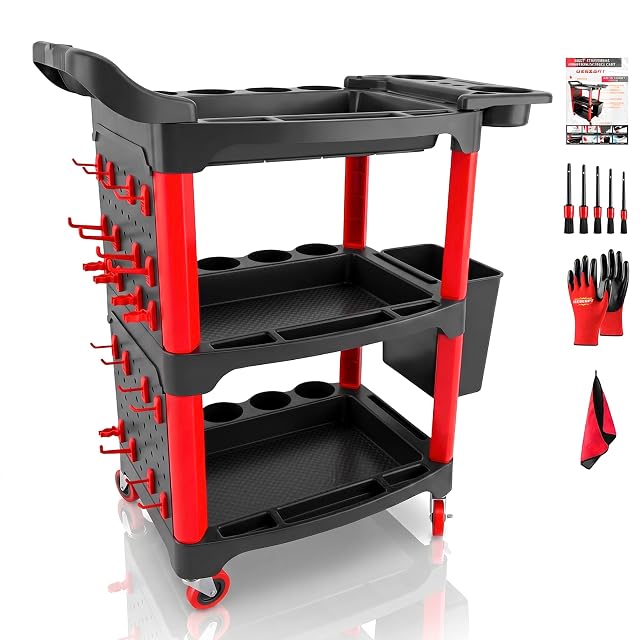
A two-tier rolling cart in high-strength industrial PP with a pegboard, 6 detachable metal hooks, a built-in handle tray and a hanging bar; a stated 550 lb total capacity split 200 lb on the top tier and 400 lb on the bottom; 5-inch PP and PVC reinforced casters, two of them lockable 360° swivels; anti-warp trays with a reinforced rib structure and a rinseable surface. 15,499 g (546.7 oz), 1,010 × 845 × 440 mm (39.8 × 33.3 × 17.3 in). $88.99.
It publishes the load figure this shelf says nobody publishes
The introduction asks for it twice. “The stated load per drawer is the figure that tells you which kind you are buying, and it is worth more than the total weight of the cabinet.” And at the end: “Not one of the drawer cabinets on this shelf publishes a load per drawer.”
VEVOR publishes a figure for each tier:
| Item | Published capacity |
|---|
| This cart | 550 lb total — 200 lb top, 400 lb bottom |
| WoopJeem bucket dolly | 220–331 lb |
| DESEQPT detailing cart | 297 lb |
| Goplus rolling tray | 55 lb |
| ANXTECH rolling case | none |
| Arebos · Masko · Scheppach, published | none |
Of the eight items on this shelf, four publish a capacity and only this one splits it by shelf. That split is the useful part, and it is a real engineering statement: the bottom tier carries twice the top, which is what a frame with its load low down should do.
It also happens to be the buying advice, published as a specification: “load the bottom drawers with the heavy sets, whatever the tool layout suggests. A cabinet tips forward when its top drawer is the full one, and it does it while open.” On a two-tier cart there is no drawer to tip, and the maker has already told you which shelf the socket set goes on.
And it is the only item on this shelf with a pegboard
“Equipped with a functional pegboard, 6 detachable metal hooks, built-in handle tray and dedicated hanging bar, this practical push cart organizes small parts, cords, hoses and daily tools.”
That is a different storage idea from everything else here. A drawer cabinet hides tools; a pegboard holds them visible and off the shelf, which on a cart used for one job at a time is faster — and hooks take the things drawers are worst at, which is cords and hoses.
Six detachable hooks means the layout changes with the job. The DESEQPT detailing cart on this shelf answers the same need with “a long hanging board with hooks, a hanging bucket, and a cat-ear basket”; nothing else here has anywhere to hang anything.
Five-inch casters, two lockable, which is the larger wheel on this shelf
“Fitted with premium 5-inch PP & PVC reinforced casters including 2 lockable 360° swivel wheels… It glides smoothly over thresholds, cords and uneven floors without jolting.”
The introduction’s third criterion: “the castors — two fixed, two swivelling, with brakes that actually reach the floor.”
Five inches is 127 mm, and wheel diameter is what decides whether a cart crosses a garage threshold or stops dead at it. No other item on this shelf publishes a caster size — the published Masko cabinet states “4 castors, two swivelling and two with brakes”, the Arebos cabinet “2 fixed and 2 swivelling”, and the DESEQPT cart “two lockable casters”.
What this cart does not publish is whether the other two casters are fixed. The introduction prefers “two fixed, two swivelling” because four swivels wander; this states two lockable swivels and leaves the rest unspecified. The Goplus tray here is explicit about the opposite — four swivel casters — and the WoopJeem dolly has five.
Industrial PP, and the failure mode it is answering
“adopts thick anti-warp PP trays and reinforced rib structure… Reinforced non-loosening connections effectively avoid warping, bending and loose structure under heavy loads.”
Warping is the real failure of a plastic cart: a tray loaded to its rating sags in the middle, the corners lift, and after a season the cart rocks. Ribs under the tray are the answer, and stating them is more than most plastic carts do.
“Resists rust, stains, oil, dirt and aging” and “smooth rinseable surface” is the other half of why plastic rather than steel. The three published cabinets here are steel, which does not take spilled brake fluid or a hose-down.
And it is worth setting that against the DESEQPT cart on this shelf, which publishes the opposite: “All components are assembled using press-fit connections and are not fixed with screws.”
Fifteen and a half kilograms, which is the shipping record and tells you something
The shipping record gives 15,499 g (546.7 oz) and 1,010 × 845 × 440 mm (39.8 × 33.3 × 17.3 in). The maker publishes no empty weight.
Fifteen kilos of PP in a 1-meter carton is a substantial cart, and against the Goplus tray’s published 4.5 lb (2.0 kg) it is the difference between a thing you carry and a thing you push. For a 550 lb rating that mass is the right order; a plastic cart that weighed 5 kg (11 lb) and claimed 550 lb would be the one to doubt.
What is not published
No drawers, which is the shelf’s first criterion and does not apply — this is a cart. No lock, which the introduction calls “the difference between a trolley and a bench” on a shared workshop; two lockable casters are not a lock. No worktop as such: the top tier is the worktop, and no surface treatment is stated. No empty weight from the maker. No tray dimensions separate from the carton. No number of fixed casters. No warranty term, where the DESEQPT cart states one year.
At $88.99 it is the cheapest full-size rolling cart on this shelf and the only one that tells you how much goes on which shelf.
Availability
On sale at around $89 on the American Amazon store at the time of checking.
Prices and availability are what Keepa reported on the date this page was updated; both move.
Prices quoted in this text were read on 6 October 2026. The live price is at the top of the page.