The last word The screen is the reason. At this price, knowing the current is worth more than a mode list.
What lands on the bench
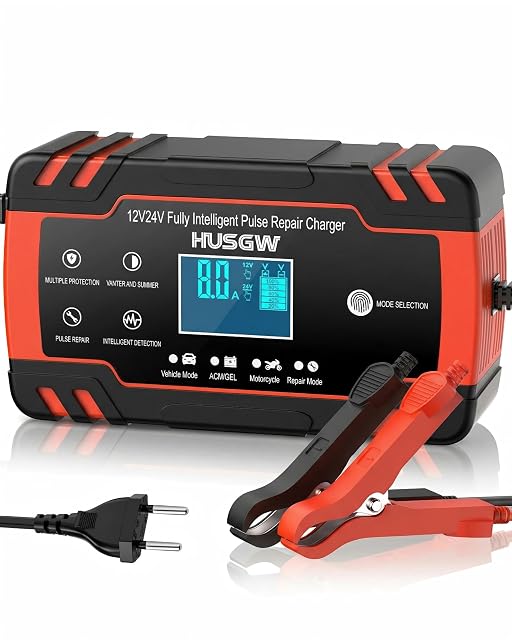
A 10 A charger for 12 V batteries with an LCD showing voltage, charging current, state and temperature.
Why the current reading matters
Voltage alone does not tell you whether a battery is charging or finished — current does. Watching it fall as the battery fills is how you know the last stage has begun, and it is the difference between a charger you can judge and one you have to trust.
What it does not name
AGM, EFB or lithium modes. Chemistry mode is the specification that decides whether a charger suits a stop-start car, and a listing that does not name one should be read as covering conventional batteries.
The five protections
Named individually rather than summarized. On a device left connected overnight, that list is the specification.
Availability
Not found on the American Amazon store, where the buy link falls back to a local search rather than to a page that does not exist.
Prices and availability are what Keepa reported on the date this page was updated; both move.
What it does, and what it misses
Strengths
A display that shows current as well as voltage, which is how you tell charging from finished
10 A suits batteries around 100 Ah at the rate makers commonly state
Five named protections rather than "multiple protections"
Compromises
No AGM or lithium mode named, which limits it to conventional batteries
"Repair mode" is described but not defined
12 V only
Specifications
Voltage and current
12 V, 10 A, stated
Display
LCD showing voltage, charging current, battery status and temperature, stated
Repair mode
Stated
Protections
Reverse polarity, short circuit, overcharge, overcurrent and over-temperature, stated
Amazon reference
B0G2Q846PC
EAN
6978545730772
The questions that reach us
What amperage do I need?
Makers commonly state a charging rate around a tenth of the battery capacity in amp-hours, so 10 A suits a battery near 100 Ah. Less simply takes longer; more generates heat.
Should I trust a repair mode?
Treat it as an attempt rather than a function. Desulphation can recover a battery that is merely sulphated; nothing recovers a shorted cell, and no maker claims otherwise in the small print.
Our score
6.9/ 10
The screen is the reason. At this price, knowing the current is worth more than a mode list.
This one’s price among garage tools
A reference exists on these Amazon stores: France, Germany, Italy, Spain, United Kingdom. Listed is not the same as in stock — availability changes daily.
Details checked on September 4, 2026.
Who should pick this one, among garage tools
A conventional flooded battery in a car that has been standing.
Attachments confirmed for this tool
Listed because the attachment names this tool by name.
Specifications: the manufacturer sheet for garage tools and the matching Amazon product page. Prices and availability: Keepa. Every figure on this page names its source.
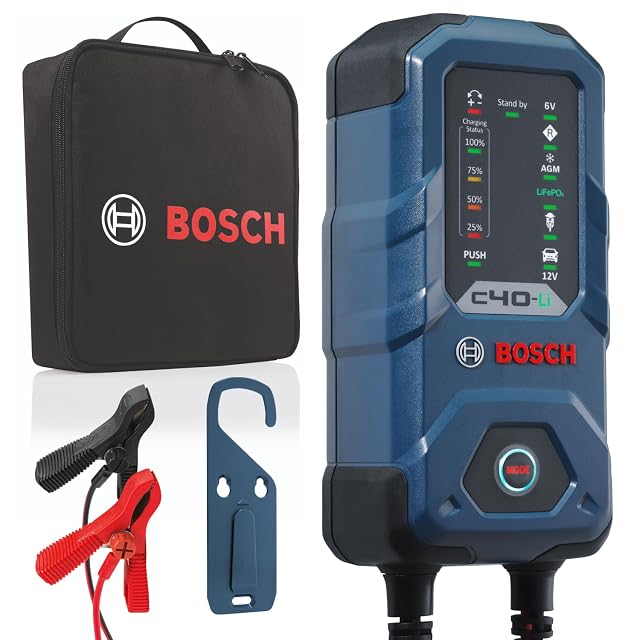
14.7 V input stated · 5 A effective charging current · 169 × 81 × 54 mm (6.65 × 3.19 × 2.13 in) · sold as a vehicle part reference
Sold and catalogued as a vehicle part rather than a consumer product: the listing publishes dimensions and effective charging current, and asks you to check compatibility against your vehicle data.
Best for: Someone who wants a Bosch part number and is willing to read the data table.
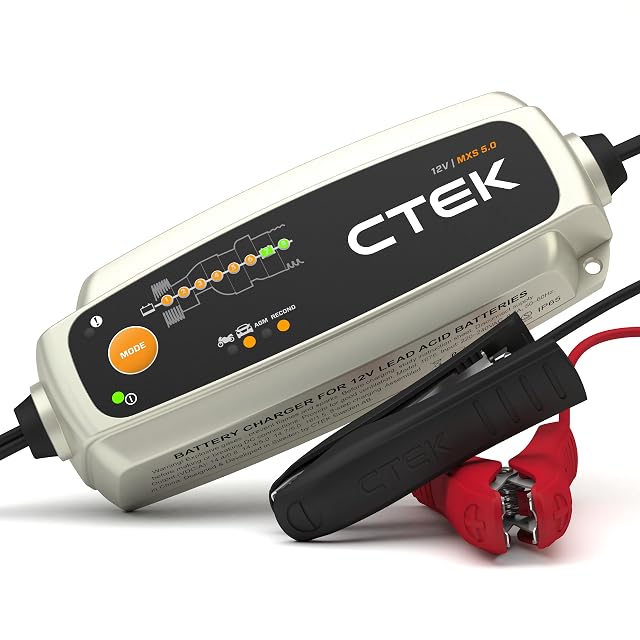
12 V · temperature compensation · RECOND recovery mode · AGM program · from the maker of the first smart 12 V charger
The reference on this shelf: temperature compensation, a recovery mode for deeply discharged batteries, an AGM program, and a charging profile used by more than forty vehicle manufacturers according to the maker.
Best for: Anyone who intends to own one charger for a decade, and anyone with an AGM battery.